Explanation of Kirchhoffs current and voltage laws

Thread Starter

JStackz26

Joined Sep 20, 2023
12
Apologies if this is in the wrong thread but can someone explain

Kirchhoff's current and voltage laws to me. I cannot seem to remember. It is all slipping my mind. Even Calculus which I understood eventually with no issue is basically leaving my mind. I'm not sure why. I feel ashamed to have to ask.

Anyway what are Kirchhoff's current and voltage laws?
And how are they applied to circuit building and circuit repair?
 

WBahn

Joined Mar 31, 2012
32,704
Apologies if this is in the wrong thread but can someone explain

Kirchhoff's current and voltage laws to me. I cannot seem to remember. It is all slipping my mind. Even Calculus which I understood eventually with no issue is basically leaving my mind. I'm not sure why. I feel ashamed to have to ask.

Anyway what are Kirchhoff's current and voltage laws?
And how are they applied to circuit building and circuit repair?
Instead of a bunch of strangers guessing what you do and don't recall, go out and do a Google search and read a handful of the many thousands of articles and websites that explain these laws. That should go a long way to refreshing your memory. Then come back with some specific questions about specific issues that you are still struggling with.
 

MrChips

Joined Oct 2, 2009
34,628
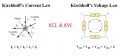
Kirchhoff's Laws.jpg

Kirchhoff's Current Law (KCL)
The sum of all currents into a node equals zero.

Kirchhoff's Voltage Law (KVL)
The sum of all voltage differences around a continuous circuit loop equals zero.
 

ErnieM

Joined Apr 24, 2011
8,415
View attachment 334759

Kirchhoff's Current Law (KCL)
The sum of all currents into a node equals zero.

Kirchhoff's Voltage Law (KVL)
The sum of all voltage differences around a continuous circuit loop equals zero.
I don't like this form of the current law as you must know the sign of the currents, be they into or out of the node.

I prefer to say:

I1 + I2 + I3 + I4 + I5 = 0

This way, whatever the sign of the currents you are good. Covers the times your assumption about the direction of the currents is not correct.
 

MrChips

Joined Oct 2, 2009
34,628
I don't like this form of the current law as you must know the sign of the currents, be they into or out of the node.

I prefer to say:

I1 + I2 + I3 + I4 + I5 = 0

This way, whatever the sign of the currents you are good. Covers the times your assumption about the direction of the currents is not correct.
Same difference.
The sum of all currents into the node equals zero.
 

WBahn

Joined Mar 31, 2012
32,704
I don't like this form of the current law as you must know the sign of the currents, be they into or out of the node.

I prefer to say:

I1 + I2 + I3 + I4 + I5 = 0

This way, whatever the sign of the currents you are good. Covers the times your assumption about the direction of the currents is not correct.
You are covered in either case since, in either case, if the numerical value of the current turns out to be negative, it merely means that the current is actually flowing in the direction opposite of the one defined for that current.

Arguments can be made either way, and both approaches are completely equivalent.

In both cases you have to define the polarity of the symbolic current and you can do so however you want.

If you have absolutely no basis for assigning a particular direction to a symbolic current, then defining them to be either all entering or all leaving the node makes the general form of the equations simpler, but it also guarantees that at least one of them is wrong (unless all are identically zero). Humans aren't good working with negative quantities, either conceptually or arithmetically, so if you have sufficient information and/or insight to assign symbolic currents so that they are expected to come out positive, then not only are you less likely to make a mistake, but you also have a built in sanity check since any values that do turn out to be negative should raise warning flags and be verified. Even if it turns out that they are correct, you will likely learn something about the circuit in the process as you discover why your expectation was wrong.
 

Thread Starter

JStackz26

Joined Sep 20, 2023
12
I definitely was not aware of any replies on this but I definitely got it down.
Kirchhoff's current law is that current value going in a junction is equal to the value that leaves the same junction.
Kirchhoff's voltage law is that the individual voltages are supposed to add up to the source voltage.

Thank you all for your responses. My questions are going to seem to be on really simplistic topics from now.
I definitely have recollection of information problems, possibly from a concussion. So I struggle to retain information but I definitely am going to try my best to hold on to any information I come across.


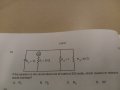
I am also having an issue trying to answer questions with missing resistor values. I am aware of Ohm's law but I have not been able to get the value of resistor 2 here basically in a few problems like this. Definitely need to figure out how the value to resistor 2 is derived.
IMG_20241121_183943502.jpg
 

Thread Starter

JStackz26

Joined Sep 20, 2023
12
Instead of a bunch of strangers guessing what you do and don't recall, go out and do a Google search and read a handful of the many thousands of articles and websites that explain these laws. That should go a long way to refreshing your memory. Then come back with some specific questions about specific issues that you are still struggling with.
I am at this current time definitely doing a lot of studying. Working on 7-8 hours a day of study. There are just some things my mind gets stuck at. And I struggle with the ability to retain information these days at too young an age at that. It seems due to a concussion I had and possibly unfixable but I am trying.
 

boostbuck

Joined Oct 5, 2017
1,034
I am also having an issue trying to answer questions with missing resistor values. I am aware of Ohm's law but I have not been able to get the value of resistor 2 here basically in a few problems like this. Definitely need to figure out how the value to resistor 2 is derived.
Have a look at your 'Variable Rheostat' question - I answered this for you there.
 

WBahn

Joined Mar 31, 2012
32,704
Kirchhoff's current law is that current value going in a junction is equal to the value that leaves the same junction.
That's a generally acceptable way to phrase KCL.

Kirchhoff's voltage law is that the individual voltages are supposed to add up to the source voltage.
This is NOT a good way to phrase KVL. Are you saying that if I have a circuit that has a single 12 V source in it and I have it powering a circuit containing a set of ten randomly-connected resistors, that if I measure the voltages across all ten resistors that those voltages should add up to 12 V? If so, how do I know if the voltage across a particular resistor is 2 V or -2 V, since that depends on which way connect my voltmeter leads?

KVL says that the sum of the voltage drops (or gains, take your pick, but pick one and stick to it) around a CLOSED loop (i.e., starts and stops at the same point) will be zero.

Note that KVL and KCL are not universally true. There is a constraint that must be true for each of them to be value. For KCL, it means that the junction is not a "charge-storage" node, and for KVL it means that the loop is not in the presence of any non-conservative electric fields. For run-of-the-mill circuit analysis, both of these constraints are usually satisfied.

I am also having an issue trying to answer questions with missing resistor values. I am aware of Ohm's law but I have not been able to get the value of resistor 2 here basically in a few problems like this. Definitely need to figure out how the value to resistor 2 is derived.
View attachment 336383
So, what is the voltage difference across R1?

As for finding R2, assume that you knew it. How would you use that to calculate the total resistance? Write out the equation you would use, and just put R2 in place of that value.

Then set that equal to the known total resistance of 10 Ω (I'm assuming it's ohms, since the diagram doesn't say).

Then solve for R2.

Show your best effort to do that as far as you can go, and we will help you understand where you are getting stuck and how to get past it.
 

Thread Starter

JStackz26

Joined Sep 20, 2023
12
That's a generally acceptable way to phrase KCL.


This is NOT a good way to phrase KVL. Are you saying that if I have a circuit that has a single 12 V source in it and I have it powering a circuit containing a set of ten randomly-connected resistors, that if I measure the voltages across all ten resistors that those voltages should add up to 12 V? If so, how do I know if the voltage across a particular resistor is 2 V or -2 V, since that depends on which way connect my voltmeter leads?

KVL says that the sum of the voltage drops (or gains, take your pick, but pick one and stick to it) around a CLOSED loop (i.e., starts and stops at the same point) will be zero.

Note that KVL and KCL are not universally true. There is a constraint that must be true for each of them to be value. For KCL, it means that the junction is not a "charge-storage" node, and for KVL it means that the loop is not in the presence of any non-conservative electric fields. For run-of-the-mill circuit analysis, both of these constraints are usually satisfied.


So, what is the voltage difference across R1?

As for finding R2, assume that you knew it. How would you use that to calculate the total resistance? Write out the equation you would use, and just put R2 in place of that value.

Then set that equal to the known total resistance of 10 Ω (I'm assuming it's ohms, since the diagram doesn't say).

Then solve for R2.

Show your best effort to do that as far as you can go, and we will help you understand where you are getting stuck and how to get past it.
I definitely get what you are saying about the way I phrases Kirchhoff's voltage law and that the purpose is to make these values equal to zero rather than the value of the voltage source. The way I was looking at it is Voltage source value would be equal to total voltage drop value and this would be zero. But it is just in the way I explained it leaves room for wrong assumption.
 

MisterBill2

Joined Jan 23, 2018
27,182
The discussion of KCL amazingly reminded me of the "MisterBill's Law" that I came up with in a higher level math class years ago. But because I could not develop a proof that was satisfactory, I got no credit for it.
That law simply states that " The sum of all N N'th roots of any expression is zero".
This is especially handy in solving complex number expressions, because if one root is real and known, then simple trigonometry allows solving for the other roots. (OK, maybe the trig is not quite simple.)
 

WBahn

Joined Mar 31, 2012
32,704
The discussion of KCL amazingly reminded me of the "MisterBill's Law" that I came up with in a higher level math class years ago. But because I could not develop a proof that was satisfactory, I got no credit for it.
That law simply states that " The sum of all N N'th roots of any expression is zero".
This is especially handy in solving complex number expressions, because if one root is real and known, then simple trigonometry allows solving for the other roots. (OK, maybe the trig is not quite simple.)
Not sure I follow what you mean -- probably just a terminology thing.

What is the Nth root of an expression?

Maybe an example will help.

Consider the expression

x² + 2x - 35

What is the one 1st root of it?

What are the two 2nd roots of it?

What are the three 3rd roots of it?

That should help me at least start putting things into the terms I am used to.
 

MisterBill2

Joined Jan 23, 2018
27,182
x² + 2x - 35 =0
X=-1+(4-4x(-35))/2=-1+(4--140)½/2=-1+(144)½/2=-1+/-12/2=5, and -5 by the quadratic formula.
The two roots are 5 and - 5
And the sum of those two roots is zero.
It also works for higher powers. Unfortunately I have not discovered how to enter roots or powers.

The beauty is that it works for complex expressions that have both real and imaginary components, that the roots look a lot like vectors that all originate from zero, and have one real root.

It was one of those things that was fun to discuss on some occasions, and it did bother a few math majors.
 

WBahn

Joined Mar 31, 2012
32,704
x² + 2x - 35 =0
X=-1+(4-4x(-35))/2=-1+(4--140)½/2=-1+(144)½/2=-1+/-12/2=5, and -5 by the quadratic formula.
The two roots are 5 and - 5
And the sum of those two roots is zero.
It also works for higher powers. Unfortunately I have not discovered how to enter roots or powers.

The beauty is that it works for complex expressions that have both real and imaginary components, that the roots look a lot like vectors that all originate from zero, and have one real root.

It was one of those things that was fun to discuss on some occasions, and it did bother a few math majors.
It's good that it bothered at least a few math majors.

What's sad is that there were ANY math majors that it didn't bother. Not surprising, just sad.

Must be some of that new math.

Under the old-math that I was burdened with,

x² + 2x - 35 =0

had two roots, namely x = -7 and x = +5.

In those days, these summed to -2, not zero. But I guess that was old-math thinking.
 

MisterBill2

Joined Jan 23, 2018
27,182
OK, it seems that perhaps I was not in a fully awake condition yesterday evening. It has been a long time since I actually needed to solve equations. And now I am trying to recall the rest of the details about that "law" that I discovered, because this may not be what it applied to.
1968 was a long time ago!! I know that it applied to complex number roots very well.
 

WBahn

Joined Mar 31, 2012
32,704
OK, it seems that perhaps I was not in a fully awake condition yesterday evening. It has been a long time since I actually needed to solve equations. And now I am trying to recall the rest of the details about that "law" that I discovered, because this may not be what it applied to.
1968 was a long time ago!! I know that it applied to complex number roots very well.
Roots of a complex number are a different thing.

A complex number can be written as

z = A·e^(jΘ)

where A is a non-negative real number and Θ is a real number such that 0 ≤ Θ ≤ 2π

But this is not the only representation since the angle and wrap around any integral number of times in either direction, so the more general form is

z = A·e^(jΘ+k2π)

where k is any integer.

z = A·e^(jΘ)·e^(k2π)

If N is a positive integer, then the Nth root is that number such that

z = y^N

y = z^(1/N) = A^(1/N)·e^(jΘ/N)·e^(k2π/N) = B·e^(jΘ/N)·e^(k2π/N)

These roots are spaced evenly around a circle in the complex plane at a radius of B = A^(1/N).

My guess is that this is what you were working with.
 

MisterBill2

Joined Jan 23, 2018
27,182
THANK YOU, W.B!!! YES, that seems closer to what I recall. It is easy to forget something that one does not use in 58 years.
I am not even sure where it would be used in electronic or electrical engineering. It was handy in that math class, I think.
 
Top