Harrison Dual Power Supply Data

Thread Starter

AnalogKid

Joined Aug 1, 2013
12,045
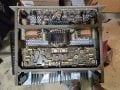
I have acquired an old, 2U rack mount power supply:

Harrison Laboratories, Inc.
Model No. 802B
Two fully independent power supplies
Each one is 0 - 36 Vdc, 0 - 1.5 A

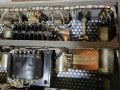
Note in both photos that the output voltage coarse adjustment is ***variac***. The fine adjust is a 2 W pot.

As you can see from the pc board components and layout, this thing is old. Harrison was acquired by HP way back, and this is before that. At first I thought the internal fins toward the front were two selenium rectifier bridges in one assembly. Zooming in, it looks more like conventional silicon diodes (for that time) bonded to fins.

The power transformer has one set of multi-tapped primary windings and two fully isolated sets of secondaries.

Does anyone know anything about this unit? User manual, service manual, schematic - anything? The variac in the secondary is a new one on me, and I'd love to see the sch.

Thanks.

ak
 

Attachments

Last edited:

crutschow

Joined Mar 14, 2008
38,322
Does anyone know anything about this unit? User manual, service manual, schematic - anything? The variac in the secondary is a new one on me,
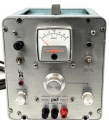
Some power supplies of that era (there were a large number of Power Designs supplies of that type where I worked way-back-when, example below) used a Variac to adjust the rectified voltage in front of a linear series regulator, to minimize the power dissipation in the linear power transistors (the ones on the back heat-sinks).

Notice the pot attached to the Variac shaft behind the front panel, which adjusts the linear supply output voltage to track a little below the Variac's rectified output voltage.
(I suspect one of the pots on the PCB adjusts that voltage difference).
That keeps the voltage drop across the linear regular basically constant, so the dissipation then mostly depends upon the output current and is largely independent of the output voltage.

Now days you would use a tracking switching regulator in place of the Variac.

1750116702991.png
 
Last edited:

MisterBill2

Joined Jan 23, 2018
27,186
The first question is "does it work?" HP was a good quality company at the time, and from the picture I see no hint of damage or abuse. So if the supply would be useful then a search for the manual would be worth the effort.
On close examination that is certainly NOT a selenium rectifier, but an early silicon diode product, as evidenced by those "top hat" diodes bonded to the fins for heat sinking.
Those products were built to be repairable, so if there is a failure they can be repaired.
The one potential challenge will be connecting the output sensing portion. Many "lab grade" power supplies are set up for remote output voltage sensing at the point of an external load, and so back-panel jumpers must be in place for correct operation.
 

Thread Starter

AnalogKid

Joined Aug 1, 2013
12,045
Some power supplies of that era (there were a large number of Power Designs supplies of that type where I worked way-back-when, example below) used a Variac to adjust the rectified voltage in front of a linear series regulator, to minimize the power dissipation in the linear power transistors (the ones on the back heat-sinks).
This is one of those situations where I'd never come across it before, but knew instantly what it was the moment I saw it. It's been a while since I've had that flash reaction. Fun.

I haven't fired it up yet, and I have to assume that all of the electrolytics are - questionable? Still, I'm tempted to just hit it and see what happens There's a fire station about a mile down the road; I'll make sure they're ready.

ak
 

Thread Starter

AnalogKid

Joined Aug 1, 2013
12,045
Do you have a Variac that you can use to slowly increase the main's voltage?
Yes, but I've found that that can cause problems. I also have an AC input-output board with a light bulb socket as another form of power limiting. But, again, not as much fun.

My preferred method is less thermal: two transformers in series, P > S > S > P. In this way the system sees 120 Vac come up rapidly as expected, but the total energy is limited by the transformer core sizes. I keep threatening to build a switchable transformer box with a variac, a 24 V 4 A input transformer, and three or four output transformers, such as 24 V, 300 mA, 1 A, 3 A. etc. It's a way to use up some old iron. A small-ish 1:1 isolation transformer would work, but I don't have one laying around.

ak
 
Last edited:

Thread Starter

AnalogKid

Joined Aug 1, 2013
12,045
Okay, don't leave me hanging. What problems?
Relay contact chatter as the armature moves slowly because the coil voltage is wandering up over seconds instead of milliseconds.

Control circuit output slammed against one of the rails, or VU meter damage, because the other rail is, again, wandering up over seconds instead of milliseconds. On that note, I recently repaired an old Ampex 440 that had excessive hum in one channel. Upon inspection, the schematic shows not one but two separate circuits that prevent VU meter damage and loud pops on power-up. Apparently this was a known problem, erratic behavior as electrolytics charged up all over the place.

I know using a Variac is a very common practice (I've done it, we've all done it), and usually does not cause more harm than it is supposed to prevent. But in a totally unknown system, especially a power system, who knows what is gonna happen before the control loops close? And yes, I know that my method also has unknown potential consequences.

ak
 
Last edited:

MisterBill2

Joined Jan 23, 2018
27,186
I recall that in the application literature of quite a few modules, there was stated the requirement that some voltages had to be applied at the same time. Those were mostly DC Amplifier modules, the sort used for controls and instrumentation.
In addition, those DC coupled audio amplifiers sometimes are not at all happy with a reduced mains voltage, such as in brown-outs. The reason is that in some power supply systems with multiple regulated voltage outputs, the sequence of outputs appearing changes as the mains voltage rises slowly.
 

schmitt trigger

Joined Jul 12, 2010
2,027
If you have an INCANDESCENT light bulb, say 60 or 75 watts, you can put that in series with the AC supply.
When you plug it first, the light bulb will burn bright for a second or so, and then go dim in a supply that has no major issues.
OTOH, if it remains burning brightly constantly, there is a problem that you must troubleshoot first.
 

MisterBill2

Joined Jan 23, 2018
27,186
The very first thing to do is to check the fuse!! Verify that it is the correct rating before trying to power the supply. Next, if the supply has any external connection terminal strips, verify that nothing is jumpered that should not be jumpered.
We have not seen the panel, but if there are current setting controls, set them to mid-range, if there are voltage limit controls, turn them to maximum. And for the voltage setting controls, set them below mid-range, within the range of your multimeter that you will be checking it with.
Then, with good lighting so you can see any smoking, switch the supply on, and measure the output voltages.
 

schmitt trigger

Joined Jul 12, 2010
2,027
Indeed you did.
I only wanted to emphasize that it must be an INCANDESCENT bulb. Neither CFLs nor LEDs will work correctly.
The reason being the positive temperature coefficient of the tungsten filament.
 

MisterBill2

Joined Jan 23, 2018
27,186
If the fuse is OK and the correct rating, then probably it should be fin just switching it on for a brief time. then switch it off, unplug it, and feel around for any hot components. Certainly the incandescent light bulb trick also works, and probably should be used first. BUT getting a hundred watt bulb will be a challenge, because those who believe that they are much wiser than us have made selling them illegal. Rules made by those who presume to be much wiser than us are often poorly thought out.
 

MisterBill2

Joined Jan 23, 2018
27,186
"Listed" versus actually available are two quite different things. In addition, product descriptions on amazon are often incomplete. THAT is what I see most of the time.
 

crutschow

Joined Mar 14, 2008
38,322
"Listed" versus actually available are two quite different things. In addition, product descriptions on amazon are often incomplete. THAT is what I see most of the time.
Okay, so we are into semantics. :rolleyes:
I'm well aware of the difference.
They do show listed incandescent bulbs as actually "available".
 
Last edited:
Top