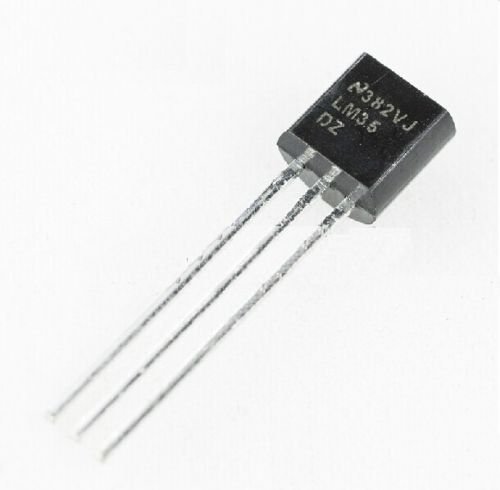
You have drawn the rounded face of the transistor.
Most datasheets show the pin-out seen from the flat face.
As @MrChips asked, what is the partnumber of the transistor you are using?
It is LM35 DZ. I figured out why it wasn't working. I was using a temperature sensor! because look at this from amazon.
It is the same part number LM35 DZ and it is a temperature sensor. I tried using real transistors and my circuit worked!. thanks for all your guys help! Have a nice day!
It is LM35 DZ. I figured out why it wasn't working. I was using a temperature sensor! because look at this from amazon.
It is the same part number LM35 DZ and it is a temperature sensor. I tried using real transistors and my circuit worked!. thanks for all your guys help! Have a nice day!
Thanks for stepping up and telling what happened. Most people who do stuff like that simply disappear and the thread goes dead. I got a good laugh and remember doing stupid things too - like putting a single op amp I to the socket if s double op amp.
It is LM35 DZ. I figured out why it wasn't working. I was using a temperature sensor! because look at this from amazon.
It is the same part number LM35 DZ and it is a temperature sensor. I tried using real transistors and my circuit worked!. thanks for all your guys help! Have a nice day!
What I am trying to fathom is how the OP mixed up a LM35 general purpose transistor with a temperature sensor. When as far as I know there is no such a thing as a LM35 transistor.
What I am trying to fathom is how the OP mixed up a LM35 general purpose transistor with a temperature sensor. When as far as I know there is no such a thing as a LM35 transistor.
My guess is that, like lots of beginners (probably including most of us here, at least about some things) who have only interacted with a handful of parts, they associated the package style with the device type. So anything in a TO-92 case is a transistor. More to the point, it is a transistor with the pins in a fixed and never changing order. Anything in a package that looks like an axial resistor must be a resistor -- similarly packaged fuses and inductors and such simply aren't yet in their world.
I was trying to build a NAND gate out of transistors but every time I plug in the battery in and press the push buttons the LED still stays on. No matter what I do the LED stays on. Even when i push both buttons the LED still stays on. I've tried different ways to build it but it always ends up where the LED stays on. Can someone explain how to fix this problem and make a NAND gate out of transistors?
Ignoring any wiring errors, for the moment, the current problem seems to be more about semantics than anything else.
For example, if the LED's ON state is considered to be a logical "1" and a switch actuation is also considered to be a logical 1, then with a 2 input NAND between the switches and the LED, the LED must be ON _except_ when both switches are actuated.
There are other solutions, but if you could describe what you want the LED to do as the switches cycle through their four possible combinations, that would help us get you an answer.
Ignoring any wiring errors, for the moment, the current problem seems to be more about semantics than anything else.
For example, if the LED's ON state is considered to be a logical "1" and a switch actuation is also considered to be a logical 1, then with a 2 input NAND between the switches and the LED, the LED must be ON _except_ when both switches are actuated.
There are other solutions, but if you could describe what you want the LED to do as the switches cycle through their four possible combinations, that would help us get you an answer.

 Facebook
 Google
 GitHub
 Linkedin