My Lamp won't light?

Thread Starter

Homebrew1964

Joined Nov 22, 2024
124
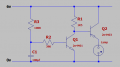
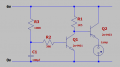
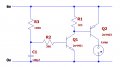
Can someone tell me what is going on here? i am trying to get my lamp to light slowly when i power up the circuit, my question is my lamp in the right place, should it be in the collector lead of Q2, is my transistor round the right way, which way does the current flow through Q2. i feel dumb because this is going to be an easy one for you bright people? I'm fairly new to electronics circuits.

My lamp doesn't light although i have a varying voltage at the collector of Q1

thanks.
 

Attachments

wayneh

Joined Sep 9, 2010
18,090
Can Q1 handle the current required by the lamp? You might replace R1 with the bulb and an appropriate resistance if that's needed.

What's the steady state voltage on the base of Q2? Try grounding the base thru a 1K resistor to verify that Q2 is switching the way you expect.
 

WBahn

Joined Mar 31, 2012
32,707
ok I turned the transistor around and moved the lamp into the emitter lead that was the collector lead if that makes sense and hey presto, my Circuit is working

thank you so much.
But do you understand WHY it wasn't working before and WHY it is working now?
 

WBahn

Joined Mar 31, 2012
32,707
Can someone tell me what is going on here? i am trying to get my lamp to light slowly when i power up the circuit, my question is my lamp in the right place, should it be in the collector lead of Q2, is my transistor round the right way, which way does the current flow through Q2. i feel dumb because this is going to be an easy one for you bright people? I'm fairly new to electronics circuits.

My lamp doesn't light although i have a varying voltage at the collector of Q1

thanks.
In your schematic, the collector and emitter of Q2 is reversed. The collector and emitter of nearly all BJT transistors are NOT interchangeable.

What kind of timing are you looking for? A small fraction of a second? A few seconds? Minutes? The more detail you provide about what you are trying to accomplish, the better we are able to help you?
 

Thread Starter

Homebrew1964

Joined Nov 22, 2024
124
But do you understand WHY it wasn't working before and WHY it is working now?
I just been reading about transistors and found out current goes in the direction of the arrow so it makes sense why my lamp wasn't lighting.

60 mA at what voltage?

What kind of "bulb" are you using? Is this an incandescent flashlight bulb? An LED? What?
My Lamp is rated 6v and yes it's an incandescent one.
 

WBahn

Joined Mar 31, 2012
32,707
ok I turned the transistor around and moved the lamp into the emitter lead that was the collector lead if that makes sense and hey presto, my Circuit is working
It really doesn't -- make sense, that is.

Did you turn the transistor around (swap emitter and collector) and that ALL you did?

Or did you also move the bulb so that it is still connected to the emitter lead?

As given in the original post, the bulb is ALREADY connected to the emitter of Q2 (the emitter of either an NPN or a PNP is the one with the arrow -- that's the purpose of the arrow on the symbol).

When you change a circuit, you should get in the habit of posting an updated schematic of the circuit as you are now working with it. Oh, and do NOT (like many people do) replace earlier circuits with an updated diagram, leave those as is so that people reading the thread are seeing the circuits as they were when the discussion was taking place.
 

MrChips

Joined Oct 2, 2009
34,630
ok WBahn...

thanks for the replies, my circuit is doing what i need now so all good.
Getting a faulty circuit to work is one thing. Knowing what was wrong in the first place and what you did to make it work is another thing. So you turned the transistor around and it worked. Now you need to go deeper and understand why.

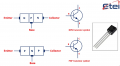
Learn the difference between an NPN and a PNP transistor.
Learn the three transistor configurations, common base, common emitter, common collector.
Learn the difference between linear and switching modes.
Learn the difference between cutoff, linear, and saturation modes.
Learn how to bias a transistor to operate in each of the three modes.

1775608441635.png
 

WBahn

Joined Mar 31, 2012
32,707
The current flows the way the arrow is pointed.
Yes, under normal operation. Transistors can be operated in a reverse mode, but this is unusual and usually done for specific reasons (unless it's inadvertent, of course).

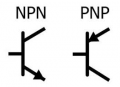
The arrow on the BJT transistor symbol represents the base-emitter diode. This is the one that is forward biased under normal operation, so showing it indicates visually where the forward voltage drop will occur. The base-collector diode is not shown because it is reverse biased under normal operation, so showing it would be confusing.
 

MrChips

Joined Oct 2, 2009
34,630
The current flows the way the arrow is pointed.
That is true under normal conditions when the direction of the arrow shows the polarity of the bias voltage. The arrow only indicates the direction of the current when the junction is being foward biased. The current will flow in the opposite direction when reverse biased.

1775856116656.png


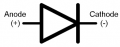
As with a diode, the anode is P-material (lack of electrons, referred to as holes) and the cathode is N-material (excess electrons). The anode must be more positive that the cathode for the P-N junction to be forward biased.

1775856231477.png


1775856419043.png
 

MrChips

Joined Oct 2, 2009
34,630
In this circuit schematics, the base-emitter junction of transistor Q2 is not forward biased. Hence it does not turn on.

1775875190918.png


Flip transistor Q2, in other words, interchange the collector and emitter. The base-emitter junction of Q2 is forward biased when the collector of Q1 falls below 6 V. The voltage across R1 has to be greater than 0.6 V for Q2 to start conducting.

Q1 Q2 Lamp Dimmer.jpg
 

Thread Starter

Homebrew1964

Joined Nov 22, 2024
124
In this circuit schematics, the base-emitter junction of transistor Q2 is not forward biased. Hence it does not turn on.

View attachment 365815


Flip transistor Q2, in other words, interchange the collector and emitter. The base-emitter junction of Q2 is forward biased when the collector of Q1 falls below 6 V. The voltage across R1 has to be greater than 0.6 V for Q2 to start conducting.

View attachment 365817
Does it matter which lead of Q2 i put my lamp in?
 

WBahn

Joined Mar 31, 2012
32,707
Does it matter which lead of Q2 i put my lamp in?
YES!!!

Go back and read all of the posts in this thread. Many of them have emphasized that your transistor is backwards and you have the emitter and collector swapped.

The emitter and collector are NOT interchangeable!

Even if you have the polarity of the transistor correct, it also matters hugely -- fundamentally hugely -- whether you put the lamp in the emitter path or the collector path.

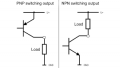
If you put it in the emitter path, you have a common-collector configuration and (unless you had a collector resistor) you will be operating in the linear region and won't be able to saturate the transistor.

If you put it in the collector path, you have a common-emitter configuration, which is typically the configuration used for switching applications because you can fully saturate the transistor.
 

Thread Starter

Homebrew1964

Joined Nov 22, 2024
124
YES!!!

Go back and read all of the posts in this thread. Many of them have emphasized that your transistor is backwards and you have the emitter and collector swapped.

The emitter and collector are NOT interchangeable!

Even if you have the polarity of the transistor correct, it also matters hugely -- fundamentally hugely -- whether you put the lamp in the emitter path or the collector path.

If you put it in the emitter path, you have a common-collector configuration and (unless you had a collector resistor) you will be operating in the linear region and won't be able to saturate the transistor.

If you put it in the collector path, you have a common-emitter configuration, which is typically the configuration used for switching applications because you can fully saturate the transistor.
Ok good, I have my lamp in the collector lead and the circuit works fine, I'll leave it there thanks
 
Top