basic temperature sensor

Thread Starter

RenesasTaac

Joined Dec 26, 2016
2
Hello All,

I am new to this forum. Please consider my question even if it is a silly one.

In my project I want to detect temperature of particular vessel by using MMBT3904 transistor. I am using SMD transistor. I have connected base of transistor to the ADC pin of my micro controller and emitter of transistor to ground. Collector of transistor is open.

For getting temperature value at ADC pin, the emitter should require bias current. Once emitter will be biased, i will get ADC values of temperature.

Now thing is that, suppose I am biasing it with Digital multi meter then I am getting adc value as 145 at room i.e temperature of room (as my ADC is of 10 bits ) and the value in digital multi meter is 0.665 V. Generally digital multi meter has bias current as approx 100 micro Amp.

I don't want to connect digital multi meter. I have to connect constant current source of 500 micro ampere current with the same adc value i.e 145.

Please help me with this. If other information is required, please let me know.

Awaiting for your reply.
 

wayneh

Joined Sep 9, 2010
18,100
Ditto. You'll need an awful lot of data to calibrate your transistor. The LM35 will give you pretty good accuracy and precision over a wide range of temperature.
 

dannyf

Joined Sep 13, 2015
2,197
Generally digital multi meter has bias current as approx 100 micro Amp.
that number is too high and is dependent on the setting of the meter.

Generally, a few ma would be sufficient to get the pn junction going. no need to go that high.

Diodes are a fairly effective way to measuring temperature, especially if you have it calibrated or you don't care about absolute readings and only relative readings.
 

WBahn

Joined Mar 31, 2012
32,783
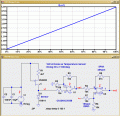
Here's a circuit that shows how to do a single diode as a temperature detector.
It would be real interesting (and I think worthwhile) to see actual data plotted against that nice simulated result. Whether it is in close agreement or not, some valuable takeaways would result.
 

WBahn

Joined Mar 31, 2012
32,783
Hello All,

I am new to this forum. Please consider my question even if it is a silly one.

In my project I want to detect temperature of particular vessel by using MMBT3904 transistor. I am using SMD transistor. I have connected base of transistor to the ADC pin of my micro controller and emitter of transistor to ground. Collector of transistor is open.

For getting temperature value at ADC pin, the emitter should require bias current. Once emitter will be biased, i will get ADC values of temperature.

Now thing is that, suppose I am biasing it with Digital multi meter then I am getting adc value as 145 at room i.e temperature of room (as my ADC is of 10 bits ) and the value in digital multi meter is 0.665 V. Generally digital multi meter has bias current as approx 100 micro Amp.

I don't want to connect digital multi meter. I have to connect constant current source of 500 micro ampere current with the same adc value i.e 145.

Please help me with this. If other information is required, please let me know.

Awaiting for your reply.
What is the context of this project? Read -- why the hell are you even attempting to do it this way?

There are much better, faster ways to accomplish the stated goal (detect temperature of a particular vessel). But there may well be quite reasonable motivations for going about it the way you are trying to (such as, "This is a requirement of this educational project and I am stuck with it"). It would really help if we had a feel for the bounds on what you are and aren't allowed to do?
 

#12

Joined Nov 30, 2010
18,224
It would be real interesting (and I think worthwhile) to see actual data plotted against that nice simulated result. Whether it is in close agreement or not, some valuable takeaways would result.
You doubt simulators as much as I do?
It should be simple enough to look at the equation for a diode under constant current conditions and see if the graph is linear.
It looks linear on this page:
"The characteristics curve of a Si diode shifts to the left at the rate of -2.5 mV per degree centigrade change in temperature in forward bias region."

http://conceptselectronics.com/diodes/effect-temperature-diode-characteristics/
 

ericgibbs

Joined Jan 29, 2010
21,425
hi #12 & WB,
I created and posted that circuit on-line back in 2013 for a OP on another Forum, it was checked out on a project board prior to posting.
The feedback I got back said it was working OK.
Eric
 

Attachments

DickCappels

Joined Aug 21, 2008
10,661
For a current source you can probably get fine results by using a 9.1k resistor (assuming a 5.0v power supply). Ground the emitter and connect the base and collector to a 9.1k resistor and watch the base for your temperature indication.

The reason you can probably get away with this is because the voltage across the resistor will not vary much. For a ±10° C temperature range the current will vary approximately (1.8 mv/°C x 10°C)/5V = 0.36%, or 545 uA ±0.36%.

You would do well to use an opamp to get a larger voltage change with temperature, but we have to know details such as your intended temperature range and your power supply voltage.
 

dannyf

Joined Sep 13, 2015
2,197
there are many simple ways to provide gain here. from using an external amplifier (like a tl431), or a transistor (-> effectively making it a poorman's bandgap), or a adc with pga -> quite a few avrs for example can do that.
 

WBahn

Joined Mar 31, 2012
32,783
You doubt simulators as much as I do?
It should be simple enough to look at the equation for a diode under constant current conditions and see if the graph is linear.
It looks linear on this page:
"The characteristics curve of a Si diode shifts to the left at the rate of -2.5 mV per degree centigrade change in temperature in forward bias region."

http://conceptselectronics.com/diodes/effect-temperature-diode-characteristics/
Simulations are only as good as the models used.

I've done simulations in which the simulator on a simple circuit using a TI-074 op-amp running well within its spec'ed range that claimed that it was drawing something like several hundred amps from the supply. Upon talking to TI I was informed that the model was designed only to give decent results at the I/O pins and that the power pins behaved however they behaved. This was back in the early to mid-90's when complex models were very rare since they would bring a simulator to its knees (we had yet to get our first Pentium machine and the fastest machine we had hadn't yet topped 100 MHz clock speed).

At the other end of the spectrum I've done simulations in which each transistor was modeled as a 300-element subcircuit that was parametrically characterized by the fab house. On those circuits I could expect the actual bias voltages produced on-chip to match the simulations within just a couple of millivolts.

The model you quote is only giving the linear order term and ignoring the higher order terms (which DO exist) -- and an equation found in a text somewhere is still only a model that describes an approximation of the behavior of a component. There are also other parameters that, themselves, are functions of temperature and that also have higher order terms. If you only include the linear term, it is not surprising that the results appear linear. The question is whether the other terms are strong enough to exert a noticeable influence on the response over that wide a range of temperature. The answer is usually yes.

Even with a perfect model for the diode, there are other components in the circuit that may or may not have good models when it comes to temperature dependence.
 
Last edited:

wayneh

Joined Sep 9, 2010
18,100
All good points why I'd use an LM35 in the first place. Whatever the cost of the parts involved, which are probably higher when not using the LM35, the BIG cost will be calibration and/or validation.

Why anyone would bother to avoid a purpose-built, one component, 3-pin solution is beyond me.
 

DickCappels

Joined Aug 21, 2008
10,661
All good points why I'd use an LM35 in the first place. Whatever the cost of the parts involved, which are probably higher when not using the LM35, the BIG cost will be calibration and/or validation.

Why anyone would bother to avoid a purpose-built, one component, 3-pin solution is beyond me.
+

Sometimes we like to try things ourselves as part of a learning process.
 
Top