basic temperature sensor

wayneh

Joined Sep 9, 2010
18,125
+

Sometimes we like to try things ourselves as part of a learning process.
And I don't have a problem with that as long as there's no self-delusion going on. The DIY philosophy was engrained in me at an early age, but I choose my battles carefully and have learned the hard way the value of choosing the right tool for a job.
 

hp1729

Joined Nov 23, 2015
2,304
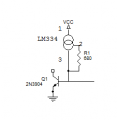
Design 978 LM334 and 2N3904 temp sensor.PNG
Hello All,

I am new to this forum. Please consider my question even if it is a silly one.

In my project I want to detect temperature of particular vessel by using MMBT3904 transistor. I am using SMD transistor. I have connected base of transistor to the ADC pin of my micro controller and emitter of transistor to ground. Collector of transistor is open.

For getting temperature value at ADC pin, the emitter should require bias current. Once emitter will be biased, i will get ADC values of temperature.

Now thing is that, suppose I am biasing it with Digital multi meter then I am getting adc value as 145 at room i.e temperature of room (as my ADC is of 10 bits ) and the value in digital multi meter is 0.665 V. Generally digital multi meter has bias current as approx 100 micro Amp.

I don't want to connect digital multi meter. I have to connect constant current source of 500 micro ampere current with the same adc value i.e 145.

Please help me with this. If other information is required, please let me know.

Awaiting for your reply.
Do you need a constant current of 100 uA? TO-92 pinout of the LM334 is shown.
 

dannyf

Joined Sep 13, 2015
2,197
some opamps cannot get to close to the rails. in those cases, put the diodes in serial. 3 - 4 for example. it also increases the sensitivity to temperature changes.
 

dannyf

Joined Sep 13, 2015
2,197
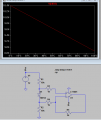
here is an adaptation of a temperature sensor I used in a controller for soldering iron. the handle used a positive temperature resistor to measure the temperature.

diode temp sensor.PNG

the circuit can drive a pnp/p-ch switch directly.

alternatively, you can flip the opamp upside down and drive a npn/n-ch switch with it.

it utilizes a few techniques that I mentioned earlier. the selection of an opamp in a low supply voltage environment can be tricky.
 

dannyf

Joined Sep 13, 2015
2,197
you may have noticed that the circuit is essentially a high-side voltage (=current*resistance) sensor. so your other alternative is to use a current sense amplifier -> there are plenty of them. the downside is that as there is a voltage offset (0.7v) so you cannot have very high gain.
 
Top