Best First Projects for Learning Basic Electronics?

Thread Starter

BeablossomR_

Joined Jun 4, 2026
19
Hi everyone
I’m new to electronics and currently trying to learn the basics step by step.


What are some of the best beginner projects you recommend for learning fundamental concepts like voltage, current, resistance, and basic components?


I’ve heard about using breadboards and simple circuits, but I’d really appreciate suggestions on where to start so I can learn properly through practice.


Thanks in advance
 

BobTPH

Joined Jun 5, 2013
11,521
Light an LED with the correct current with a 9V battery.

You cannot get much simpler, but it requires a calculation based in Ohms law and an understanding of voltage, current and resistance.
 

Reloadron

Joined Jan 15, 2015
7,891
My advice is to start simple with DC Theory projects. Low DC voltage and current using things as simple as resistors. The type circuits one starts with in EL-101. Learn how to read schematics and draw the component symbols. Keep in mind, every enthusiast starts somewhere. :) AC theory comes along later. Your first piece of test measurement and diagnostic equipment should be a decent SMM (Digital Multi-Meter)). Learn how to use the meter to measure voltage and current for starters.

Ron
 
assemble 2 resistors in series with 9V at one end and 0V at the other then calculate the voltage across each individual resistor using ohms law, the value of the resistors isn't important here, you can then use a multimeter to check your results, that will get you started on learning about resistance, voltage and current.
 

dl324

Joined Mar 30, 2015
18,333
I’ve heard about using breadboards and simple circuits, but I’d really appreciate suggestions on where to start so I can learn properly through practice.
What is your knowledge/experience level? What tools and components do you have?

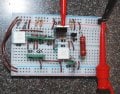
Most of us use solderless breadboards for prototyping. This is a 400 point (half board):
discreteMosfetRegulatorFinalAsBuilt.jpg
The circuit is a discrete voltage regulator using mostly MOSFETs. Used a BJT for one of the current sources because it was easier than using MOSFETs. Jumpers are 22 AWG solid tinned copper wire.

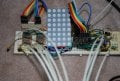
This is a single digit scrolling LED clock that uses a combination of solderless breadboard with custom homemade printed circuit boards:
scrollingLedClock.jpg
It's driven by a Raspberry Pi Zero W.

I've bought the 400 tie-point and 830 tie-point boards on AliExpress. Initially I bought to find out how bad they were. I found out that they were all usable and bought dozens more. However, I think the ones from the 1970's are clearly better.
 

WBahn

Joined Mar 31, 2012
32,871
I've already recommended that you look at some of the experimenter kits that are out there. Even if you don't end up getting any of them, just reviewing what they have and the kind of projects they include will give you some ideas of what you might want to do.

If you are truly new to electronics, I would strongly recommend that you learn about electrical safety before you begin. Most introductory EE textbooks start off covering this topic. I would recommend getting an actual textbook and work your way through it, otherwise you will leave gaping wholes in your knowledge that will start tripping you up and frustrating you pretty quickly.

After that, I would recommend working with low-voltage DC powered circuits for quite while so that most mistakes that you make (and you will make plenty of them, they are actually some of the best learning opportunities) will only result in nonworking circuits, nonsensical measurements, or some magic smoke being let out of components.

What do you currently have in terms of equipment?

You can actually do quite a bit with a cheap DMM (digital multimeter) to make measurements and a 9 V battery as your power supply. I would recommend having at least two meters so that you can measure voltage and current at the same time, or the input and output voltages at the same time. But, of course, there are also severe limitations and it probably won't be too long before you are past these and need some better stuff.

Get a pack of assorted resistors and perhaps a potentiometer kit. I'm not recommending those specific kits -- they are just the first ones that popped when I did a search. There are lots of cheap kits where you can get hundreds of resistors with dozens of different values for $10 or so. Look at other options and see if something catches your eye. As you progress, consider getting other kits to build up your bench stock with some LEDs, capacitors, diodes, transistors, and even some of the more common ICs. No need to rush into buying lots of stuff now, but no real harm in it, either, as long as you accept that you will likely never actually use most of what you buy, but just having the stuff that you do end up using on hand when you need it makes up for a lot of that.

Again, if you are truly new to electronics, I would start with DC resistive circuits and Ohm's Law. As I mentioned in your Welcome thread, electronics is math-intensive, so you need to start building up your math skills by applying them and discovering where they might be weak and need some reinforcing. Start simple and take that 9 V battery and pick a resistor that is at least 1 kΩ and learn how to use your VOM as an ammeter and measure the current and compare that to what you calculated it should be. Do that for several different values going up to about 100 kΩ. This won't take long -- a half hour to an hour -- but will get your feet wet on making measurements. You will also start getting a feel for how closely the expected results you calculate match real world measurements. The result will likely be "pretty close, but certainly not exact". Don't worry, that's normal -- and it goes downhill from here.

Now you are ready to start having some fun. Put two resistors in series, calculate the total resistance, determine the expected current draw from the battery, and then see if you get it right. Then put two resistors in parallel and do the same. Use resistors that are close to each other and then resistors that differ by a factor of five or ten. Now start learning how to reduce networks of series/parallel combinations of resistors into their total effective resistance. Start with three resistors and move up to more and more as far as you want (probably not a lot to be gained beyond five or six).

Next, start making resistive voltage dividers using two resistors, keeping one of them at least 1 kΩ but picking the other pretty freely from 10 Ω up to 100 kΩ. Put them in series and measure the voltages across each after calculating what you expect them to be. When you are comfortable with that, put a string of four or five resistors in series and calculate the expected voltage across each and then measure them and see how well you did.

Now you might start learning about circuit analysis and using Kirchhoff's Laws to take an arbitrary network of resistors and determine the expected voltage and current in each resistor in the network, verifying your results experimentally as you go. That textbook I suggested you get (and there are any number of decent texts out there) will really start paying off at this point. It will have all kinds of circuits you can try, both in the in-chapter exercises and the end-of-chapter problems. Work your way through learning how to use more sophisticated and efficient analysis techniques such as nodal analysis, mesh analysis, and superposition.

At the same time you are gaining these fundamental skills and knowledge, you can also start playing with simple LED circuits and circuits containing diodes.

At some point you will want/need a better supply than a 9 V battery (or battery packs made up of, say, 4 AA cells), if for now other reason that it keeps you from having to keep buying batteries (or recharging them), a wall wart supply for some old piece of electronics that is long since broken can be your next step. But these are generally very poorly regulated, which means that making an regulated supply a good early project. Start out small and make a fixed-voltage supply using something like a 7805 regulator IC. Then move up to making an adjustable supply using something like an LM317. Eventually, you can build and package your own multiple output variable supply. Keep it simple at first and build better ones later. Of course, you can also buy cheap supplies (often called battery eliminators in the hobby market) and those are fine, but you don't learn anything that way.

This is just to get you dipping your toes in the water as you crack open a door to a whole new world.
 

MisterBill2

Joined Jan 23, 2018
27,551
To really learn very much about electronics you will need to read the textbooks. Sorry to deliver "bad news", but unless you have years of time to learn by experimenting, textbooks are the way to go. Of course, having somebody to provide explanations when something is hard to understand helps a whole lot.
It is one thing to assemble some project and have it work, but understand that it works because somebody already understood what math to do.
Of course, you ALSO NEED TO LEARN about the actual parts, and the means to connect them to do stuff.
BUT to inderstand what is happening takes knowing the theory.
 

crutschow

Joined Mar 14, 2008
38,521
I know some may disagree with me but, after you've learned some basic electronics theory, another tool to help learn electronics is an analog simulator, such as the free LTspice tool from Analog Devices.
It has a somewhat steep learning curve, but there are good tutorials on using it, and several on this forum. including myself, can help you with any questions.

The advantages of a simulator is that it allows you to rapidly build and modify virtual circuits, and probe any circuit node for both current and voltage during the simulation, displaying multiple nodes at once as an oscillograph plot during the sim.
A simulation can also help determine why a designed circuit you built does not work as anticipated (in case it doesn't).

Of course, also after simulating a circuit, some of them should be built with real parts to verify that it operates as the simulation shows.
 
Last edited:
1- What level are you at?
2-What have you done so far?
3-How well-equipped are you? From components to measuring devices?
Without these info, well, I am a beginner compared to some others. From beginning to Intermediate, there are 1000s of things to learn.
 

WBahn

Joined Mar 31, 2012
32,871
I know some may disagree with me but, after you've learned some basic electronics theory, another tool to help learn electronics is an analog simulator, such as the free LTspice tool from Analog Devices.
It has a somewhat steep learning curve, but there are good tutorials on using it, and several on this forum. including myself, can help you with any questions.

The advantages of a simulator is that it allows you to rapidly build and modify virtual circuits, and probe any circuit node for both current and voltage during the simulation, displaying multiple nodes at once as an oscillograph plot during the sim.
A simulation can also help determine why a designed circuit you built does not work as anticipated (in case it doesn't).

Of course, also after simulating a circuit, some of them should be built with real parts to verify that it operates as the simulation shows.
I'm certainly not one that will disagree with this. Just be aware of the potential downside of only using a simulator to learn electronics. The first time I taught an electronics course, it had been thrown at me two weeks before the beginning of the semester, so I just used the prior instructor's syllabus. In it there were three projects but they only required students to design the circuit and simulate it and then write a report. The results were atrocious. I don't recall any student (and I had some very sharp students) getting a circuit that would actually have worked and, worse, most of them thought that they had. In many cases their simulations weren't even showing anything useful or relevant and in other cases they simply didn't know how to interpret the results. But since they didn't have a non-working circuit starting them in the face, they didn't realize that they had garbage and so wrote their report as if everything was good. So, the next semester I had them not only design it and simulate it, but they had to build it, test it, and demonstrate it. The first project was a true blood-letting. But by the end of the third project (a significantly more difficult project than the first), every team was able to get a functioning circuit that came very close to meeting, the spec (it turned out it was actually impossible to completely meet the spec, though you could get close, because of a late tweak I made to accommodate smaller (and therefore more) teams with distinct specifications. I found it early on, but decided to keep my mouth shut, since real customers often give engineers impossible specs, to see what they would do. Every team realized that they weren't meeting spec, though only one team was able to show why it was impossible to do so. Oddly, the weakest team was the one that actually came the closest. I was quite impressed by the real engineering thinking and systematic approach that I was seeing by the end.
 
Hi everyone
I’m new to electronics and currently trying to learn the basics step by step.


What are some of the best beginner projects you recommend for learning fundamental concepts like voltage, current, resistance, and basic components?


I’ve heard about using breadboards and simple circuits, but I’d really appreciate suggestions on where to start so I can learn properly through practice.


Thanks in advance
When I got into Electronics, I took a basic course at the local college. From that, I had a good idea of what I needed for supplies to continue the exploration.
 
Welcome to electronics!

I'd recommend starting with simple LED and resistor circuits on a breadboard. They are great for learning voltage, current, resistance, and Ohm's Law in a hands-on way. After that, try push-button circuits, light sensors (LDRs), and simple transistor switching projects.

A basic multimeter is also one of the best learning tools you can have ..... it helps you see what's actually happening in the circuit.

Take it one step at a time and enjoy the process. We've all started exactly where you are. Good luck!
 

dendad

Joined Feb 20, 2016
4,639
This is an iconic electronic starter book by Forrest Mims III
The Youtube video below is pretty rough but gives you a look at it.There are bound to be others but this is the first that came up for my search.
It is still available for purchase and is well worth having a look at.
I am using it in my electronics class.
 
Certainly a GOOD circuuit simulator can be a very useful tool, but ONLY IF it has a good user interface.
Of course, there are some simulators with very poor user interfaces, trying one of those years ago certainly led to my avoiding them for a long time.
The challenge to learning by experiments is that electricity is invisible to most folks. So seeing the current flowing thru a circuit connection error is not possible, although the smoke from some failing part can often be seen.
The result is that calculating the current and voltage in each part of a circuit, on paper, is a useful method. Or, possibly on a computer screen, if a good simulator is used. Tracing out the current flow in a drawn circuit, and figuring the voltage drop, is a good way to develop an understanding. AND, it backs up the understanding of KVL, which states, (in my words) that the sum of the voltage drops in a loop must equal the sum of the supply voltages. That does become complex when a loop has multiple paths and multiple sources.
 
Can a simulator work in the real world though, I mean doesn't it calculate assuming all components in the circuit are perfect? I don't know never having used one and never will, I prefere to lay out a circuit on breadboard with real components and deal with the magic smoke where necessary, although so far that has evaded me. I find using a scope and dvm more exciting than the thought of a mere simulation.
 
Hi everyone
I’m new to electronics and currently trying to learn the basics step by step.


What are some of the best beginner projects you recommend for learning fundamental concepts like voltage, current, resistance, and basic components?


I’ve heard about using breadboards and simple circuits, but I’d really appreciate suggestions on where to start so I can learn properly through practice.


Thanks in advance
When I was about 14 (1973) I got interested in electronics from a friend, he got me started. Back then there were no microcontrollers or microprocessors, certainly not so far as hobbyists were concerned.

Breadboard was a rarity, we'd build circuits using stripboard, soldering parts to the board, there were no surface mount devices, everything had pins/wires and were soldered by hand, custom PCBs were very rare too, sometimes we'd make our own PCB for non trivial projects, but the methods were a bit crude and error prone.

Back then we had dedicated magazines, these had projects often for beginners, so every month there'd be some magazine out with something reasonable to build.

The kinds of projects often had a practical result, for example we'd build:

Radios
Metal detectors
Radio control
Moisture sensors
Car alarms
Guitar amps
Burglar alarms

and so on. Everything was built from discrete parts, very few (if any) integrated circuits (chips). These projects also didn't require an oscilloscope because you can hear a radio!

So the very nature of the hobby for a beginner today is very different and I think something has been lost today. Today one is immersed in complex integrated circuits, microcontrollers, protocols, Raspberry this and that, "coding" is never very far away. There's nothing wrong with all these computers (I do lots with them myself) but they do kind of insulate a beginner from the real science of the subject.

So I'd suggest getting a decent breadboard, these are great and allow you to experiment in ways one could not when I was a kid.

Then build a simple radio on the breadboard, actually hearing music/voices from a bunch of little components always astonished me as kid.

A truly simple radio could be built on breadboard using a great device, a ZN414, it looked like a transistor, 3 leads.

The ZN414 was a British device, made by Ferranti and no longer made, but the newer TA7642 is equivalent. You can build a working radio using like eight parts approximately so its certainly not a huge ordeal.

Now a radio (even a basic one using these devices) probably isn't an ideal first project, but I'd argue it should be one of the first.

Radio was truly foundational to the hobby once, in fact almost all hobby electronics emanated from radio hobbyists.

Radio exposes you to real electronics, analog signals, rectification, amplification etc. All very important concepts in electronics.

Today computers (in some form) has replaced radio as the basis for the hobby, and its sad because that emphasis has reduced electronics to merely connecting things together in a very abstract way, masking so much raw electrical science.

So yes, do get a breadboard and multimeter too, these are easily obtained from Amazon and people here can suggest actual brands etc, but without these your going to be flying blind so to speak, a good breadboard and meter is a platform that underpins all that you will do as you begin to understand the subject.

Finally, definitely get this too: https://www.amazon.com/Electronics-Part-Quick-Study-Academic/dp/1572225262
 
Last edited:

Thread Starter

BeablossomR_

Joined Jun 4, 2026
19
Light an LED with the correct current with a 9V battery.

You cannot get much simpler, but it requires a calculation based in Ohms law and an understanding of voltage, current and resistance.
Thank you I like that idea. It seems like a good way to learn the relationship between voltage, current, and resistance through a real example rather than just reading about it.
 
Top