Why won't my linear stepper motor work?

Thread Starter

Ben Varvil

Joined Apr 30, 2018
197
Hi, thanks for the update. If you are wanting an easy to use/learn schematic program, to my way of thinking DipTrace is the way to go. I tried bot Eagle and DesignSpark and still couldn't get it, but Diptrace was pretty easy and that's what I've stayed with. https://diptrace.com/download/download-diptrace/ You can even import any parts you might have made in Eagle or their schematics. DipTrace also has mot of the micros in it's libraries.

Like much of what your doing in this, I don't understand why you want to use 6 hall sensors? Most electronically commutated motors only use 3. BLDC, SRM, they all only use 3 sensors to do the job no matter how many "poles" in the particular motor. Basically what you have going on is a linear BLDC, in your latest configuration.
I took your advice and went with Diptrace. Yet another learning curve, but I'm getting faster at learning PCB software after 3 different software packages. Unlimited size and pretty intuitive interface does feel like the right way to go. Thanks for the tip.

Regarding using 12 sensors: My simple mind saw a way to the finish line by sensing if there is metal on the inlet or outlet of each coil. 6 coils x2 sides each = 12 sensors. I took on the challenge of reducing the number of sensors and feel like I've found a way to do it with 5 sensors. I don't understand how it can be done with only 3, but professionals are pros for a reason...

I'm redoing the pcb design with 5 sensors and will post when finished.

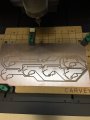
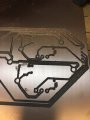
My plan is to use the Carvey to remove copper from a double sided copper coated board. I'm not yet sure how I'm going to get the cut pattern on the backside of the board to align with the pattern on the top side. What are the best practices there?
 

shortbus

Joined Sep 30, 2009
10,050
I took your advice and went with Diptrace. Yet another learning curve, but I'm getting faster at learning PCB software after 3 different software packages. Unlimited size and pretty intuitive interface does feel like the right way to go. Thanks for the tip.

Regarding using 12 sensors: My simple mind saw a way to the finish line by sensing if there is metal on the inlet or outlet of each coil. 6 coils x2 sides each = 12 sensors. I took on the challenge of reducing the number of sensors and feel like I've found a way to do it with 5 sensors. I don't understand how it can be done with only 3, but professionals are pros for a reason...
I am basically computer illiterate, And tried all of the different software out there, and kept coming back to DipTrace. Many swear by Eagle, but I spent a lot of time swearing at it, before giving up. DesignSpark was a close second, but they keep messing with it and you have to learn parts again all of the time.

I still don't see how your going to do the sensor thing? Hall sensors are mostly magnet sensitive, and when you have coils, like you do, how are you going to over ride the magnetic field of the coil when it is on?

On the BLDC and SRM motors, the halls are away from the electromagnet coils, and are trigered by athree permanent magnets on a disc at the end of the shaft. But some use opto-interrupters and a slotted wheel instead. I think the term for how the signals from the sensors work is called "quadrature", but could be wrong about that. Been a while since I was researching that stuff.
 

DNA Robotics

Joined Jun 13, 2014
670
PCB-gcode program makes g code from Eagle board files. I don't know if it works for Diptrace.

I usually try to keep all of my traces on one side of the board and use jumper wires as needed for the few remaining traces on the flip side. Then it is just a single sided board.

Otherwise, you need alignment pins to flip the board over & keep everything lined up.
 

Thread Starter

Ben Varvil

Joined Apr 30, 2018
197
I still don't see how your going to do the sensor thing? Hall sensors are mostly magnet sensitive, and when you have coils, like you do, how are you going to over ride the magnetic field of the coil when it is on?
This is a work in progress, but it shows how the 5 hall sensors (on the right) are away from the 6 coils on the left. I'm betting the hall sensors are far enough from the coils to not be bothered.
Judith PCB hall sensor.PNG
 

shortbus

Joined Sep 30, 2009
10,050
If your halls are not near the linear rod where the steel slugs are, how are you sensing their position with regard to the coils? A lot of the way your doing seems to me to be more involved that it needs to be. But then according to some of the others in this thread I'm not that smart.

Here is a link to an old type BLDC driver that explains about how the 3 hall sensors can control the motor. The simplest explanation I know of.
https://www.onsemi.com/pub/Collateral/MC33035-D.PDF
 

Thread Starter

Ben Varvil

Joined Apr 30, 2018
197
I'm trying to hardwire an LED into each coil circuit as a visual indicator that the coil is active. In my mind, it seemed simple. As I'm drawing out the PCB, I'm not so certain.

Won't it just be on all the time? A fresh set of eyes on this task would be much appreciated.
How can I get the LED to go on only when the MOSFET connects the source/drain? Bridge the source/drain with the LED/resistor? Indicator LED coil.PNG

EDIT: I meant the drawing below, not the drawing above. Sorry.
Indicator LED coil.PNG
 
Last edited:

cmartinez

Joined Jan 17, 2007
8,768
I'm trying to hardwire an LED into each coil circuit as a visual indicator that the coil is active. In my mind, it seemed simple. As I'm drawing out the PCB, I'm not so certain.

Won't it just be on all the time? A fresh set of eyes on this task would be much appreciated.
How can I get the LED to go on only when the MOSFET connects the source/drain? Bridge the source/drain with the LED/resistor? View attachment 156502

EDIT: I meant the drawing below, not the drawing above. Sorry.
View attachment 156504
If I understand your diagram correctly, you've connected the LED and its series resistor in parallel with the coil ... and I'd say that's the right way to do it. The LED will only light up when the coil is active. That is, it will light up when you turn the mosfet on, and will turn off as soon as you turn the mosfet off.
 

Thread Starter

Ben Varvil

Joined Apr 30, 2018
197
If your halls are not near the linear rod where the steel slugs are, how are you sensing their position with regard to the coils?
here is a work in progress snapshot, but hopefully this makes the concept clearer. There is definitely an assumption that the steel/wood pieces of the que are identical. The rectangles are PCB placeholders.
judith linear motor drawing.PNG
 

shortbus

Joined Sep 30, 2009
10,050
I'm trying to hardwire an LED into each coil circuit as a visual indicator that the coil is active.
I've been told I'm such a downer on others ideas, but that said, why the need for the LED's? Won't the actual movement of the cue tell you it's working? Most circuits only have an LED to show that power is on and working.

And in the same vein as always, you are really over thinking the motor and it's drive. My offer of giving some PDF's of how people are doing it still holds. And most don't even use hall sensors.
 

Thread Starter

Ben Varvil

Joined Apr 30, 2018
197
why the need for the LED's? Won't the actual movement of the cue tell you it's working?
Coil activation is harder to detect than you think, mainly because there are multiple coils pulling on the same cue stick.

My offer of giving some PDF's of how people are doing it still holds. And most don't even use hall sensors.
What do you mean by "how people are doing it?" People are making cue stick linear stepper motors?
 

shortbus

Joined Sep 30, 2009
10,050
Coil activation is harder to detect than you think, mainly because there are multiple coils pulling on the same cue stick.


What do you mean by "how people are doing it?" People are making cue stick linear stepper motors?
Most of these linear type motors are just using a single end DC three phase. No sensors required.

Why do you think a cue stick linear motor is so different than a common linear motor? In the end they are both a linear motor. Can you explain the difference? And most linear motors are under way more precise control than you need to shoot a cue ball. Like in a pick and place robot.
 

Thread Starter

Ben Varvil

Joined Apr 30, 2018
197
Why do you think a cue stick linear motor is so different than a common linear motor? In the end they are both a linear motor. Can you explain the difference? And most linear motors are under way more precise control than you need to shoot a cue ball. Like in a pick and place robot.
I'm choosing to do it this way so that I can remove the cue stick by simply pulling it out (no belts, no linkages) and so that it doesn't sound like a pick and place machine.
 

shortbus

Joined Sep 30, 2009
10,050
I'm choosing to do it this way so that I can remove the cue stick by simply pulling it out (no belts, no linkages) and so that it doesn't sound like a pick and place machine.
Good luck with that. So you think your way will be silent when the cue is in place? Again I don't quite understand, you think the linear motors in a pick and place are the source of noise in them?
 

Thread Starter

Ben Varvil

Joined Apr 30, 2018
197
So you think your way will be silent when the cue is in place?
I didn't say it would be silent. Here is what I said:
so that it doesn't sound like a pick and place machine.
I do believe the sound of the carbon fiber tube sliding through coils without belts or sprockets will be distinctly different from a pick and place machine, hopefully further interesting experts who see the machine expecting to see a traditional belt/motor solution.

you think the linear motors in a pick and place are the source of noise in them?
I think the source of noise in a pick in place machine is the sprockets/belt interaction and the linear rails/bushings interactions.

I'll take the bait... please go ahead and post your PDFs of how the pros do this. While you're at it, please post links to the commercial motor you mentioned using 100+V to do what I'm trying to accomplish. I've not been able to find that in my searching.
 

shortbus

Joined Sep 30, 2009
10,050
I'll take the bait... please go ahead and post your PDFs of how the pros do this. While you're at it, please post links to the commercial motor you mentioned using 100+V to do what I'm trying to accomplish. I've not been able to find that in my searching.
No, I wouldn't want to influence you before you figure out your and you supporters way won't work :)

As far as the 100+Volt motors, that just shows me that you haven't even looked at what I have provided so far. Or you would have seen it. So why should I think you wouldn't even look at the PDFs I can provide? Seems like those that kept egging you on to do it"your way" have left the building.
 

Thread Starter

Ben Varvil

Joined Apr 30, 2018
197
No, I wouldn't want to influence you before you figure out your and you supporters way won't work :)

As far as the 100+Volt motors, that just shows me that you haven't even looked at what I have provided so far. Or you would have seen it. So why should I think you wouldn't even look at the PDFs I can provide? Seems like those that kept egging you on to do it"your way" have left the building.
Hahahaha. I knew I shouldn't have taken the bait. Anyway, Let me know if you want me to post a PDF of tomorrow's lotto numbers.

Yup, all supporters gone. Just you and me now. Lucky for you, I'll be running this all the way into the ground. OR, it will work and you'll be left with a hefty self-reflection assignment.
 
Top