Why won't my linear stepper motor work?

Thread Starter

Ben Varvil

Joined Apr 30, 2018
197
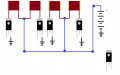
You can't change direction with the coil without reversing the poles he has to wire it up as unipolar
The way he has it shown he is just hooking all four coils to ground on one side.
Im not adding to anything the way your wiring it will not work it will only move one way.
You can wire it unipolar But you show it done wrong.
Ill draw you something up
Yes. please. I'll study whatever you draw up. Thank you.

I want to add my observations to the mix:
When I start the steel to the left of coil center, the steel jumps right in order to align with the coil center. When I start the steel to the right of the coil, it jumps to the left to align with coil center.
 

be80be

Joined Jul 5, 2008
2,395
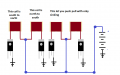
This a quick drawing it doesn't show all the parts
but to drive with 4 fet's you have to use something like this.
stepper2.png
This let's your coils push out and pull in without changing the battery poles
But I still say a H-bridges the way to go what's the Resistance of your coils

Take a 100 ohm resistor read it with you DVM then hook it to your coll and take a reading the change will be your coil resistance you get a better reading that way.
 
Last edited:

DNA Robotics

Joined Jun 13, 2014
670
From post 243
More to think about
This let's your coils push out and pull in without changing the battery poles
That is almost starting to make sense. Maybe if you could walk us through each step, starting with a non magnetized slug just outside of the first coil. Then what polarity the coils are and the slug is during each stage until it comes out the other side of a couple coils.

And maybe again with the H-Bridges so we can see the difference.
 
Last edited:

be80be

Joined Jul 5, 2008
2,395
If the ST uses H-bridges he has 4 driving coils. If he uses what he showing in his post he has really 4 coils that can only hold the stick
There all hooked to ground on the left side as I see it.

He needs to tie them together as I show that lets you change poles from + to - by grounding one side.

Next he is using the fet's as a high side driver lot harder to do.
I would go with what I posted above.

With H-Bridges he can change the poles of all 4 coils + and - lots more power to move the shaft
plus he can move both ways the way he is going is like running a motor one way but it will move one way
Guess he want's to push it back to start after that cause it will not move back as he is trying to do.

I really don't see how anyone can't see this


But the coils have to line up like i posted in #322.
Q would be your fet's
 
Last edited:

be80be

Joined Jul 5, 2008
2,395
Self exciting the iron core if he is using iron will become magnetized or use magnets
the last would be the best way to go and have lots more force on the shaft.
 

Thread Starter

Ben Varvil

Joined Apr 30, 2018
197

This let's your coils push out and pull in without changing the battery poles
I'll wire the new coils this way. My methodology doesn't care coil polarity. It works under the assumption that electromagnets can only pull on a hunk of steel. When I get back to the shop, I'm going to flip the steel from the earlier video and see if the coil pushes it out. I will learn a lot if it does... my mind will be blown.

Take a 100 ohm resistor read it with you DVM then hook it to your coll and take a reading the change will be your coil resistance you get a better reading that way.
Will do. Good tip. Thanks. I'll post when I get to the shop next.

He needs to tie them together as I show that lets you change poles from + to - by grounding one side
The current coils are not magnetically coupled like the ones in post #1. Looking at the left 2 coils in your drawing: Grounding the left side only turns on the left coil. Grounding the right only turns on the right coil. the left and right coils have opposing fields. I don't see how polarity of either changes.

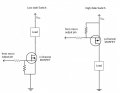
he is using the fet's as a high side driver lot harder to do.
I've never heard "high side driver", but based on this google pic, I feel I'm doing a low side driver, and what you have drawn is also a low side driver. Yes? What am I missing? Is "low-side switch" not the same as "low-side driver"?

high side driver.jpg

For what it's worth, I second CMartinez's request. (edit: DNA Robotic's request)
Thank you again for your help.
 

cmartinez

Joined Jan 17, 2007
8,768
I'll wire the new coils this way. My methodology doesn't care coil polarity. It works under the assumption that electromagnets can only pull on a hunk of steel. When I get back to the shop, I'm going to flip the steel from the earlier video and see if the coil pushes it out. I will learn a lot if it does... my mind will be blown.


Will do. Good tip. Thanks. I'll post when I get to the shop next.


The current coils are not magnetically coupled like the ones in post #1. Looking at the left 2 coils in your drawing: Grounding the left side only turns on the left coil. Grounding the right only turns on the right coil. the left and right coils have opposing fields. I don't see how polarity of either changes.


I've never heard "high side driver", but based on this google pic, I feel I'm doing a low side driver, and what you have drawn is also a low side driver. Yes? What am I missing? Is "low-side switch" not the same as "low-side driver"?

View attachment 155210

For what it's worth, I second CMartinez's request. (edit: DNA Robotic's request)
Thank you again for your help.
The diagrams you've just posted lack proper protection for the mosfets. Especially if the load is inductive, such as yours is. Inverse parallel diodes are needed across the loads.

If you decide to go for an h-bridge, then a tvs, or back-to-back zeners must be used.
 

be80be

Joined Jul 5, 2008
2,395
If you look at your first post your using a fet to source the 12 volts the n channel is way better at sinking your using high side.

Next it you look at my post you start from left to right
You have negative then positive then positive then negative

When you turn on first it will push to the right if your rod is positive
When you turn on the next one it pushes back left
With the right setup of your rod it will push right then be able to pull back left

With H Bridge you can just can use all 4 coils anyways you want.
There not much you can buy some on ebay for $2 each that would probably handle your new coils.

stepper3.png
 
Last edited:

Alec_t

Joined Sep 17, 2013
15,121
if your rod is positive
Eh? The rod is a non-energised lump of steel, so is neither positive nor negative.
A lump of steel can't be pushed; only pulled (as Ben has found), regardless of coil current polarity.
Even if you replaced the steel with a magnet polarised along the tube axis, unless the magnet poles were widely separated relative to the coil's axial length the magnet would tend to centralise (more or less) in the coil irrespective of the coil current polarity.
 

be80be

Joined Jul 5, 2008
2,395
Ok Alec_t think on this a bit how does a motor with a iron rotor move.

No magnet the iron will produces its own magnetic field current induced in it by coil.

But the ts said he was using magnet's it's in his first 3 post.

I was thinking after 330 post and so many ball breakers here this waste of time.
I think I'm still at work
Non of that was at You Alec_t I see what your thinking It will just pull in an park if there is not a change to push it more.

But The Ts uses magnets and space it right it will move But to pull back you have to change poles There only to ways to do that and I posted both.
 
Last edited:

Thread Starter

Ben Varvil

Joined Apr 30, 2018
197
The diagrams you've just posted lack proper protection for the mosfets. Especially if the load is inductive, such as yours is. Inverse parallel diodes are needed across the loads.

If you decide to go for an h-bridge, then a tvs, or back-to-back zeners must be used.
Quick clarification: those diagrams are not my project, just what popped up when I searched "High Side Driver"
Thanks for keeping a look out.
 

shortbus

Joined Sep 30, 2009
10,050
Since pictures/video seems to have more credit here than real world science. If you look there are many, many papers explaining how to determine the geometry of the motors. It is more involved than just randomly winding coils an placing magnets or steel slugs.

Around 1 minute in the explanation starts.


Thread Starter

Ben Varvil

Joined Apr 30, 2018
197
Since pictures/video seems to have more credit here than real world science. If you look there are many, many papers explaining how to determine the geometry of the motors. It is more involved than just randomly winding coils an placing magnets or steel slugs.

Around 1 minute in the explanation starts.


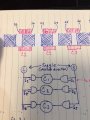
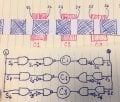
Here's what I'm doing. Imagine time and money was spent to make this narrated, animated and shiny. Please let me know

to go right: C2, C3, C1 --- repeat
to go left: C1, C3, C2 ---- repeat

Furthermore, I think I can eliminate the micro-controller (and the stress about timing) by wiring 6 sensors (S1 - S6) to detect steel at the coil openings.

IMG_1856.JPG

if cue motion to the right is desired, S2 and S5 are high, meaning that C2 and C3 fire. C2 is the ideal coil to fire but C3 doesn't hurt.

in the slightly shifted orientation below, S2 and S5 are high, but now firing C3 fights motion by pulling to the left. The updated wiring scheme deactivates any coil that has both of it's sensors high. Both S5 and S6 are high, deactivating C3. This means that only C2, the primary coil, fires.

IMG_1857 c.jpg

This solution is simple and the logic keeps working as I test different scenarios.
Depending on the thoughts I hear here, and if I can figure out how to physically build the circuit, I should be able to control the cue motion with just a right or left signal. I should also be able to control shot strength by controlling the supply voltage.
 

Thread Starter

Ben Varvil

Joined Apr 30, 2018
197
But the ts said he was using magnet's it's in his first 3 post.
Hi Be80be, after Alec_t's post #17... :
This would be similar to using a non-magnetised steel disc instead of a permanent magnet.
...I've been trying to do this without using permanent magnets. I should have been more clear. As I mentioned earlier, in the event that the system using just steel is weak, I'll add permanent magnets.
 

shortbus

Joined Sep 30, 2009
10,050
Here's what I'm doing.
Well I'm glad you have at least come to the realization to use three phases instead of four. The only electronically commutated motors that use four, that I'm aware of, are steppers. BLDC, SRM and VRM use three phases. And not one of them use center tapped winding's, and they move both directions, with no H-bridges.

I won't continue to insist you change you're thinking, but when your ready, I can hook you up with a good PDF that explains how to do it, from the geometry of the coils and magnets to the actual controller. Even one that doesn't use magnets but iron for the rod, though it is really for a "rotary" motor, but the principle and geometry would be the same. Just can't understand the reluctance to do things with a proven design from the start?
 
Last edited:

be80be

Joined Jul 5, 2008
2,395
Na I can't see how a BLDC looks like a center tap coil too LOL


But I'm sure I no nothing after 34 year of control wiring and motor control .
What is the one on the left doing and what is the one on the right doing?
There both tapped in the center of a coil.
Wonder what they call the left one LOl
 
Last edited:

Sensacell

Joined Jun 19, 2012
3,785
Be careful with ideas like "I'll just vary the supply voltage to control the shot strength"

You will end up with yet another complex problem to solve: how design and build a dynamically variable power supply capable of many amps output.

Better to stick with the micro-controller, tough it out, master the code.
With software, you can fix the million stupid problems you have not yet considered.

Use the micro-controller's PWM engine to control the coil current, it will be much simpler in the end.
 

Thread Starter

Ben Varvil

Joined Apr 30, 2018
197
Well I'm glad you have at least come to the realization to use three phases instead of four.
It was a cool realization to make. It is interesting that the number of coils needed depends on the gap thickness between coils. I had to change from gap thickness = 1.5x steel thickness (needs 5 coils) to .5 steel thickness (needs 3 coils).
 

Thread Starter

Ben Varvil

Joined Apr 30, 2018
197
Be careful with ideas like "I'll just vary the supply voltage to control the shot strength"

You will end up with yet another complex problem to solve: how design and build a dynamically variable power supply capable of many amps output.

Better to stick with the micro-controller, tough it out, master the code.
With software, you can fix the million stupid problems you have not yet considered.

Use the micro-controller's PWM engine to control the coil current, it will be much simpler in the end.
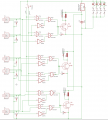
Lol. Just as I finish my attempt at making a schematic hardwiring the hall sensors for coil control...
Judith linear motor schematic.PNG
 
Top