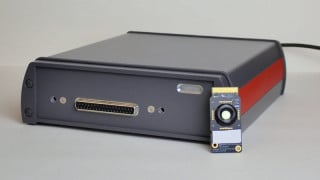
I laid out a short code strip, 1/16 in Al on 1/8 in centers. K2362 read all 9 stripes when spaced 1/8 in above stripes. I used this same sensor as an emitter follower to read a gray code disc.
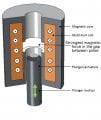
This surprised me; the stick .7 in. dia. X 33 in. long, 30 oz., steel pipe, shot thru coil for half of its length.
Coil, 2 in. long, 1.75 dia. wound with 85 ft. of 7 strands of # 26 cu. wire giving .45 ohms. Power supply 3V @ 9A
Stick supported on 2 rollers which limited its travel.
Light force with stick flush with coil, moderate force .5 in. inside, strong force 1.5 to 2 in. , & light force @ 7 in.
of a solenoid support the idea that at least half (2/3rds is better) of the metal should be within the coil if energizing it is to create usable force. Starting from rest, in the position as drawn, I don't believe this design moves.
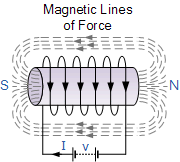
That is because neither of the examples you give has any iron or back iron in the coil. So your not getting the full use of any magnetism your making with the coil. In both the solenoid or your coils your only using a slight amount of the magnetism, look at an illustration of a magnetic field of an electrical coil.
Now imagine if you had that magnetic field in the middle of a U shaped steel part. You then would have both the S and N poles of that coil working together. Not true , I hear you saying, but look where the most flux lines are in the illustration, at both poles. So by connecting something that directs both poles to do something you get more work done. It is also the reason a transformer has a magnetic core not just an air core.
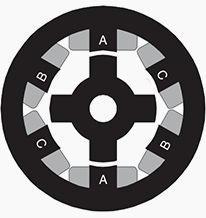
Starting from rest, in the position as drawn, I don't believe this design moves. Perhaps if another set of coils, half step out of phase is used, those can help get the mover started, enabling B or C of the coils shown to do work.
1) Use a brass threaded rod, to avoid magnetic effects in your support structure for the cores.
2) Avoid using metallic components in your coil bobbins- even if they are non-magnetic.
They end up looking like "shorted turns" in your coil, which will absorb energy (eddy currents) during switching- in a way you do not want.
You can use these materials if you "gap" the metal so current cannot flow around in a loop.
Now I'm seeing that if you have ALL metal (back iron style), it is good. Interesting how a little metal just creates eddy currents, but if everything is metal, it helps...
I appreciate the clarification. It still doesn't change what I (and CMartinez) have observed. If the slug isn't in the coil, it doesn't move when the coil is activated. After all the enlightening discussion about back iron and about using metal to help keep the magnetic field strong, I now understand that if there were metal all around the coil, the coil's magnetic field would likely have enough strength to pull a steel slug resting just outside. Since I went the route of eliminating all metal around the coil, I need the slugs inside the coils to start.
Regardless, I'm still stuck trying to get the power circuit to work. I still have not found the leak to ground. Maddening. I'm literally going over each centimeter of trace at a time trying to see where there is a false connection to ground. No luck yet. When I do find it, I should be able to test the 6 coil system in an "open loop" configuration.
More wild thoughts. Instead of a code strip, might be better to have wide bands, the width = to length of each coil
laid out in inverse order. Optical sensor is aligned with band 1. If using a SW to start then might remove 5mm
of the band so that sensor is resting on black & slug is flush with coil. SW starts slug moving, sensor picks up band continuing powering coil until the end of the band. Second band powers coil 2 & so on. Uneveness of coil spacing is made up by band spacing. Later bands might need to be shortened to account for coil discharge time.
My .45 ohm coil seems to have quite a bit of punch on 12 car battery.
A 6 bit counter controls the coil firing.
That is only on a pulling solenoid. And it is because of the fact there is no iron to center/concentrate the magnetism. Also in a solenoid you need the slug inside the coil to direct the movement, by that I mean there isn't any support to "make" the rod go into the coil. That isn't the case in what your doing. Try putting a small chunk of steel on a hot wheels car and put the solenoid coil close but not in the coil. You will be able to move the coil and the hot wheels will go where you move the coil.
If what your saying is true there wouldn't be any magnetic relays in the world. The metal part that moves in a relay, to turn on or off the circuit wouldn't work. But it does because the metal part is pivoted and allowed to move when the coil get energized. And not part of that relay goes into the coil, it is just attracted to the iron that the coil surrounds.
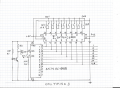
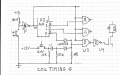
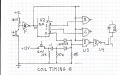
An outline to show how detected Al bands control powering the coils. The 4022 will handle 8
coils, 4017, different pin out, handles 10. The start is a bit messed up but too lazy to start over. U3D should be an OR feeding into a NAND like others so that SW start pulse
overlaps detected first band. Reset is from trailing edge of last band. Might this also in reverse??
This might clarify or gum it up. Used last inverter-driver to give better drive to reflective sensor. The .1 uF & 10k timing should be just less than slugs transit time thru coil 1.
View attachment 158876 This might clarify or gum it up. Used last inverter-driver to give better drive to reflective sensor. The .1 uF & 10k timing should be just less than slugs transit time thru coil 1.
Hi Bernard. This work is amazing. Thank you. I look forward to digging in.
Summer is over, my time is thin, so I'm limited in where I can put my energy. As of now, it is all towards getting the power circuit working. Once I can do that and control the coils at my command, THEN, I get to experiment with your work, microcontrollers and anything else yet to be mentioned.
I'll post progress and will definitely get into the details of your control system when I get there. Right now I'm looking for thicker copper circuit board blanks and re-drawing the design with much thicker traces. I still don't know how I managed a false ground in the last design, so I can only hope to not repeat that mistake.
Thank you again.

 Facebook
 Google
 GitHub
 Linkedin