Why isn't this Op Amp saturated ?

Status
Not open for further replies.

MrChips

Joined Oct 2, 2009
34,829
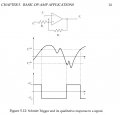
Examine this figure carefully.

opamp schmitt trigger.jpg
For your consideration, V1 = 0V.
There are two threshold voltages, V+(utp) which is equal to +Vs/2 and V+(ltp) which is equal to -Vs/2.

In between these two threshold voltages (the two dashed lines) is a dead zone.
Any input voltage Vi that falls in this dead zone has no effect on the output voltage.

Vi must go above the upper threshold to cause the output to switch to -Vsat or -Vs.
In other words, (Vi - Vutp) > 0 for saturation to the negative rail to occur.

Vi must go below the lower threhold to cause the output to switch to +Vsat or +Vs.
In other words, (Vltp - Vi) > 0 for saturation to the positive rail to occur.
 

Thread Starter

Xenon02

Joined Feb 24, 2021
504
And what did I say to do with that result?
Since the output is initially unknown, try an arbitrary voltage for the positive input, multiply that by the op amp gain, and see what voltage and polarity that gives you.
If it's more than the supply voltage, than the op amp is saturated at its maximum voltage with that polarity.
Then you can calculate the actual positive input voltage.

If you start with a different arbitrary voltage, you may end up with a different result.
That's characteristic of bistable circuits.

Multyply by op amp gain which is I guess infinite ?
I had there 15V arbitrary and 4V in the negative inpute. So 15 - 4 = 11* infinite then positive 15V outpute? because it is max ?
 

Wendy

Joined Mar 24, 2008
23,798
Not infinite, but very very high(x 1e6). When I said infinite earlier I was referring to my mental model. I don't use simulators my simulator is between my ears. Far from perfect but usually adequate.
 

Thread Starter

Xenon02

Joined Feb 24, 2021
504
Yea but I made an error in my equation ?

I don't know what did I messed up.
It showed that it is positive in the output but I have negative.
 

Wendy

Joined Mar 24, 2008
23,798
Remember the configurations if you're inputting on the minus side it will be inverting, if your input putting on the positive side it will be non inverting and there are minor differences in the formula too, you might as well accept that you're gonna have to memorize them.
 

MrChips

Joined Oct 2, 2009
34,829
Yea but I made an error in my equation ?

I don't know what did I messed up.
It showed that it is positive in the output but I have negative.
We have told you repeatedly.
The initial state is arbitrary. We don't know what events led to the bi-stable circuit being in one state or another.
It is what occurs after that we can analyze.
 

Thread Starter

Xenon02

Joined Feb 24, 2021
504
Remember the configurations if you're inputting on the minus side it will be inverting, if your input putting on the positive side it will be non inverting and there are minor differences in the formula too, you might as well accept that you're gonna have to memorize them.
In this one I can say the output is inverted :

1659297367211.png

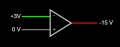
0-3V * Av = negative output.

So I tried the same here :

1659297406358.png

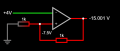
So for the negative inpute I have 4V and for positive inpute I just picked and it was 15V.
So 15- 4V * Av. Av = >>1 so output is positive. Or did I make an error again ?
 

MrChips

Joined Oct 2, 2009
34,829
In this one I can say the output is inverted :

View attachment 272672

0-3V * Av = negative output.

So I tried the same here :

View attachment 272673

So for the negative inpute I have 4V and for positive inpute I just picked and it was 15V.
So 15- 4V * Av. Av = >>1 so output is positive. Or did I make an error again ?
No. the threshold voltage is -7.5V.
(-7.5V - 4V) x 100,000 ⇒ saturation to the negative rail.
 

Thread Starter

Xenon02

Joined Feb 24, 2021
504
No. the threshold voltage is -7.5V.
(-7.5V - 4V) x 100,000 ⇒ saturation to the negative rail.
I just picked an arbitrary voltage.
Like mr.crutschow said that I can pick any voltage for the positive input. And check that output will be saturated for an exact polarity.
 

Thread Starter

Xenon02

Joined Feb 24, 2021
504
Ok wait I think I know how it works now.

Let's say again I have 4V in the negative input so the output will be random. It can be +15 V or -15V. Because I don't know what is the voltage in the positive input which can be any (arbitrary value). But for the negative input= 8V i Know that the output must be -15V because the threshold can be max -7,5V.
 

BobTPH

Joined Jun 5, 2013
11,533
Do you understand that when you pick an arbitrary output voltage you are changing the non-inverting input voltage? So then you compute a new output voltage based on the known input voltages. If it stays the same we say it is stable, if not, we have to recompute again based on the new output voltage. Keep doing that until it is either stable, or repeats. If it repeats, you have an oscillator.

Try starting with the arbitrary output of 0V and show us what happens.
 

Thread Starter

Xenon02

Joined Feb 24, 2021
504
Okey so IN - = 4V and arbitrary IN+ = 0V.
0-4V * let's say infinite. -15V (that's the max). So now I have IN + = -7.5V.
And again (-7,5V-4V )*infinite = -15V and it will repeat so again IN + = -7,5V and (-7,5V-4V) *infinite = -15V.

For IN - =4V and arbitary IN + = 6V
I have 6-4 = 2 * infinite = 15V max.
IN + = 7,5V so again 7,5V - 4V = 3,5V * infinite = 15V so stable 15V.

I don't know if I can have arbitrary IN + = 20V but here it would be stable 15V.
 

Thread Starter

Xenon02

Joined Feb 24, 2021
504
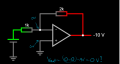
For the negative feedback I also assume a arbitrary negative input ?

Like here :

1659304364074.png

Can it work the same that I assume what is the arbitrary value of negative input like in the one with positive feedback ?


Edit :

Like here AV < 1

So when IN - = 0V and IN + = 0V then Vout = (0-0)*Av? = 0 V ?

I also found this video :


1659314824464.png

He also used the same equation Vout = (Vp-Vn)*Av

So when I used it did I make a mistake ? Vp is 0V and Vn is also 0V.

1659314962750.png

So where did I make a mistake ?

EDIT :

I mean this equation Vout = (Vp-Vn)*Av. Works for Op Amp without feedback and for Op Amp with positive feedback. But why this basic equation for every Op Amp doesn't work for negative feedback ?

Like I said it worked here:

1659316727480.png

And here :

1659316735593.png


But it doesn't work here :

1659316752332.png

Don't know why. Like it is a basic equation for every Op Amp.
 
Last edited:

MrChips

Joined Oct 2, 2009
34,829
The basic differential amplifier operation is:

Vout = (V1 - V2) x amplifier gain

In the first drawing,
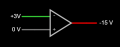
Vout = (0 - 3) x 100,000 ⇒ saturation to the negative rail.

In the second drawing,
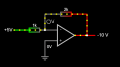
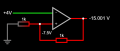
Vout = (-7.5 - 4) x 100,000 ⇒ saturation to the negative rail.

In the third drawing,
Vout = (0 - 0) x 100,000 ⇒ ??? unknown quantity
In an ideal op-amp, we assume the open loop gain is infinite.
What is 0 x ∞ ?

1659318214483.png

Look at this circuit.
V+ = V-

(V+ - V-) x ∞ still applies.

The purpose of negative feedback is to adjust the output voltage so that V- matches V+ otherwise the output would be infinite.

The first too circuits work because V1 and V2 are not equal.
What happens if V1 = V2?
Does Vout = (V1 - V2) x gain still apply? In other words, what is 0 x ∞ ?

0 x ∞ is undefined.

V1 is never equal to V2, only in theory.
(V1 - V2) is never zero.
 

Thread Starter

Xenon02

Joined Feb 24, 2021
504
Understandable.

I have one last question. Because to prove that this positive feedback loop I could pick any arbitrary value for IN+.
For the negative feedback it works the same with Arbitrary value ?
 

BobTPH

Joined Jun 5, 2013
11,533
I think you have misunderstood. You should be picking a value for the output, not the input. The input is determined by the output. And the
reason we asked you to do that was just to show you how that will inevitably lead to one of the rails.

Circuits with negative feedback are generally well behaved and you can derive the behavior by writing equations for the two inputs and setting them equal, because the negative feedback will ensure that is the case.
 

MrChips

Joined Oct 2, 2009
34,829
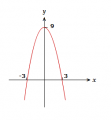
In the positive feedback example, there are only two states, saturation on the positive rail or saturation on the negative rail. This is a run-away scenario with no viable solution. Imagine trying to balance a pin on its tip. Or imagine trying to balance a ball on the top of this parabola. In reality, the width of the parabola is extremely thin. The ball falls off the top instantly.

1659358319025.png


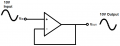
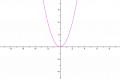
In the negative feedback example the op-amp is operating in the linear region. There is a solution. Imagine a ball sitting In the bottom of a well. There is a stable solution.

In this case a ball placed in the well will reach a stable position. This is what negative feedback does.

1659358369237.png
 

Thread Starter

Xenon02

Joined Feb 24, 2021
504
In the positive feedback example, there are only two states, saturation on the positive rail or saturation on the negative rail. This is a run-away scenario with no viable solution. Imagine trying to balance a pin on its tip. Or imagine trying to balance a ball on the top of this parabola. In reality, the width of the parabola is extremely thin. The ball falls off the top instantly.

View attachment 272743


In the negative feedback example the op-amp is operating in the linear region. There is a solution. Imagine a ball sitting In the bottom of a well. There is a stable solution.

In this case a ball placed in the well will reach a stable position. This is what negative feedback does.

View attachment 272744

I understand the concept :D

I was just thinking if I could do the equation with Vout using arbitrary value.

I think you have misunderstood. You should be picking a value for the output, not the input. The input is determined by the output. And the
reason we asked you to do that was just to show you how that will inevitably lead to one of the rails.

Circuits with negative feedback are generally well behaved and you can derive the behavior by writing equations for the two inputs and setting them equal, because the negative feedback will ensure that is the case.
Okey.
So this was like a "proof" :D
I thought that I could do it the same with negative feedback. But it's more like it should work like that.

Although I understand the concept. The last question was just a curiosity if I could do the same calculations with negative feedback.

Thanks for replys and patience to my personality.
 

MrChips

Joined Oct 2, 2009
34,829
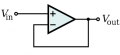
Yes the equation works with negative feedback.

1659360112535.png

Vout = (V1 - V2) x gain

Vout = (Vin - Vout) x 100000

Solve the equation for Vout.

Set Vin to any arbitrary value.
 

Thread Starter

Xenon02

Joined Feb 24, 2021
504
Yes the equation works with negative feedback.

View attachment 272745

Vout = (V1 - V2) x gain

Vout = (Vin - Vout) x 100000

Solve the equation for Vout.

Set Vin to any arbitrary value.
I thought more about arbitrary negative input.
But nevermind about that.

Edit:


Do you have guys any example of Op Amp with 2 feedbacks and with equations ? I want to see how the op amp works. If he has 2 feedbacks then will it work as a positive feedback or as a negative feedback ? I want to see and example with solutions.
 
Status
Not open for further replies.
Top