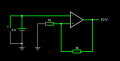
Why isn't this Op Amp saturated ?

Status
Not open for further replies.

MrChips

Joined Oct 2, 2009
34,829
Ah yes more more thing.
What will happen if I have 2 feedbacks ? Positive and Negative ? How do I know if it works as a "forever saturated" or a OpAmp that wants to be stable like for only negative feedback ?
What is the voltage gain, Av?

Av = -ve for negative feedback
Av = -1 for unity gain inverting buffer
Av = 0 for zero output
Av = 1 for unity gain buffer
Av >>1 becomes unstable with positive feedback
 

Thread Starter

Xenon02

Joined Feb 24, 2021
504
What is the voltage gain, Av?

Av = -ve for negative feedback
Av = -1 for unity gain inverting buffer
Av = 0 for zero output
Av = 1 for unity gain buffer
Av >>1 for positive feedback
Ok, so it depends on the Av.

So again how to prove that positive feedback will be always saturated ? Vout = -7,5V - 4V * Av. But yea how to prove that +IN will be always -7,5V or 7,5V? Is it a rule that it is saturated always or is there a proof ?
 

crutschow

Joined Mar 14, 2008
38,529
it a rule that it is saturated always or is there a proof ?
For a circuit with positive feedback and no negative feedback, the "proof" is multiplying the input voltage difference by the very high open-loop op amp gain.
Since it's impossible to make the input difference exactly zero (due to noise and offset) the output will always go to one of the rails, depending on the polarity of even a slight input difference.
 

MrChips

Joined Oct 2, 2009
34,829
Ok, so it depends on the Av.

So again how to prove that positive feedback will be always saturated ? Vout = -7,5V - 4V * Av. But yea how to prove that +IN will be always -7,5V or 7,5V? Is it a rule that it is saturated always or is there a proof ?
If Vout attempts to go outside of the supply rails then the op-amp is saturated.
 

Thread Starter

Xenon02

Joined Feb 24, 2021
504
For a circuit with positive feedback and no negative feedback, the "proof" is multiplying the input voltage difference by the very high open-loop op amp gain.
Since it's impossible to make the input difference exactly zero (due to noise and offset) the output will always go to one of the rails, depending on the polarity of even a slight input difference.
I mean let's have an example like before 4V. And let's say that I don't know that positive feedback will make output saturated.
So now how to show that it is now saturated ?

You said that I should have an input difference but I don't know what is the exact voltage on the positive input. I know only on the negative that is 4V.
 

crutschow

Joined Mar 14, 2008
38,529
You said that I should have an input difference but I don't know what is the exact voltage on the positive input. I know only on the negative that is 4V.
You are not listening.
You keep going round and round about things that have already been explained to you.
I stated that this is circuit forms a bistable latch and you can't unambiguously determine the output without knowing the history of the input.

At power up, its unknown whether the differential input voltage will be slightly plus or slightly minus so it can come up in either state.

Is that difficult to understand?
 

Thread Starter

Xenon02

Joined Feb 24, 2021
504
You are not listening.
You keep going round and round about things that have already been explained to you.
I stated that this is circuit forms a bistable latch and you can't unambiguously determine the output without knowing the history of the input.

At power up, its unknown whether the differential input voltage will be slightly plus or slightly minus so it can come up in either state.

Is that difficult to understand?
So as I understand for positive feedback it is hard to tell if the differential input voltafe is plus or minus ?
And that's why the output is saturated ?

Because I was trying to use this equation Va-Vb. But the problem was that I didn't know the voltage from positive input.
 

crutschow

Joined Mar 14, 2008
38,529
I didn't know the voltage from positive input.
Since the output is initially unknown, try an arbitrary voltage for the positive input, multiply that by the op amp gain, and see what voltage and polarity that gives you.
If it's more than the supply voltage, than the op amp is saturated at its maximum voltage with that polarity.
Then you can calculate the actual positive input voltage.

If you start with a different arbitrary voltage, you may end up with a different result.
That's characteristic of bistable circuits.
 

MrChips

Joined Oct 2, 2009
34,829
So as I understand for positive feedback it is hard to tell if the differential input voltafe is plus or minus ?
And that's why the output is saturated ?

Because I was trying to use this equation Va-Vb. But the problem was that I didn't know the voltage from positive input.
1659292780004.png

As said, this circuit is a bi-stable circuit. It only has two output states.
Vout is either +Vs or -Vs.
Hence with two equal value resistors, the threshold voltage is either +Vs/2 or -Vs/2.

The other input (inverting input) has to go above +Vs/2 to switch to negative output (-Vs)
or go below -Vs/2 to switch to positive output (+Vs).
 

Thread Starter

Xenon02

Joined Feb 24, 2021
504
Since the output is initially unknown, try an arbitrary voltage for the positive input, multiply that by the op amp gain, and see what voltage and polarity that gives you.
If it's more than the supply voltage, than the op amp is saturated at its maximum voltage with that polarity.
Then you can calculate the actual positive input voltage.

If you start with a different arbitrary voltage, you may end up with a different result.
That's characteristic of bistable circuits.
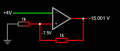
So in this circuit :

1659292896886.png

What would be the arbitrary voltage in positive input ?
 

Thread Starter

Xenon02

Joined Feb 24, 2021
504
If the threshold voltage is -7.5V, then the inverting input has to go below -7.5V for the output to switch to +15V.
Why is it negative though ? Why the output can't be positive ?
4V in the negative input and positive output ?


How to calculate it? Vp = arbitraty 1 mV ? and Vn = 4 V. Vp - Vn = negative ???
I want to just know how to show it that the positive is always saturated. With the example there.


I know that the positive feedback is saturated all the time but I want to prove it with the equation.


Do you not understand the meaning of arbitrary?
Start with any value you want.
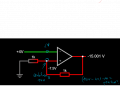
Ok so let's say that the voltage on the positive input can be any right ? So 15V ? Or 20V ? Or the arbitraty value should be small ?
Then :

1659293649003.png
 

MrChips

Joined Oct 2, 2009
34,829
We are going around in circles.

Do you understand that the output can only be one of two values, +Vs or -Vs, assuming that this is a bipolar supply +Vs and -Vs?

Do you understand that the threshold voltage at the non-inverting input is one of two values +Vs/2 or -Vs/2?
 

BobTPH

Joined Jun 5, 2013
11,528
I think the confusion comes from your original circuit. Another
So as I understand for positive feedback it is hard to tell if the differential input voltafe is plus or minus ?
And that's why the output is saturated ?

Because I was trying to use this equation Va-Vb. But the problem was that I didn't know the voltage from positive input.
Since we have drilled into you that it can be only two possibilities, try each of them.

If we take your original example:

Try Vout = 15. Then Vin+ is 7.5 and Vin- is 5. So the difference is +2.5V and the output is max or 15. So this checks out okay.

Now try Vout = -15. Now Vin+ is -7.5 and Vin- is 5 so the the difference is -2.5 and the output is -15. This one checks out also.

What that means is that either is possible, i.e. both states are stable.

That is the nature of a bistable circuit.

In the real world, it will go one way or other, no way to predict.
 

Thread Starter

Xenon02

Joined Feb 24, 2021
504
We are going around in circles.

Do you understand that the output can only be one of two values, +Vs or -Vs, assuming that this is a bipolar supply +Vs and -Vs?

Do you understand that the threshold voltage at the non-inverting input is one of two values +Vs/2 or -Vs/2?
Yes.
I do understand that it must be one of two values. That is -Vs or +Vs which in this case are 15V +/-.


So what did I say to do after you calculate the output with the arbitrary value?

If you are trolling us or not understanding what I am saying then it would seem I'm spinning my wheels and will stop replying.
I'm no trolling but did I do something wrong with the arbitrary value ?


I'm just thinking that for positive feedback it is different and it is just I think the rule that is must be saturated.

I think the confusion comes from your original circuit. Another

Since we have drilled into you that it can be only two possibilities, try each of them.

If we take your original example:

Try Vout = 15. Then Vin+ is 7.5 and Vin- is 5. So the difference is +2.5V and the output is max or 15. So this checks out okay.

Now try Vout = -15. Now Vin+ is -7.5 and Vin- is 5 so the the difference is -2.5 and the output is -15. This one checks out also.

What that means is that either is possible, i.e. both states are stable.

That is the nature of a bistable circuit.

In the real world, it will go one way or other, no way to predict.
Of course but I was thinking of an arbitrary value for Vin +.

Like Vin- is 5V and Vin+ (arbitrary) is -7.5V ? Because all the time I see that we have to say for granted that output is max Vs. But I wanted to check it that Vout is for example here : dunno 5V - 6V = -1V and it is negative so the Vin + rises, so it's 5V - 8V = -3V it still rises to the point of saturation which is output = -15V.
 

Thread Starter

Xenon02

Joined Feb 24, 2021
504
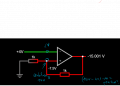
So when I did not make a mistake with arbitrary value then it should be positive output here:

1659295000160.png

As I said completely random value on the positive input.

Of course I understand that you are guys very annoyed and I feel very guilty about that.
 
Status
Not open for further replies.
Top