Electret mic amplifier isn't working.

Thread Starter

rahulb

Joined Jun 5, 2019
44
Hi Everyone,

I am trying to build an amplifier for an electret mic( collar mic) which gives output to a headphone. I am using NE5532 ic for the amplification.

I am not getting any sound on headphone. I have made the circuit on breadboard.

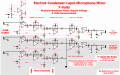
Please check the attached schematic and products I am using.

d.jpgwhat I am doing wrong here? please help me.

thanks
 

sghioto

Joined Dec 31, 2017
8,633
Besides the supply voltage I would use 47uf caps for C7 and C8.
Also increase the gain and check connections on the mic connector.
 

Ian0

Joined Aug 7, 2020
13,097
the supply voltage is 12v 2amps through smps
I could understand if it was a bit tinny. 1uF coupling to a 32Ω load gives a high-pass filter at 5kHz, but I am surprised you are getting no output at all.
What are the DC voltages on pin 1 and pin 7?
Also, don't forget that the output is limited to 38mA, that's less than 1V rms into a 32Ω load, but that might be loud enough.
 

LowQCab

Joined Nov 6, 2012
5,101
Hi Everyone,
I am trying to build an amplifier for an electret mic( collar mic) which gives output to a headphone. I am using NE5532 ic for the amplification.
I am not getting any sound on headphone. I have made the circuit on breadboard.
Please check the attached schematic and products I am using.
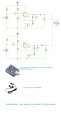
What I am doing wrong here? please help me.
thanks
.
You must have a Low-Impedance-Audio-Amplifier to drive the Headphones.

We need to know your reasons for building this project to
provide advise that will provide the results You are looking for.

Tinkering around, trying to teach yourself about Electronics ............
or,
A high-quality finished-product that will provide high-performance results ...........
.
.
Mic Mixer 1 .png.
.
.
 

Attachments

MisterBill2

Joined Jan 23, 2018
27,172
What I noticed this time is that the headphone set uses a FOUR CIRCUIT connector, with the top circuit being the microphone connection. What I think I see is that the headphone connection to the amplifier outputs is a three circuit connector.
So my suggestion is try your amplifier with an earphones only set before making changes.
If that check is not easy or convenient, use the ohm meter function of your multimeter to see if your headphones are actually connected. Meter common to the amplifier common, meter positive to the C7R11 junction and the C8R12 junctions.
You should read a lower resistance if the headphones are actually connected.
My guess is that they are not connecting.
 

Thread Starter

rahulb

Joined Jun 5, 2019
44
I could understand if it was a bit tinny. 1uF coupling to a 32Ω load gives a high-pass filter at 5kHz, but I am surprised you are getting no output at all.
What are the DC voltages on pin 1 and pin 7?
Also, don't forget that the output is limited to 38mA, that's less than 1V rms into a 32Ω load, but that might be loud enough.

I am getting 1.4V at Pin 1
 

LowQCab

Joined Nov 6, 2012
5,101
"" rahulb said:
Hi Everyone,
I am trying to build an amplifier for an electret mic( collar mic) which gives output to a headphone. ""


As BobTPH accurately pointed-out,
I neglected to state exactly how much Current the Amplifier should be able to produce.

Then MisterBill2 made the observation regarding the Headphone-Jack possibly being
intended to include a 4th Circuit for the Microphone.
But as of yet, no-one has actually verified that the picture supplied
is a picture of the actual part being used.

This got me to thinking.
Lots of very basic questions need to be answered first.

Like why does his picture of a Lapel-Microphone have a 4-Conductor- Plug,
and what is the function of each of these conductors.
And, what does the Headphone-Plug look like.
We haven't seen a picture of it yet.

Where are the Spec-Sheets and/or Instructions that should accompany these products ?

Both the Headphone, and Microphone connections
need to be verified independently from the proposed Pre-Amp-Circuit.
.
.
.
 

AnalogKid

Joined Aug 1, 2013
12,043
1.4 V sounds like the output is saturated low. What is the voltage across the mic element, from the left sides of C1/C2 to GND?

Another test: Remove C1/C2 from both circuits, so the non-inverting (+) inputs are floating at the 7.5 V bias. If the outputs still are at 1.4 V, remove C3 and C4, leaving R8 and R10 floating. Now the circuit is a simple unity gain voltage follower with a 1.5 V input. The outputs should be at 7.5 V.

ak
 

KeithWalker

Joined Jul 10, 2017
3,603
The sockets you are using for input and output appear to have spring loaded contacts which activate when the plug is inserted. Double check your wiring. If you are using the wrong terminals, you will not have continuity through them.
 
Top