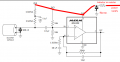
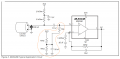
Electret MIC and MAX4466 Picking Up VCC Noise (sometimes)

Thread Starter

GroundLoop_0

Joined Jan 13, 2026
8
Hello there,

The backgorund:
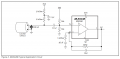
I'm working in an audio module using an electret microphone and a MAX4466 amplifier, I'm using the layout recommended in the MAX4466 datasheet (datasheet Figure 2), with the only difference being there is a 100 nF cap between the MIC+ and MIC-, the presence of said cap showed some improvement signal quality in earlier tests. BTW, I'm using 3V3 instead of 5V.

The circuit:
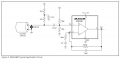
1768328304728.png

The problem:
The MIC+ picks up VCC noise, from the regulator (which has a very peculiar appearance), and this gets amplified with the MIC signal and messes up with the MIC signal. I've already tried removing the 100 nF cap between MIC+ and MIC-, just to check if it was injecting the noise into MIC+, but nothing changed.

The Weird Part:
From the multiple modules I've soldered (by hand), just one does not pick up the VCC noise, the one I am the most confident of its assembly, but still, most of the of modules show the problem. I have checked all modules, just to see if they have anything "out of place", but all boards boards look the same. I also checked the resistors, I could have messed up maybe, but they all check. I couldn't check the caps though with a capacitance meter though.

The question:
1. Is there a way to make sure to eliminate this noise from the VCC?
2. What might cause this weird behavior, considering all boards have the same layout and components?
 

Thread Starter

GroundLoop_0

Joined Jan 13, 2026
8
Add a 1uF and 10uf cap in parallel to the 0.1uF cap between the two 1k (2k in your case) resistors. Attach all your analog grounds to a single point -- avoid ground loops.
This modification did provide some improvement, even though the signal remains noisy. Thanks for the ideia!
 

Thread Starter

GroundLoop_0

Joined Jan 13, 2026
8
ALSO CONNECT A 10 MFD CAPACITOR DIRECTLY ACROSS THE dc SUPPLY. And since the electret does not draw much current, why such low value resistors??
Tbh, I do know for sure, these resistors were selected before my involvement in the project, I simply kept em.

After your reply, I replaced em for 2K2 ones, the entire signal spectrum got stronger, the human voice and also noise. That's cool, as less gain is needed. But unfortunately the SNR remains the same.
 

Thread Starter

GroundLoop_0

Joined Jan 13, 2026
8
My guess is that some of the constraints of the board are killing the signal quality:
- the board is small, but it has only 2 layers, so there is no solid GND plane (although it is as solid as it can be);
- the board is powered by a somewhat noisy switched power supply, with high frequency 40 mV spikes, although the filtering does filter em out, the problem is the sub-100 Hz noise, even digital filtering has a hard time with those frequencies without filtering out some of the lower frequency pitches of the human voice.
 

ronsimpson

Joined Oct 7, 2019
4,663
VCC noise, from the regulator
I add a LC or RC filter. The filter should block the frequency of noise you are worried about. When I did audio amplifiers years ago I worried about 60/120hz noise. Now I worry about noise from switching power supplies. You might need a "big ass" cap. The resistor or inductor is important. Just a cap has limited effect.
1768499727351.png
 

MisterBill2

Joined Jan 23, 2018
27,330
Consider ALSO that the noise can be transferred in thru resistance on that "ground"side of the circuit. That "ground loop" can be a real problem, when noise currents share a conductive path with the signal currents.
Noise in the common portion of a PCB can certainly become part of the signal voltage.
A capacitor directly across the op-amp supply terminals is worth trying. If that works as a temporary fix, then creating a permanent connection would be the fix.
 

Thread Starter

GroundLoop_0

Joined Jan 13, 2026
8
Here is an update on the problem.

The boards I found the noise were all assembled by hand. I got my hands on a machine assembled board, the Vcc noise was gone. There is still a very tiny hiss, but the pulsing noise from Vcc is completely gone.

Considering I'm using a general purpose MCU, the result is good.

Thanks for the help everyone!
 

MisterBill2

Joined Jan 23, 2018
27,330
Here is an update on the problem.

The boards I found the noise were all assembled by hand. I got my hands on a machine assembled board, the Vcc noise was gone. There is still a very tiny hiss, but the pulsing noise from Vcc is completely gone.

Considering I'm using a general purpose MCU, the result is good.

Thanks for the help everyone!
OK, if machine assembled PCBs are satisfactory, then it is time to do a comparison and see what is different. It could be an actual error in the hand assembled ones, or a failed solder connection. I have seen assemblies where some pins became folded rather than passing thru the required holes. AND I have seen, and repaired, quite a few poor solder connections. WHAT is so difficult about good soldering???
 

JTEX

Joined Mar 19, 2026
10
I highly suspect the noise comes from the 1Mohm resistive divider providing DC bias on the non-inverting input. Done this way, any noise present on your power supply goes straight into the input.

This is a better bias scheme if you want to avoid PSU noise (the 10uF cap shorts it out to ground):
MIC_amplifier_circuit.png
 

MisterBill2

Joined Jan 23, 2018
27,330
Another thought, IF the PCB is two-sided, there may be a thru-hole that is not plated thru, and hand soldering might not connect both sides. That is a sneaky failure mode that can cause all sorts of problems. AND, I would use 5K resistors or 4.7K, instead of 1K for the mic power divider. Also, that 1 meg resistor can probably be 100K and not produce as much noise.
 
Top