Powering electret mic with differential op amp

Thread Starter

rpschultz

Joined Nov 23, 2022
808
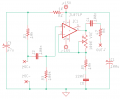
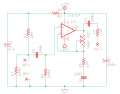
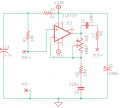
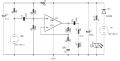
Hi. This is @Audioguru again's electret mic circuit (more/less). It runs on 9v and powers an electret mic putting the audio signal at Vcc/2 into the single sided op amp (TL072), and has a potential gain of 11.
1753047297118.png

If I wanted to use the same TL072 in a differential configuration at +/- 15v, what would I change? I shouldn't need to bias the input do I? I probably don't want 15v on an electret, something like 4-6v maybe?

Thanks!
 

Alec_t

Joined Sep 17, 2013
15,101
You would be running the TL072 at its maximum rated supply voltage. I wouldn't recommend that if you want the IC to have a long and happy life.
 

ericgibbs

Joined Jan 29, 2010
21,390
hi rp,
As the inputs and outputs are AC coupled, have you considered using just a single +15V supply?
E

Please post a diagram of your proposed differential circuit.
 

Ian0

Joined Aug 7, 2020
13,097
Hi. This is @Audioguru again's electret mic circuit (more/less). It runs on 9v and powers an electret mic putting the audio signal at Vcc/2 into the single sided op amp (TL072), and has a potential gain of 11.

View attachment 352982

If I wanted to use the same TL072 in a differential configuration at +/- 15v, what would I change? I shouldn't need to bias the input do I? I probably don't want 15v on an electret, something like 4-6v maybe?

Thanks!
Just leave out R2.
 

BobTPH

Joined Jun 5, 2013
11,463
Actually, to maintain the same frequency response, R3 should be changed to 50K.

But the low frequency cutoff is ridiculously low at 3Hz in the original circuit.
 

Ian0

Joined Aug 7, 2020
13,097
Actually, to maintain the same frequency response, R3 should be changed to 50K.

But the low frequency cutoff is ridiculously low at 3Hz in the original circuit.
50k/100nF gives 32Hz, but C5/R5 will be setting the low-frequency -3dB point at 72Hz (admittedly, C5/R5 only rolls the gain off as far as unity)
 

Ian0

Joined Aug 7, 2020
13,097
I was taught that where there are two time constants determining a roll-of characteristic, it was not a great idea to make them around the same value as it gives a 2nd order roll-off with a very low Q. It is better to have one of them determine the frequency response, and move the others a decade way where they have very little influence, and also that it was always better to have a film or NPO capacitor determine the frequency response, not an electrolytic.
 

AnalogKid

Joined Aug 1, 2013
12,043
"differential configuration" usually refers to the input circuit, but in your case I think you are referring to the power supplies. To modify the circuit for operation on dual supplies (+15 V, -15 V, and GND):

1. Delete R2.
2. Connect the bottom end of C8 to GND.
3. Connect the bottom end of R1 to GND.
4. Connect the bottom end of the mic capsule to GND.
5. Connect the bottom ends of C5, R100, and the LED to GND.
6. Add decoupling capacitors from both X1 power pins to GND.
7. Add another diode and 100 uF capacitor for the negative power input.

ak
 
Top