Why isn't this Op Amp saturated ?

Status
Not open for further replies.

Thread Starter

Xenon02

Joined Feb 24, 2021
504
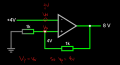
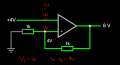
I'm a bit confused with how it works.
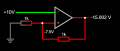
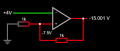
I don't know if the simulation is right and I don't know to be honest why it is saturated in negative.

Edit :
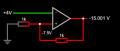
Saturated negative in the second picture.
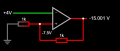
1659277707305.png
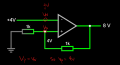
And it doesn't change the input into 4V dunno why. No matter if I change the input from 4V to 3V or 0V
 
Last edited:

Thread Starter

Xenon02

Joined Feb 24, 2021
504
Schmitt Trigger Hysteresis Calculations with Op Amps
I never did quite finish this but I suspect it will be useful for you think of it as a homework hint
I've read it.
But the math here doesn't show for which circuit it is exactly for. So I'm not sure.

Okay maybe I'll try to ask it in a different way.
This is a schmitt trigger as I see. But it looks like a very simple circuit. Looking at this one.

1659278703695.png

But you mentioned in your post that it should be saturated (digital output ?).
So why is it here 4V ? Is the simulation wrong ? Or Am I wrong ? And why if I saturate it then the voltage is negative.

1659278779609.png

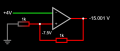
and when I change the voltage again to 4V the output stays in -15 V like it can't go back to 8V like before.

1659278819418.png

I'm sorry for being stubborn but I've searched some websites and I couldn't get the exact answear to this specific moment.
 

MrChips

Joined Oct 2, 2009
34,828
1659278703335.png

Let us assume that the supply voltages are +15V and -15V.
If the output is already at -15V, then your threshold voltage is -7.5V because of the 2-resistor voltage divider.

Forget about the sign. Pay attention to the actual voltage when compared with the threshold voltage.
Is the input voltage greater than or less than the threshold voltage?
Your input voltage at -IN has to fall below -7.5V for the output to switch to a positive output of +15V.

Once it switches, you have a new threshold voltage at +7.5V.
The voltage on -IN has to be greater than +7.5V in order to switch back again.
In other words you have hysteresis of 15V, (+7.5V) - (-7.5V).
 

BobTPH

Joined Jun 5, 2013
11,524
PS.

Why the Op Amp doesn't want to make +IN = -IN here ?:

View attachment 272629

It was saturated but 4V on the input is posible to have 4 V positive on the positive input but it stays negative dunno why.
Because that only happens when you have negative feedback. That circuit has positive feedback, which means if the output is too high, it will try to go higher. Real opamps will always go to one of the rails with this circuit. The simulator does not because it is simulating ideal behavior.
 

Thread Starter

Xenon02

Joined Feb 24, 2021
504
View attachment 272631

Let us assume that the supply voltages are +15V and -15V.
If the output is already at -15V, then your threshold voltage is -7.5V because of the 2-resistor voltage divider.

Forget about the sign. Pay attention to the actual voltage when compared with the threshold voltage.
Is the input voltage greater than or less than the threshold voltage?
Your input voltage at -IN has to fall below -7.5V for the output to switch to a positive output of +15V.
I thought that it would go back to this state :

1659279096545.png

Because at the beggining it could but now it can't ?

1659279118987.png

Oh and why it jumps from positive voltage to negative ?
 

MrChips

Joined Oct 2, 2009
34,828
Go back and read my post #24 which I have edited.
You have two threshold voltages, +7.5V and -7.5V.

The voltage at -IN has to go higher than +7.5V for the output to switch negative (-15V).
The voltage at -IN has to go lower than -7.5V for the output to switch positive (+15V).

Any voltage between -7.5V and +7.5V on -IN will not cause the output to change, i.e. a dead zone.
This is called hysteresis and in this example has a value of 15V.

A small amount of hysteresis is desirable because it prevents the output from oscillating on noise.
Hysteresis in analog comparator circuits is implemented by applying a small amount of positive feedback.

A common example of where hysteresis is applied is in your home heating and cooling system.
 

Thread Starter

Xenon02

Joined Feb 24, 2021
504
Go back and read my post #24 which I have edited.
You have two threshold voltages, +7.5V and -7.5V.

The voltage at -IN has to go higher than +7.5V for the output to switch negative (-15V).
The voltage at -IN has to go lower than -7.5V for the output to switch positive (+15V).
But I mean here why does it hold -7.5V ?
Why from this state :

1659279934243.png

It can't go back to this state :

1659279947070.png

You say that it is now switching between -15V and +15V.
But why it can't bo back to the point where it could bo back to 4V ? Because the only thing the Op Amp should to is change from -15V to 8V so why it can't do that and stays in this -15V and 15V

Like here :

https://tinyurl.com/224j9xvt - simulation

It just go up and down trying to make +IN = - IN
 

Thread Starter

Xenon02

Joined Feb 24, 2021
504
Go back and read all of my posts and those of others.

+IN = -IN is for negative feedback systems.
You have positive feedback. The output has only two states, +Vs and -Vs.
Hmm okey.
One more question. So the simulation here is wrong ?

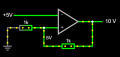
1659280608091.png

Because you have mentioned that it should be +Vs or -Vs. But here it is normal 10V (Vs is equal -15V and +15V).
 

dcbingaman

Joined Jun 30, 2021
1,065
Consider this, an Op-amp is nothing more than a very high gain amplifier that amplifies the difference between the positive input minus the negative input. Say the negative input is at +4V and the positive input is say 0V the output is (0V - 4V) * G. Say G is 10,000 this would be an output of -40,000 which is not possible so the output saturates at the negative supply rail of -15 V. The opposite is also true and without negative feedback this saturation situation will always occur.
 

crutschow

Joined Mar 14, 2008
38,526
Why the Op Amp doesn't want to make +IN = -IN here ?:

1659275530694.png


It was saturated but 4V on the input is posible to have 4 V positive on the positive input but it stays negative dunno why.
You have been given some confusing info.

To clarify, it is both the differential voltage and its polarity that determines the op amp output.

In the simulation the output is -15V, giving -7.5V at the positive input.
The negative input is +4V so the differential voltage is -10.5V (+input to -input), meaning the output stays negative.

You would need to change the -input voltage to greater than -7.5V (magnitude) to cause the output to go positive.

Make sense?
 

MrChips

Joined Oct 2, 2009
34,828
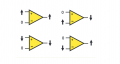
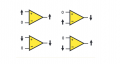
1659282513416.png

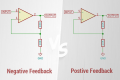
This diagram is throwing you off.
The arrows do not represent positive or negative voltages.
An upward arrow means rising voltage.
A downward arrow means falling voltage.

It would be best for you to ignore this diagram altogether.
 

Thread Starter

Xenon02

Joined Feb 24, 2021
504
FYI

Pay attention to how the input pins are connected.

View attachment 272644
May I also ask you one more question ?

I know that the simulation here is wrong :

1659282436510.png

But you also said that the polarity on the negative input doesn't tell you what is the output voltage


So why is the picture here telling that it tells ?

1659282708291.png

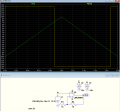
Also I don't know if this simulations is telling the truth but it shows the same :
1659282743722.png
 
Status
Not open for further replies.
Top