Using MAX038 to generate triangular waveform with 2MHz

Status
Not open for further replies.

Thread Starter

JackieChan

Joined Sep 17, 2017
50
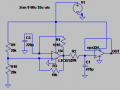
Asc file (modified) attached. You can download the 74HC model library and potentiometer model from the Yahoo LTspice User Group.
R1/C1 set the '2MHz' frequency and a trimpot sets the amplitude. The IC 5V supply will need to be very stable if you really need 1.22mV accurate to the second decimal place.
Hi Alec_t,
Now i want to make two circuits to generate triangular waveform. One from Bordodynov, one from you.
Because i am new in LTspice and i don't know so much. I have logged in Yahoo LTspice User Group and searched it, but it's hard for me to find it and put it in your circuit. Could you help me to send your circuit including the 74HC model library and potentiometer model? Thanks so much!

Best regards,
Jackie
 

Alec_t

Joined Sep 17, 2013
15,121
Here you go. Unpack the zip then put the 74HC.lib file and the potentiometer.sub file in LTspice's ....Documents\.....\lib\sub folder. Put the 74HC folder and the potentiometer.asy file in the .....Documents\.....\lib\sym folder or suitable sub-folders. This assumes you're using Win10 and LTspiceXVII.
 

Attachments

Thread Starter

JackieChan

Joined Sep 17, 2017
50
Here you go. Unpack the zip then put the 74HC.lib file and the potentiometer.sub file in LTspice's ....Documents\.....\lib\sub folder. Put the 74HC folder and the potentiometer.asy file in the .....Documents\.....\lib\sym folder or suitable sub-folders. This assumes you're using Win10 and LTspiceXVII.
Wow, thanks so much! !
 

Thread Starter

JackieChan

Joined Sep 17, 2017
50
I do not understand why you are not satisfied with the half signal. But then use +/- 5 volts power, and that operational amplifier, which I recommended (it will work with a total power of 10 volts). Otherwise, you will not get it.
Hi Bordodynov,
Thanks so much for your help.
Now i have one last question, your triangular generator principle is also Comparator+Integrator or others? Which capacitor or resistor i can change to change the frequency?

I knew not so much about circuits. Thanks for your help and your understanding.
Best regards,
Jackie
 

Bordodynov

Joined May 20, 2015
3,431
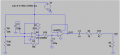
The frequency (period) is specified by the capacitor and the resistor which are connected to the inverting input of the comparator. Next is a simple integrator on the capacitor and resistor. The transmission coefficient (and the output amplitude) depends on the product of these elements. It is not an ideal integrator, but it has no emissions, like an integrator on an operational amplifier. The smaller the amplitude of a triangular signal, the more it has a more ideal shape.
 

Thread Starter

JackieChan

Joined Sep 17, 2017
50
The frequency (period) is specified by the capacitor and the resistor which are connected to the inverting input of the comparator. Next is a simple integrator on the capacitor and resistor. The transmission coefficient (and the output amplitude) depends on the product of these elements. It is not an ideal integrator, but it has no emissions, like an integrator on an operational amplifier. The smaller the amplitude of a triangular signal, the more it has a more ideal shape.
Thanks so much!!!
 

Thread Starter

JackieChan

Joined Sep 17, 2017
50
The frequency (period) is specified by the capacitor and the resistor which are connected to the inverting input of the comparator. Next is a simple integrator on the capacitor and resistor. The transmission coefficient (and the output amplitude) depends on the product of these elements. It is not an ideal integrator, but it has no emissions, like an integrator on an operational amplifier. The smaller the amplitude of a triangular signal, the more it has a more ideal shape.
Hi Bordodynov,
long time not to talk to you. Thanks for your help before.
Now i have one simple question. I want to use the voltage regulator TPS72325 to generate fest output -2.5v as negative voltage source for the amplifier.
Because i can't find the LTSpice model of it. So I have simulated it in LTSpice using the Psice model as the data sheet, but i don't know what is the problem.
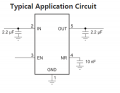
As below is the circuit from the data sheet.
upload_2017-12-1_20-27-7.png
I have selected the 5V for the enable pin. Input is -6V, and output is very strange. If the enable pin is open and not connected, the result is also wrong. Could you tell me what's my problem.
upload_2017-12-1_20-31-9.png
Thanks so much in advance!
 

Attachments

Bordodynov

Joined May 20, 2015
3,431
In my opinion this is not a docking of the order of the symbol and model pins. More correctly in my opinion it would be to build the symbol automatically. Then it can be adjusted so that it looks like a datasheet. I'll take this model on Monday.
 

Thread Starter

JackieChan

Joined Sep 17, 2017
50
In my opinion this is not a docking of the order of the symbol and model pins. More correctly in my opinion it would be to build the symbol automatically. Then it can be adjusted so that it looks like a datasheet. I'll take this model on Monday.
Hi Bordodynov,
Thank you for your wish to help me. I have fixed the problem.
upload_2017-12-2_11-55-8.png
Now i have one more practical question: my load is six amplifier of OPA354. They need +2.5V and -2.5V as voltage source. And there are no problems with the +2.5V. I have tried the TPS can generate voltage of -2.36V with the enable pin unconnected. And it can also supply two amplifier, but for six it didn't work.Is it the problem with current or the resistor divider 1k and 680R?
Thanks so much for your help.
 

Thread Starter

JackieChan

Joined Sep 17, 2017
50
In my opinion this is not a docking of the order of the symbol and model pins. More correctly in my opinion it would be to build the symbol automatically. Then it can be adjusted so that it looks like a datasheet. I'll take this model on Monday.
Hi Bordodynov,
Now i have used the circuit you have suggested to make a PCB board for generating the triangular waveform with 2MHz.
upload_2017-12-8_11-29-55.png
At first it works. But after i have tested the sawtooth waveform via oscilloscope after the comparator LTC6752 a few times, the comparator is going broken. I don't know why i test the signal can make the comparator broken. What's worse is, i have change the new LTC6752 as comparator in the PCB, and at first the output is not right. So i have to check the solder, and once more time to test. After a few times repeat like this, the comparator is once again broken. The character of broken is the output is directly 5V, not the sawtooth waveform between 0V and 5V.
I don't know what is the reason. Could you give me some advice? Thanks in advance.
 

Bordodynov

Joined May 20, 2015
3,431
Perhaps the comparator does not like the capacitive load. Or you use an oscilloscope with a 50 Ohm input impedance. I advise you to connect the oscilloscope through a 100 ohm resistor. Try not to short circuit the test points of the circuit.
 

Thread Starter

JackieChan

Joined Sep 17, 2017
50
Perhaps the comparator does not like the capacitive load. Or you use an oscilloscope with a 50 Ohm input impedance. I advise you to connect the oscilloscope through a 100 ohm resistor. Try not to short circuit the test points of the circuit.
Hi Bordodynov,
thanks for your advice.
I am sure i haven't short the circuit of the test point.
I am using DPO2024 Oscilloscope and directly using the probe to test the output of the comparator. As you advised i will test through 100Ohm later.
 

Thread Starter

JackieChan

Joined Sep 17, 2017
50
The frequency (period) is specified by the capacitor and the resistor which are connected to the inverting input of the comparator. Next is a simple integrator on the capacitor and resistor. The transmission coefficient (and the output amplitude) depends on the product of these elements. It is not an ideal integrator, but it has no emissions, like an integrator on an operational amplifier. The smaller the amplitude of a triangular signal, the more it has a more ideal shape.
Hi Bordodynov,
as you suggested i have designed the circuit for triangular waveform with 2MHz, +-50mV and it works. Thank you so much for your help.
But in the practical experiment of university the frequency with 2MHz is too high. So i have to change the frequency to 1MHz.
I know how to change it. But after changing the resistor and capacitor, the waveform generator works if i give directly a -2.5V as negative source for the six amplifier opa354.
But if i use the negative regulator to generate -2.5V. Before it works when R1=1010 Ohm and C5= 220pF. Now i have changed R1= 955 Ohm and C5 = 470 pF or R1=2033 Ohm and C5 = 220pF. The negative regulator works no longer and only generate +2.8V. It's wrong. And the output of triangular waveform generator is also wrong with +1.55v and +1.73v, not +-50mV. I don't know why. There is even no connection between the triangular waveform generator and the negative regulator.
Attached is my whole circuit.
Thanks in advance for your help.
Jackie
 

Attachments

Thread Starter

JackieChan

Joined Sep 17, 2017
50
The frequency (period) is specified by the capacitor and the resistor which are connected to the inverting input of the comparator. Next is a simple integrator on the capacitor and resistor. The transmission coefficient (and the output amplitude) depends on the product of these elements. It is not an ideal integrator, but it has no emissions, like an integrator on an operational amplifier. The smaller the amplitude of a triangular signal, the more it has a more ideal shape.
Hi Bordodynov,
i have solved by myself the problem as before.
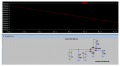
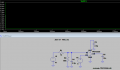
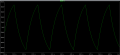
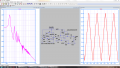
Do you know how can i make the waveform more like a triangular waveform. Now my waveform and circuit are as below, it works with 1MHz but not so good.
upload_2017-12-14_22-9-19.png
upload_2017-12-14_22-8-34.png
I think i can change a capacitor to make it better. But i don't know which one to which value is better. That means, more like a triangular waveform.

Thanks a lot for everything.
Jackie
 

Bordodynov

Joined May 20, 2015
3,431
Hi Bordodynov,
i have solved by myself the problem as before.
Do you know how can i make the waveform more like a triangular waveform. Now my waveform and circuit are as below, it works with 1MHz but not so good.
View attachment 141656
View attachment 141654
I think i can change a capacitor to make it better. But i don't know which one to which value is better. That means, more like a triangular waveform.

Thanks a lot for everything.
Jackie
You set the task of obtaining a triangular signal of small amplitude. My scheme did this. To obtain a larger amplitude, another electronic circuit is needed.
 

Thread Starter

JackieChan

Joined Sep 17, 2017
50
You set the task of obtaining a triangular signal of small amplitude. My scheme did this. To obtain a larger amplitude, another electronic circuit is needed.
See
View attachment 141682
Hi Bordodynov,
i want to obtain still small amplitude of a triangular signal. My goal is +-6mV, 1MHz, but i have used the resistor to divide the voltage to generate this signal. But in the experiment it works not and i can have only a strange signal, maybe because after the triangular signal generator i have six opa354 as summer and inverter. So i have to change the resistor to generate +-50mV, 1MHz. And it works and i can also use it.
Now there is only a problem, the waveform is not like a triangular wave, rather a waveform with curve. So i want to make it better, and i want to know which resistor or capacitor i can change. Because i have designed the PCB, so i can't change the design, only the value.

Thanks
Jackie
 

Thread Starter

JackieChan

Joined Sep 17, 2017
50
Hello,

Have a look at the signal on the - input of the LTC.
It is most likely a perfect triangle as it is used as integrator.

View attachment 141662

Bertus
Yes, i have seen it. But i can only use the output at "TRI" as my triangular signal, because i can't change the pcb design. So i want to know how to change the value of resistor or capacitor to make it better. Thanks.

Jackie
 

Thread Starter

JackieChan

Joined Sep 17, 2017
50
You set the task of obtaining a triangular signal of small amplitude. My scheme did this. To obtain a larger amplitude, another electronic circuit is needed.
See
View attachment 141682
The amplitude is not so important, rather the frequency and the waveform is very important. The amplitude can variable between minimal +-0.6mV and maximal +-100mV. The smaller, the better. The frequency is strictly 1MHz and waveform is triangular wave. But i have changed the value of resistor or capacitor to generate 1MHz and it did work. But the waveform is now with curve and not so good. So i want to make it better.

Jackie
 
Status
Not open for further replies.
Top