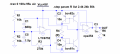
Why you suggested to using vc(variable capacitor) to adjust the frequency, don't you afraid of the frequency range will be too narrow to adjust, we normally use the VR to adjust.
Well, the only difference is that a low level triangle is added to the normal ADC input which is the input to be measured, and the output of the summer goes to the ADC. It's that simple of a block diagram.
So nothing changes but we add:
1. A low level triangle.
2. A summer, such as with an op amp.
Well, that's a dithered ADC input for ya
We need a uC and that is usually part of the ADC anyway, or should i say that the ADC is part of the uC anyway. The uC code does the oversampling and i dont see any way around that, but then again when we decide to oversample we are going to have an uC already anyway or something similar. An Arduino perhaps?
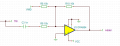
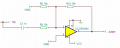
I believe that the inverting combiner has a better decoupling between the channels. You can connect only one input signal, and do not connect the second channel. The transmission ratio will not change. You can make different transmission factors for different channels (signals) by applying summation resistors of different values. In addition, you can use several channels.
If you need to amplify the total signal, then, in the case of an inverting adder and an additional inverting amplifier, you can set a smaller gain to one cascade and get a larger gain band.
I believe that the inverting combiner has a better decoupling between the channels. You can connect only one input signal, and do not connect the second channel. The transmission ratio will not change. You can make different transmission factors for different channels (signals) by applying summation resistors of different values. In addition, you can use several channels.
If you need to amplify the total signal, then, in the case of an inverting adder and an additional inverting amplifier, you can set a smaller gain to one cascade and get a larger gain band.
Thanks for your reply.
You mean the inverting summing amplifier is better? But then i need a additional inverting amplifier.
My problem is if i use a summing amplifier, i can't get a right sum of the two inputs. And i don't know why. Now i use OPA684 as adder.
Do i need a isolation between the inputs and the summing amplifier? Or which amplifier is better?
My task is to add a triangular waveform as dither signal to a voltage input and in this way i can make the performance of ADC better.
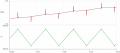
Now the two inputs are: one dither signal +-0.6mV with 2MHz, the other one normal input such as variable voltage between +-5V.
And now i try to use OPA684 as the summing amplifier, but now i can't get a right sum of the two inputs. I don't know why.
Can you help me to solve it? Thanks.
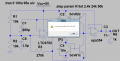
where VMID: 2.5V, VCC:5V, TRI: Dither, Adder: Output of sum.
I have a big suspicion that you did not set the opamp mode correctly. On a non-inverting input (for unipolar power), half the power is usually supplied (for example, from a resistive voltage divider).
I have a big suspicion that you did not set the opamp mode correctly. On a non-inverting input (for unipolar power), half the power is usually supplied (for example, from a resistive voltage divider).
Note the small capacitance of the capacitors. These containers remove the harmful effect of teeth on the vertices of the triangles. View attachment 136086
Hi Bordodynov,
thank you so much for your suggestion.
But now my biggest problem as #35 said, the result after the summing amplifier is not correct. I have tried many times, but i still don't know how to fix it. Could you help me about that?
JackieChan.
The operating amplifier you use is not fully compensated. This can cause problems. In my circuit, without small capacitors, the transient response is poor. I'm not sure that you can add picofarad capacitors to your opamp.
JackieChan.
The operating amplifier you use is not fully compensated. This can cause problems. In my circuit, without small capacitors, the transient response is poor. I'm not sure that you can add picofarad capacitors to your opamp.
Hi Bordodynov,
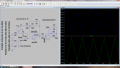
i want to try your circuit in LTspice. But i don't know so much about this software and i have met this problem. Do you know why?
Before i used TINA TI, but it is not so common.

 Facebook
 Google
 GitHub
 Linkedin