Facebook
 Google
 GitHub
 Linkedin

Hi, I'm a physics student, and I have a small problem for a lab that I have to solve.
Here is my problem: I must create a circuit which uses capacitors to gradually close a light, but in addition, we must pass the current from the capacitor which discharges by the base of an NPN transistor.
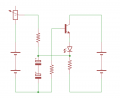
A picture of what I'm trying to do is below. The top circuit is the complete circuit tying everything together. The bottom circuit is the same, but divided into 3 parts which are not connected (the diodes present on this circuit are just used to show that it is a connection point between parts 1 and 2 or 2 and 3)
 The question I have for you is can you find the error in my circuit and how to fix it? Individually part 1 (left) works, it's just that the capacitors do not discharge. Part 3 (right) works entirely if you remove the transistor and put a wire in its place (causes the light to turn on infinitely).
Part 2 (middle) is just used to bring together the two parts to allow the capacitors to discharge in part 3 and allow the current from the battery of part 3 to turn on the light and gradually let less voltage pass the more the capacitor empties.
If you are interested in helping me, you can fix the problems my current circuit has by adding new components or removing some.
You can also create another completely different circuit that does what I need. the only thing is that I am limited to using NPN transistors, switches, 3V batteries, resistors, capacitors,
a bulb (led) and multimeters
Description of the image components:
-the black thing with a big N is the transistor
-the large black cylinders are the capacitors
Sorry if my circuit is not the clearest I am still a beginner in the subject.
Here is my problem: I must create a circuit which uses capacitors to gradually close a light, but in addition, we must pass the current from the capacitor which discharges by the base of an NPN transistor.
A picture of what I'm trying to do is below. The top circuit is the complete circuit tying everything together. The bottom circuit is the same, but divided into 3 parts which are not connected (the diodes present on this circuit are just used to show that it is a connection point between parts 1 and 2 or 2 and 3)
The question I have for you is can you find the error in my circuit and how to fix it? Individually part 1 (left) works, it's just that the capacitors do not discharge. Part 3 (right) works entirely if you remove the transistor and put a wire in its place (causes the light to turn on infinitely).Part 2 (middle) is just used to bring together the two parts to allow the capacitors to discharge in part 3 and allow the current from the battery of part 3 to turn on the light and gradually let less voltage pass the more the capacitor empties.
If you are interested in helping me, you can fix the problems my current circuit has by adding new components or removing some.
You can also create another completely different circuit that does what I need. the only thing is that I am limited to using NPN transistors, switches, 3V batteries, resistors, capacitors,
a bulb (led) and multimeters
Description of the image components:
-the black thing with a big N is the transistor
-the large black cylinders are the capacitors
Sorry if my circuit is not the clearest I am still a beginner in the subject.