Ib current for transistor saturation

Thread Starter

Homebrew1964

Joined Nov 22, 2024
125
Is there an easy way to know what value resistor is needed in the base lead of an npn transistor to saturate the CE junction?

i want to drive my transistor into saturation without going too far, i have googled it but they showed me a formulae which i'm trying to avoid since i'm crap at math.

my voltage at the base is 6v and my load in the emitter lead is 60mA, my supply voltage is also 6v
 

dl324

Joined Mar 30, 2015
18,222
Is there an easy way to know what value resistor is needed in the base lead of an npn transistor to saturate the CE junction?
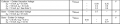
It depends on the transistor. For small signal US transistors, e.g. 2N3904, 2N2222, you can guarantee saturation with Ic/Ib=10 (the number is given in the datasheet). For European transistors like BC547, the ratio is usually 20.
1775688384953.png
1775688430370.png

1775688475466.png
1775688501759.png

a formulae which i'm trying to avoid since i'm crap at math.
There's no way to avoid the math.

For 2N3904, worst case Vbe(sat) is 0.95V at Ic=50mA. So
\( R_B=\frac{6V-0.95V}{6mA}=842Ω \)
Use 820Ω.
 

panic mode

Joined Oct 10, 2011
4,871
if the mode was common emitter, calculation and resistor value suggested by dl324 would be correct.

configuration you refer to is known as common collector. the downside is that output voltage is always lower than input. so you will be loosing up to 1V across that transistor even when it is in saturation.
you can get voltage drop across transistor lower (0.1V or so) but this requires higher voltage at the base (such as 7V or more). to stay within 0-6V bounds, you need to either make transistor a low side switch, OR... add one more PNP transistor o act as high side switch.
.
about base resistor value... you do not need base resistor in common collector configuration as long as load connected to its emitter is not drawing more than transistor can handle,
 

Thread Starter

Homebrew1964

Joined Nov 22, 2024
125
Thanks Dennis...i'll play with some numbers and worst case i'll just try different values untill my Vce is around 0.2v

For 2N3904, worst case Vbe(sat) is 0.95V at Ic=50mA. So
RB=6V−0.95V6mA=842Ω

where are you getting the 6mA figure from?
 

WBahn

Joined Mar 31, 2012
32,710
Is there an easy way to know what value resistor is needed in the base lead of an npn transistor to saturate the CE junction?

i want to drive my transistor into saturation without going too far, i have googled it but they showed me a formulae which i'm trying to avoid since i'm crap at math.

my voltage at the base is 6v and my load in the emitter lead is 60mA, my supply voltage is also 6v

SCHEMATIC!!!

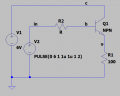
If the circuit is as you've described, and assuming no other components, then what you have is the following:

1775691618476.png

The R1 resistor is standing in for your bulb and is sized to draw 60 mA when there is 6 V across it. It's a crude model, but good enough for the current purpose.

In this circuit, you can't get the transistor into saturation because there is no way to forward bias the base-collector junction. The base resistor serves almost no purpose.

The highest voltage you can get the emitter voltage to is about 5.3 V (one diode drop below the base voltage). That means that the lowest you can get Vce to is that same diode drop, or about 0.7 V.

If the above circuit doesn't match your circuit, then don't make us guess -- show us the schematic for your circuit.

If you are going to work with electronics, you are going to need to do some math. That's just the way it is.
 

WBahn

Joined Mar 31, 2012
32,710
I am feeding the output square wave pulse at 6v pk to pk into the base of an npn transistor, (2n4401) and i need to get my Vce down to about 0.2v if possible
You can't, not if your collector is connected to 6 V (which, without a schematic, we don't know for sure whether it is or not, so we are having to use our crystal balls and guess).

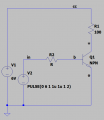
If you want to use the transistor as a switch, the connect the emitter to ground and put the bulb on the collector side of the circuit.

1775692049189.png

Now you can saturate the transistor.

The amount of base current it takes to do this is highly variable, even from one transistor to another of the same type. It also varies with temperature and other operating variables.

A commonly used rule of thumb is to get the base current to be at least 10% of the collector current when driving it into saturation. You can almost always use less than this, but this will ensure that you are in saturation for most small-signal transistors.

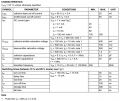
You need to refer to the data sheet for the transistor you are using for better information.

1775692387814.png

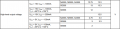
Notice that, at a collector current of 150 mA (so ~2.5x what you are shooting for), they don't guarantee that you can EVER get down to a Vce of 200 mV. They only claim it will be no more than 400 mV. But there's a pretty good chance you will be in the 200 mV range (or less) at 60 mA provided you have at least 6 mA of base current.

So what value base resistor do you need to get that current?

Assuming that Vbe is about 0.7 V, the voltage drop across R2 will be about 5.3 V. To get 6 mA flowing through it at the voltage drop, you would need

R2 = (6 V - 0.7 V) / (6 mA) = 883 Ω

You want at least 6 mA, so your resistor value needs to be less than 883 Ω. The next standard value down is 820 Ω.

You might try 1 kΩ, as you will likely find that it is sufficient to get your transistor far enough into saturation to suit your needs. It's not guaranteed, but if it does, it will save you a bit of base current.
 

Thread Starter

Homebrew1964

Joined Nov 22, 2024
125
Thank you WBahn...I'm actually feeding the transistor from the output of a ne555 timer chip, I'll have some time to play this weekend

Sorry I don't have a schematic

Thanks for your time
 

WBahn

Joined Mar 31, 2012
32,710
Thank you WBahn...I'm actually feeding the transistor from the output of a ne555 timer chip, I'll have some time to play this weekend
That's useful information, because it tells us that you are NOT driving with a square wave that is going up to 6 V, you just think you are (I'm assuming that your are powering your NE555 timer from 6 V as well -- I have to assume because I don't have a schematic for the circuit you are using).

NE555 Data Sheet

1775700144764.png

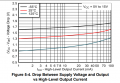
The NE555 has TTL outputs, and TTL outputs cannot pull all the way up to the positive rail. They typically can only pull up to about 1.3 V from the rail, even when their is no load on them.

1775700251497.png

As you can see, at 25°C, the typical drop at a current of 6 mA is just under 1.4 V, meaning that your output will only be about 4.6 V if you are powering it from a 6 V supply. Also, note that these graphs in data sheets are almost always just giving typical values. The minimum output can be as much as about 0.5 V below the typical, so YOUR circuit, even at room temperature, may barely get to 4 V.

Are you beginning to see why schematics of your circuit are SO important? They don't have to be fancy. They can be something thrown together in Paint. They can be hand-drawn sketches that you've taken a picture of with your phone.

When you tell us that you are driving the transistor base (via a resistor) with a 6 V signal, we have no choice but to assume that you are using a 6 V signal. But if you show us a schematic, many of use will spot immediately that you aren't because an NE555 has TTL outputs which have a significant drop from the power rail. We can spot that and give you a heads up, instead of you ending up chasing your tail because you are trying to apply what we have told you based on what we've had to assume you are doing and you are seeing something very different because what you are actually doing is very different.
 

MrChips

Joined Oct 2, 2009
34,630
Thank you WBahn...I'm actually feeding the transistor from the output of a ne555 timer chip, I'll have some time to play this weekend

Sorry I don't have a schematic

Thanks for your time
You need to show your schematics.

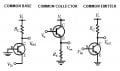
Here are the three configurations using an NPN transistor. We don't know what you have until you show it in a drawing. What you want is a COMMON EMITTER circuit.

NPN CB CC CE.jpg
 

dl324

Joined Mar 30, 2015
18,222
The complete equation in post #2 is:
\( \large R_B=\frac{V_{R_B}}{I_b}=\frac{6V-0.95V}{6mA}=842Ω \)

Datasheet for 2N4401 indicates using a factor of 10:
1775703656139.png
1775703691286.png

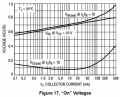
It doesn't give a Vbe(sat) for a current close to 60mA, so you need to use the typical graph:
1775703798348.png
so Vbe(sat) is closer to 0.75V for a typical device.

Here's some saturation data I posted in this thread. Didn't happen to have any 2N4401, but the results show that ratios other than what's specified in the datasheet will work. It just isn't guaranteed for all conditions.
 

Attachments

Last edited:

MrChips

Joined Oct 2, 2009
34,630
Even if you don’t know Vbe,
6 V / 6 mA = 1 kΩ

Even that would work because using Ic / IB = 10 is very conservative.

Working backwards, even if the control voltage is 4 V,
4 V / 1 kΩ = 4 mA
60 mA / 4 mA = 15

You are asking the transistor to operate with a DC current gain (beta) of 15 instead of 10 and that's not asking for too much.
 

LvW

Joined Jun 13, 2013
1,999
I really need to get some transistor theory into my head...i'll find a good text book for that.
In addition to the many practical tips you’ve received, you might also be interested in the DEFINITION of the saturation state.
The npn-transistor is in saturation when, in addition to the B-E junction, the B-C junction is also conducting in the forward direction.
This is the case when the voltage drop across the collector resistor Rc (due to a sufficiently large collector current Ic) is so large that Vc < Vb (Vbc>0).

As a result, the base current Ib increases remarkably , since it now consists of two parts (two forward biased pn junctions connected in parallel). The exact value of Ib is, however, not known.

Therefore, we make use of a rule of thumb which says that we should calculate the resistor Rb (in series with the switching voltage Vsw) for a base current Ib that is app. 1/10 of the desired collector current (Ib=~Ic/10): Rb=(Vsw-0.7)/Ib.
 
Last edited:

Thread Starter

Homebrew1964

Joined Nov 22, 2024
125
I gave up on the formula's and just faffed around with different values untill the circuit worked as desired lol

Thanks for all the replies though
 

WBahn

Joined Mar 31, 2012
32,710
I gave up on the formula's and just faffed around with different values untill the circuit worked as desired lol

Thanks for all the replies though
This is known as "design by happening", in which you make random changes hoping that, at some point and by some chance, something good just happens.

We have all resorted to it at one point or other, but if it is how you choose to routinely do things, don't expect to get very far, either in your ability to do things or your ability to understand what you are doing or why it is or is not working.
 

Thread Starter

Homebrew1964

Joined Nov 22, 2024
125
I'm
but if it is how you choose to routinely do things, don't expect to get very far, either in your ability to do things or your ability to understand what you are doing or why it is or is not working.
Lol I'll come to you guys if I get really stuck.
 
Top