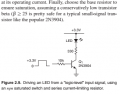
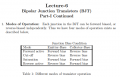
AOE still hasn't gotten this right (3rd edition):
The datasheet for every 2N3904 I've seen says to use a beta of 10:
BC547 says to use 20 for saturation mode:
I semantically disagree with this; I think you are reading into the datasheet something that is not actually there. A datasheet states the operating conditions for which the listed parameter values are guaranteed to be met or exceeded. This is not in any way an instruction. The 10:1 rule of thumb has been discussed many times around here. My vote is that it is a relic from the 1950's. Yes, Vcesat will be lower at 10:1 than at 20:1, but if you have a datasheet with charts it will show that Vce is even lower at 5:1, and really low at 2:1. Where does it end? Oh, the insanity!
Also, saturation is not a "mode". What we call saturation is a consequence of the circuit around the transistor, not a separate operating mode the transistor itself. When the collector is starved of the current it could move based on the transistors beta and base current, the beta of the transistor does not change. While the part is being forced to operate in a non-linear (ok, as linear as a transistor's beta actually is) manner, its internal physics still are trying. For the same base current, if you increase the available collector current, the transistor will "open up", returning to linear amplification.
Has anyone got a bunch of BC546/547/548/549 or 2N3904 on which they could measure Vce for various currents using Ib=Ic/20 or Ib=Ic/10?
Also it does seem strange that BC546/547/548/549 are available in three gain selected versions, yet the gain for use as a saturated switch is the same for all three versions.
Also it does seem strange that BC546/547/548/549 are available in three gain selected versions, yet the gain for use as a saturated switch is the same for all three versions.
Again, in the saturation condition the transistor is not operating as a linear amplifier, so the concept of "gain" does not apply.
My guess is that the 1:10 **condition** is being applied blindly because it's always been done that way, with no regard for why.
Rick - as you can see, we get distracted sometimes. If you like this kind of content, wait a while until you ask a question about opamp "gain". Bring popcorn.
Back on topic, check out the World Radio History archive. It is gigantic. Here is their bookshelf for the electronic hobbyist. In it are several layers of introductory books on electronic circuits, some with math and theory, some without. Browse around in there to find some at your level.
I don't know which manufacturer originally used a beta of 10 for measuring their saturation parameters at -- and that information is very likely lost to history -- but other manufacturers used the same value so that the performance of their products could be compared directly to their competitors. It thus became a defacto reference beta for reporting saturation parameters, particularly for small signal transistors (power transistors often use a lower beta, because their current gains in the active region often weren't much more than 10).
I'm not aware of any manufacturer ever claiming that a beta of 10 somehow defines when the transistor is in saturation. The transition from active to saturation is a smooth process that has no sharply-defined transition point.
From a designers standpoint, the practical definition varies depending on what is important for that particular application -- which is true in general about most things (or at least should be).
When using a transistor as a switch, the concern is often about limiting the power dissipation in the transistor, and so a maximum Vce voltage is often chosen. That used to commonly be something in the 200 mV to 300 mV range, and that is still pretty common, although many transistors can easily get below 50 mV. The drive circuit was then chosen that would make this happen. Often, that was done by choosing to force the base current to be at least one-tenth of the collector current that would flow if the Vce was zero volts. This was done in large part because that was a data point that most transistor data sheets had information on. But if the data sheet had more graphs available, it could often be seen that a beta of 10 was unnecessarily conservative and resulted in more base-emitter power dissipation than was really needed. Minimum power dissipation is often achieved with a somewhat higher forced beta in the 20 to 50 range, though some care needs to be taken at the higher values.
Yes - exactly THIS is the definition for saturation.
The large base current results from the fact that now the base-collector junction is forward biased (in addition to the base-emitter junction) and the current into the base is increased correspondingly.
Therefore, the small Ic/Ib ratio is the RESULT of (and a safe indication for) saturation (and not its cause!)
This is the background to the information found in many publications: B=10 or B=20.
(Whether the symbol B should be used in this operating mode is another question)
Yes, sometimes it's call forced-beta, since it's just the ratio of applied collector current to applied base current, and is not directly related to the actual transistor beta current gain.
My vote is that it is a relic from the 1950's. Yes, Vcesat will be lower at 10:1 than at 20:1, but if you have a datasheet with charts it will show that Vce is even lower at 5:1, and really low at 2:1. Where does it end? Oh, the insanity!
In this field, we all stand on the shoulders of giants. Are you claiming that you are more knowledgeable than these people and have the credibility to formulate a new "rule"?
Horowitz is claiming "β ≥ 25 is pretty safe" for 2N3904. I disagree and will stick with the conditions that the manufacturers, who I freely admit know more about their devices than I do, specify.
What do you call the modes of transistor operation? I learned them as modes. Don't have my text book handy, but here's something from Columbia University:
I learned "forward active" as simply "active" and "reverse active" as "inverted".

 Facebook
 Google
 GitHub
 Linkedin