Facebook
 Google
 GitHub
 Linkedin

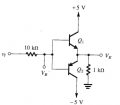
\(
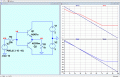
a. v_l=0V \\
v_l=0V => \text{Q1. Q2 is OFF} \\
V_E,V_B=0V \text{since no IC1 current flowing and drop across 1kOhm is 0V}\\
b.v_l = 3V; \\
\text{for Q1} \\
V_B - 0.7V = V_E \\
\text{for Q2} \\
V_{EB} = 0.7V => \text{Q2 OFF} - eq1 \\
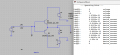
\text{Applying KVL to Base circuit of Q1} \\
3V - 10k\Omega*I_B - 0.7V - 1k\Omega*101I_B =0 - eq2 \\
I_B = 0.0207mA ; V_B = 3V - 10k\Omega*0.0207mA = 2.98V \\
c.v_l = -5V; \\
\text{Q1 is OFF} \\
\text{Q2 Active} \\
\text{Applying KVL to Base circuit of Q2} \\
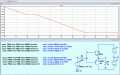
-101I_B*1k\Omega - 0.7V - 10k\Omega * I_B +5V = 0; \\
I_B = 4.3V/111k\Omega = 0.0387mA;
V_E = 0V - 101*0.0387mA *1k \Omega (I_E*\beta) => -3.91 V \\
V_B = -3.91 - 0.7V = -4.61V \\
d. v_l = -10V
\text{Q1 is OFF} \\
I_B = 9.7V/111k\Omega = 0.087mA; \\
V_E = 0V - 101*0.087mA*1k\Omega = -8.82V \\
V_B = -9.52V \\
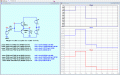
\text{Q2 is not active but saturation} \\
V_E = -5V + 0.2V = -4.8V \\
V_B = -4.8V - 0.7V = -5.5V \\
\)
After quite an effort i calculated the values, are my justifications correct for the states of Q1 and Q2 and the values?