Transistor sanity check for simple buzzer

Thread Starter

Robsco

Joined Mar 16, 2026
31
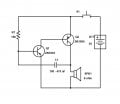
I need some help checking and explaining the attached circuit.

It basically doesn't work as expected, but after a bit of tinkering by swapping the collector/emitter on one or both transistors, it does work.

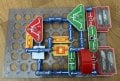
For context, this is a simple buzzer circuit (for doing morse code) my daughter is working on with her Hot Wires kit - when wired up, only the LED lights, and the speaker makes a short crackle when tapping the push button.

But turn either transistor upside down and it works nice and loud.

I'm about to replicate it on a breadboard with a bunch of my own components I have lying around, but would love some detailed explanation on how the transistors are working together, or rather, how they should be to make this work. Transistors have never been my strong point beyond working as a switch, and I assume this is setting up an oscillator for the buzzer?

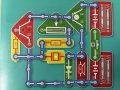
I took the 2 transistor parts apart and checked the wiring, which all LOOKS correct, according to the diagram on the part, ie emitter is pin 1 with the connector with the arrow.

The red NPN is an "S8050", the green PNP is an S9012.

Thinking back now a few of the other oscillator/tone generator experiments didn't work very well either, or at all, but yet other circuits using the transistors did, ie for switching, so it doesn't feel like the transistors are dead.

Thanks,
Rob
IMG_2986.JPG
 

bertus

Joined Apr 5, 2008
22,909
Hello,

It looks like there is a mistake at the left transistor.
The emittor is to the minus of the battery and the resistor goes from the base to the same point.
Is there a picture from the schematic in the instruction book?

Bertus
 

Thread Starter

Robsco

Joined Mar 16, 2026
31
To save any confusion, from the emitter of the NPN, the "4" connector is underneath the horizontal "3" connector and they're not connected.

So yes the emitter goes to ground, the base is connected to the buzzer (11) and then on to the LED.

There's no schematic in the booklet, just these pictures.
 

Thread Starter

Robsco

Joined Mar 16, 2026
31
I've also checked both transistors for basic conductivity from base to collector and emitter for the NPN, and vice versa for the PNP.
 

Thread Starter

Robsco

Joined Mar 16, 2026
31
Thanks, I've tripled-checked that, and most show the pins relative to the flat face anyway.

The pins are definitely "correct" in that they match the schematic of the plastic triangle pieces 51 and 52, ie, pin 1 is the emitter on the NPN with the arrow facing outwards.

It leads me to think maybe the wiring is just wrong, and the circuit as a whole should be different, but I don't know enough about wiring up a pair on NPN/PNP transistors to get an oscillation, and struggling to find a similar circuit online.
 

MrChips

Joined Oct 2, 2009
34,714
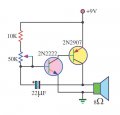
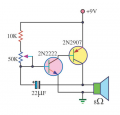
Your circuit looks similar to this one.

Morse code practice oscillator.jpg

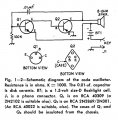
This is the same circuit which appeared in early editions of ARRL Handbook (only the connection to ground has been moved).

Morse code practice oscillator ARRL.jpg
 

Thread Starter

Robsco

Joined Mar 16, 2026
31
Thanks that's a huge help, so the wiring for the 2 transistors looks similar to the first circuit, I'll have to try experimenting with a capacitor instead of my piezo buzzer.

It's still baffling why inverting either transistor suddenly makes the circuit "work", or work better with actual sound, and not just the LED lighting.
 

MrChips

Joined Oct 2, 2009
34,714
Pay close attention to the polarity of the two transistors. One is PNP and the other is NPN.
You cannot interchange the transistors or swap the leads around and expect the circuit to work.
 

Thread Starter

Robsco

Joined Mar 16, 2026
31
The dilemma I have is that when this is connected, the LED lights, and there's a small crackle from the speaker, but no "beep".

However, switching the polarity of EITHER transistor, makes it work.

Swapping the polarity of BOTH transistors does not work.

The pins on the transistors themselves appear to be correct, ie, the flat faces of the transistors are facing each other in the picture. So pin 1 (emitter) of the NPN is at the bottom, and pin 1 of the PNP is at the top - both with the arrows on.

Is there anything else that could explain this bizarre situation? Before I simply reverse one of the transistors for good, and even then I'm unsure on which would be best to invert.

Other circuits in the kit appear to work when the transistors are acting as simple switches.

View attachment IMG_2987.JPG
 

MrChips

Joined Oct 2, 2009
34,714
The yellow Snap Circuits component marked 11 is not a capacitor. It is a piezo-electric transducer used for emitting sound. Replace this with a capacitor. The value of the capacitor in combination with the resistor value will determine the frequency of the tone generated by the loudspeaker. You need to select proper values in order to get a tone in the audible range.


Elenco Snap Circuit.jpg


The capacitor is connected between the base of the NPN transistor and the collector of the PNP transistor.
The resistor is connected between the base of the NPN transistor and +ve battery voltage (emitter of PNP transistor).

1773754447849.png
 

Thread Starter

Robsco

Joined Mar 16, 2026
31
Yes it is a buzzer, it's marked as a buzzer in the booklet, and included in most of these sound generator circuits.

I believe piezo buzzers generally behave as a capacitor in these types of circuits, in the range of 10nF - 100nF.

Swapping it out for any of the included capacitors (0.02uF, 0.1uF, 100uF), makes no difference, still a crackle from the speaker and LED lights up as before.

But again, simply swapping the polarity of either transistor makes it work as expected (without a capacitor).
 

MrChips

Joined Oct 2, 2009
34,714
Yes it is a buzzer, it's marked as a buzzer in the booklet, and included in most of these sound generator circuits.

I believe piezo buzzers generally behave as a capacitor in these types of circuits, in the range of 10nF - 100nF.

Swapping it out for any of the included capacitors (0.02uF, 0.1uF, 100uF), makes no difference, still a crackle from the speaker and LED lights up as before.

But again, simply swapping the polarity of either transistor makes it work as expected (without a capacitor).
You have two sound emitting devices in your circuit. You likely have one of two scenarios:

1) Your circuit does not oscillate. The transistor conducts and the LED lights up.
2) Your circuit oscillates at a very high frequency that is above the audible range.

Remove component 11. Wire the circuit with one resistor and the capacitor.
 

Thread Starter

Robsco

Joined Mar 16, 2026
31
It still emits no sound, unless I invert one of the transistors.

I'm half way through replicating it on a breadboard, which works as expected, so will now swap out the actual transistors in the kit - maybe one is just knackered.
 

Thread Starter

Robsco

Joined Mar 16, 2026
31
I replicated it all on a breadboard, and got the same outcome, ie no sound unless I reverse either transistor.

Though interestingly only if I use the 32 ohm speaker that's included in the kit - if I use a smaller impedance speaker (8 ohms) I get beeps all the time.
 

Thread Starter

Robsco

Joined Mar 16, 2026
31
The LED isn't in parallel to the buzzer.

And none of this explains why inverting a transistor makes the circuit work for my daughter?
 
Top