Facebook
 Google
 GitHub
 Linkedin

William passed away, a homeless man living with his dog in his car, seven years ago. He took his charged barrier technology with him to his grave making it a proprietary, patented concept which no one -- save, possibly, Tom Bearden -- was privy to. And Tom is dead. So, who do we have to confer with on resolving this mystery? No one but each other.
To this end, I have devoted myself over the past week (or so) experimenting with various derivations from one of his patent drawings, figure #1 (see attached):
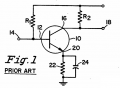
It didn't take long, a few minutes staring at this figure, for me to come up with my first derivation. This was necessary since adhering strictly to this figure yields nothing interesting.
Eventually, I went through a lot of transformations such that the latest version became quite simple composed of a single NPN transistor requiring the capacity for handling lots of current (selected from the manufacturer: Rohm), three coils shorting out each of the transistor's three terminals with each other, and an additional parallel short between the collector and the base which passes through a minimum resistance of 17.4k ohms. A sine wave generator feeds a mere milliamp into this circuit simulation at half a million cycles per second. In LTSpice, the schematic looks like this:
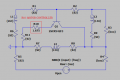
SJ are solder joints. R10 represents the resistance of a motor controller for a 2002, RAV4 EV, first gen, requiring 206A at full throttle acceleration, and 345V. 50A would be for cruising at 60 mph on level ground. This simulation takes 2.74 milli seconds to escalate to this full throttled, power level through this 1.675-ohm resistor.
The distortion harmonics of a parasitic oscillation, veering away from the sine wave generator's preset of 500k cps (give or take a few cycles), appears everywhere with variations of the rate of these oscillations at different locations within the circuit. But, more importantly, the collector of the transistor harbors an inversion of current indicating a negative sign convention of generating current. The sine wave generator also inverts its current into a positive sign convention indicating its status of absorption of current rather than its emission.
Probably nothing out of the ordinary occurs regarding production versus consumption of power. But since the polarity of sign inverts at these two locations, the mathematical result is an accumulation of power faster than its dissipation.
Whether or not any of this is physically replicated upon testing this simulation on the bench, I wouldn't know since that option is not presently open to me.
I'll provide the spice *.asc file, attached.
To this end, I have devoted myself over the past week (or so) experimenting with various derivations from one of his patent drawings, figure #1 (see attached):
It didn't take long, a few minutes staring at this figure, for me to come up with my first derivation. This was necessary since adhering strictly to this figure yields nothing interesting.
Eventually, I went through a lot of transformations such that the latest version became quite simple composed of a single NPN transistor requiring the capacity for handling lots of current (selected from the manufacturer: Rohm), three coils shorting out each of the transistor's three terminals with each other, and an additional parallel short between the collector and the base which passes through a minimum resistance of 17.4k ohms. A sine wave generator feeds a mere milliamp into this circuit simulation at half a million cycles per second. In LTSpice, the schematic looks like this:
SJ are solder joints. R10 represents the resistance of a motor controller for a 2002, RAV4 EV, first gen, requiring 206A at full throttle acceleration, and 345V. 50A would be for cruising at 60 mph on level ground. This simulation takes 2.74 milli seconds to escalate to this full throttled, power level through this 1.675-ohm resistor.
The distortion harmonics of a parasitic oscillation, veering away from the sine wave generator's preset of 500k cps (give or take a few cycles), appears everywhere with variations of the rate of these oscillations at different locations within the circuit. But, more importantly, the collector of the transistor harbors an inversion of current indicating a negative sign convention of generating current. The sine wave generator also inverts its current into a positive sign convention indicating its status of absorption of current rather than its emission.
Probably nothing out of the ordinary occurs regarding production versus consumption of power. But since the polarity of sign inverts at these two locations, the mathematical result is an accumulation of power faster than its dissipation.
Whether or not any of this is physically replicated upon testing this simulation on the bench, I wouldn't know since that option is not presently open to me.
I'll provide the spice *.asc file, attached.
Attachments
-
19.1 KB Views: 0
Last edited: