TR switching and receiving echo signals

Thread Starter

demir-ali

Joined Jul 13, 2024
321
Unintended coupling by means of the power positive and negative supply conductor resistance is quite common and is usually avoided by the addition of capacitors in parallel with the supply terminals of each active device.
The coupling problem is common enough that the capacitors are often included even without analysis, in many designs.
I did not see such capacitors in the experimental construction photos.
Hi MisterBill2 , in previous respond I published my new thread. Could you please have a look at ?
 

Thread Starter

demir-ali

Joined Jul 13, 2024
321
hi,
At 9600 Baud, assuming an 10 Bit Byte, that is approx 1/960 , approx 1mSec/byte.
So for your 20 Byte message, that is 20mSec.

In air sound travels at approx 340m/Sec, so in 20mSec that is a distance of 340m*0.02sec =6.8mtrs.

E
Hi Eric , since u were leading me you know I've been learning about active filters , amplifier topologies and more.
U also knew that I designed a T/R switch. I came up with good news , but first I need you to remember that I was using opas in dual packages but when I try to use 2 opas in same package it was not working.
Today , I set up the circuit I designed , with small changes , I made it working out with only 2 opas in same package.
Since there is a TR switch , I increased the transmitter Vpp to 12volts. I've tested with higher values but anymore higher than 12 is useless.
Now It works fine. I did not set up the comparator and Vref part yet.
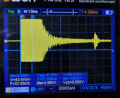
Here is the last result I got.
I am using 1 opa for active filtering , 1 for straight amplifying.
yenidevre.png
 

ericgibbs

Joined Jan 29, 2010
21,448
Hi demir,
That post #202 image is OK and is exactly what I would expect. :)
That ~2mSec 'ringing' of the transducer, after the TX pulse ends, requires a Suppression period in the Echo detection circuit or program.
It sets the limit to the shortest distance you can measure.

E
 

Thread Starter

demir-ali

Joined Jul 13, 2024
321
Hi demir,
That post #202 image is OK and is exactly what I would expect. :)
That ~2mSec 'ringing' of the transducer, after the TX pulse ends, requires a Suppression period in the Echo detection circuit or program.
It sets the limit to the shortest distance you can measure.

E
Shall I use a dampening resistor with switch again ? Or is there a better way ?
 

ericgibbs

Joined Jan 29, 2010
21,448
Hi demir,
The suppression method, I use, is in the processor program.
The program only starts testing for a valid echo 2mSec after the end of the TX pulse time.
The suppression period is also adjustable by the user.
Also, if an echo does not appear within the maximum distance time, the program registers no echo.
How do you plan to display the distance value?
E
 

Thread Starter

demir-ali

Joined Jul 13, 2024
321
Hi demir,
The suppression method, I use, is in the processor program.
The program only starts testing for a valid echo 2mSec after the end of the TX pulse time.
The suppression period is also adjustable by the user.
Also, if an echo does not appear within the maximum distance time, the program registers no echo.
How do you plan to display the distance value?
E
Ah I get you , I was using same method but I mean a dampening resistor would make that period shorter right ?
Actually , if I get the peak on mcu its okay for me but when I accomplish it , I may design a pcb for them circuit with a led display and make it a product.
You know the purpose was to learn so its more important the design part for me.
 

Thread Starter

demir-ali

Joined Jul 13, 2024
321
Hi demir,
The problem with a damping resistor is that it also damps any echo that occurs in the damping period.
You could experiment with an adjustable period.

For experiments and learning, the Arduino Uno is a good option.

E

Update;
Also the short range IR distance measurement project, you mentioned, check this link.
https://forum.arduino.cc/t/ir-sensor-for-short-distance-arduino/531003
Hi , i know resistor supress any echo incoming but i mean if we open the path of that resistor for first 1msec than disconnect it using mos so it only dampens the ring. Assuming we accept echos after 1.5msec it should work ?
 

Thread Starter

demir-ali

Joined Jul 13, 2024
321

Thread Starter

demir-ali

Joined Jul 13, 2024
321
Hi , this is my current schematics. In real circuit , I straight wired that input and output where is in red box.
Simulation does not give accurate output when it is straight wired in sim. Why is that ?
1725726886467.png
 

Attachments

Thread Starter

demir-ali

Joined Jul 13, 2024
321
Hi demir,
Look at the voltage levels when the link is in,
View attachment 331154
E

Added: Voltage print method, right click
View attachment 331156
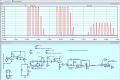
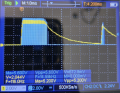
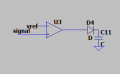
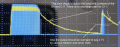
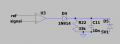
Hi eric, with variable Vref and comparator , I got corresponding output. But since my input is a sine wave , the output is square wave at comparator. I simply connected a diode and capacitor at output to straigten the output but this time , the deadzone at start affects it. I add the outputs. What would you suggest me to detect peak in arduino ?
In first figure , blue traces are comparator output , yellow is the output over capacitor.
Second figure shows comparator output.
Last figure shows the circuit I use.
capvar.pngcapyok.png
filter.png
 

ericgibbs

Joined Jan 29, 2010
21,448
Hi demir,
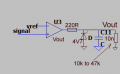
Replace the D4 with a 220R resistor and place a 4.7V Zener across C11, and make C11 a 10nF cap.
Also a 10k to 47k across C11
E

EG57_ 2062.pngfilter.png
 
Last edited:

ericgibbs

Joined Jan 29, 2010
21,448
Hi demir.
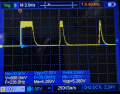
That looks a lot better.
That RX pulse could be detected by an Arduino pin set for High level detect or an Interrupt.
Do you have an Arduino PCB?
E
Why have you used a diode and not a 220R???
 

Thread Starter

demir-ali

Joined Jul 13, 2024
321
Hi demir.
That looks a lot better.
That RX pulse could be detected by an Arduino pin set for High level detect or an Interrupt.
Do you have an Arduino PCB?
E
Why have you used a diode and not a 220R???
Hi , I do have an arduino uno , thats how I create burst pulses.
The circuit you mention does not worked at all. I consider it is due to that comparator creates output voltage by sinking current.
I guess I forgot to add it to the schematics. Here is a updated schematic. Excuse me.1725819774700.png
 

Thread Starter

demir-ali

Joined Jul 13, 2024
321
Hi demir.
That looks a lot better.
That RX pulse could be detected by an Arduino pin set for High level detect or an Interrupt.
Do you have an Arduino PCB?
E
Why have you used a diode and not a 220R???
Hi eric , I also wonder that that deadzone I am having is normal to be large like that ?
 
Top