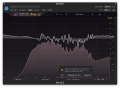
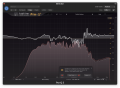
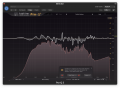
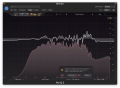
Ok, so I played hopefully the same thing 4 different times. 1st running through a 10 foot cable straight into my tube amp and through a Captor X into my sound interface Neck and Bridge Pickup separately. Then, I connected the buffer circuit with the 10pF cap to GND and recorded the same thing, neck and bridge.
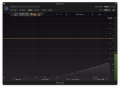
Then, I tossed on the Fab Filter Pro-Q EQ and did an EQ match on the buffer vs. the 10-ft cable. The bold white line in this screenshot is what EQ would need to be applied to the buffer's signal to match 100% the 10-ft cable.
First neck pickup, then bridge:
To my ears it sounds just as good as it did before putting the 10pF cap in there. Tomorrow maybe I'll have time to make the same recordings without the 10pF cap just to see visually if I can see any difference.
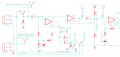
That peak isn't noise, it's an oscillation. Looking back at your circuit diagrams I still don't see any series resistance between the Op-amp output pin and the output jack socket. The op-amp is having to drive the capacitance of the cable, and that will change its phase shift and make it oscillate.
Looking back at your circuit diagrams I still don't see any series resistance between the Op-amp output pin and the output jack socket. The op-amp is having to drive the capacitance of the cable, and that will change its phase shift and make it oscillate.
Thanks for the link to the article. Lots of good stuff in there!
Yesterday we did try putting a resistor at location B with no change in the oscillation.
Speaking of which, what would be the proper location(s) to put a series resistor? A or B?
Also, the B side of the TL072 is another unity gain buffer that sends the signal to the MCP6002 op amp (two gain stages) where the signal gets amplified to send to the microcontroller for frequency evaluation. Would we need a series resistor at all in location C or D?
I thought that the filter solution was dubious, definitely a case of "For every complex problem there is an answer that is clear, simple, and wrong." As soon as someone connects a longer lead, the oscillation will come back at a lower frequency.
Someone once told me never to leave out the build-out resistor.
The MOSFET resistor is only sort-of similar. The op-amp situation prevents the capacitive load interacting with the dominant pole capacitance, resulting in a phase shift which means that the situation is no longer stable.
The MOSFET driver is not controlled by feedback, and we are interested in what is going on at a much higher frequency where track and lead inductances are significant. It prevents the Q of the resonant circuit getting too high, which may produce oscillations beyond the voltage that the gate oxide can withstand.
Yes. I probably just called it the wrong thing to simplify the term. My bad.
Thanks for the link to the article. Lots of good stuff in there!
Yesterday we did try putting a resistor at location B with no change in the oscillation.
Speaking of which, what would be the proper location(s) to put a series resistor? A or B?
Also, the B side of the TL072 is another unity gain buffer that sends the signal to the MCP6002 op amp (two gain stages) where the signal gets amplified to send to the microcontroller for frequency evaluation. Would we need a series resistor at all in location C or D?
How about on the output jack sockets?
It is only a capacitive load where one side of a capacitor connects to an op-amp output and the other side connects to a power supply (and that capacitor may be a cable).
Striving for ever lower output impedance is a dangerous thing to do, apart from the capacitive loading of cables.
Every guitarist has a short-circuited lead - it's the one at the bottom of the lead bag that they forgot to get fixed, or the one that their friend fixed who said he could solder. Low output impedance and short circuit = high fault current.
Also, it two pieces of equipment share the same earth, then whenever you connect a jack lead, a short circuit occurs when the plug goes into the socket.
It was relatively easy for me to put a 47R at positions A and C for testing. Would that work as well? Is a series resistor even needed for the B side of the TL072 since it's just feeding the gain op amp (MCP6002)? In the actual next PCB we could put the series resistor in position B.
With those series resistors and the 10pF cap I'm getting a close EQ to a 10-ft cable.
It was relatively easy for me to put a 47R at positions A and C for testing. Would that work as well? Is a series resistor even needed for the B side of the TL072 since it's just feeding the gain op amp (MCP6002)? In the actual next PCB we could put the series resistor in position B.
With those series resistors and the 10pF cap I'm getting a close EQ to a 10-ft cable.
Yes. R4 and R25. They used to be called "build-out resistors" as the go between the circuit and the outside world, and they take the bullet instead of the ICs when the customer does something daft. They also keep things stable. Don't forget that a unity gain circuit (because it has lots of feedback) is closer to instability than one with lots of gain, although it seems counter-intuitive.
Obviously, it forms a low-pass filter with the cable capacitance. Look up the capacitance per metre of your leads, and see what frequency it cuts off at.
Many moons ago when this thread was young (or maybe it was a previous thread) you mention some fantastic "super buffer" circuit that you found on YouTube.
I would suggest replacing it by the circuit in fig 3 of the AD application note, using a butch op-amp such as the AD8510 with 50mA drive capability. Then you have a proper buffer designed by proper people!
Many moons ago when this thread was young (or maybe it was a previous thread) you mention some fantastic "super buffer" circuit that you found on YouTube.
I would suggest replacing it by the circuit in fig 3 of the AD application note, using a butch op-amp such as the AD8510 with 50mA drive capability. Then you have a proper buffer designed by proper people!

 Facebook
 Google
 GitHub
 Linkedin