TL072 unity buffer circuit oscillating with floating input?

Thread Starter

joulupukki

Joined Sep 9, 2022
271
We've (@rpschultz) recently discovered that the buffer circuit we have in our upcoming tuner makes a nasty high pitch noise if the output is plugged into an amp and there's no input cable connected to an instrument/guitar. We're currently using the TL072 option (ignore the OPA1642 in the schematic). The oscillation/high pitch goes away as soon as we connect an instrument to the input jack.

We've tried adding a 560R in series to the output after C7 and before the output pin with no success.

Any idea what this could be and what we might be able to do to address it? We could obviously just tell people to keep a guitar plugged in, but it's likely people will hit this problem and not be thrilled with the high pitch. The buffer circuit is IC1A and output is through C7-C8 and to the output jack.

Edit: correct schematic now included:
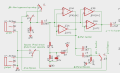
1746887982688.png
 
Last edited by a moderator:
Ian0

Joined Aug 7, 2020
13,117
I can't immediately see a problem, but I doubt that the op-amps would be too happy with their outputs joined together without buffer resistors. When the noise occurs, check with a scope to see if it is on the power supply. That would indicate that one op-amp was driving current into the other's output, because of different voltage offsets, or because it upsets the compensation.
 

Ian0

Joined Aug 7, 2020
13,117
Two from the same package in parallel would perhaps fare better than one from each, but definitely not recommended.

A TL072 doesn't have a great output current capability (±26mA) so why put two in parallel when you could buy an op-amp (OPA1678, for example) with twice the output current.
Another thing they don't like is capacitve loads, like cables, for instance. They need a buffer resistor to make the load look resistive at high frequencies.
 

Thread Starter

joulupukki

Joined Sep 9, 2022
271
The reason I said to ignore the OPA1642 in the schematic is that only one of the opamps will be installed but not both. The OPA1642 is there in the schematic so we can have the SMD pads on the board. When someone goes to build this kit, they will choose one or the other.

The buffer in this circuit is only using one half of the TL072.
 

Thread Starter

joulupukki

Joined Sep 9, 2022
271
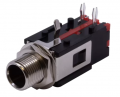
A jack with a shorting switch when no plug is inserted is always a good idea.
Yeah, we've been using these because they snap into place really well on the PCB and make it so it's easy to be perfectly aligned when installing them. I haven't been able to find a shorting switch version.

1746883323746.png
 

Thread Starter

joulupukki

Joined Sep 9, 2022
271
Another thing they don't like is capacitve loads, like cables, for instance. They need a buffer resistor to make the load look resistive at high frequencies.
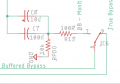
Are you talking a resistor in-line with the input signal or a pull-down resistor, like what we have with RPDI (input pull-down resistor) and R1 + R2? Doing circuit simulations of this circuit in LTspice, I'm seeing that the input AC impedance is 1MOhm.
 

schmitt trigger

Joined Jul 12, 2010
2,056
The reason I said to ignore the OPA1642 in the schematic is that only one of the opamps will be installed but not both. The OPA1642 is there in the schematic so we can have the SMD pads on the board. When someone goes to build this kit, they will choose one or the other.
Thanks for the clarification, makes perfect sense.
 

Thread Starter

joulupukki

Joined Sep 9, 2022
271
I should also mention that the PCB that we're experiencing this problem doesn't even have the OPA1642 pads. I should have posted the older schematic that doesn't have that. Sorry for the confusion there. I know a shorting input jack would solve the issue, I'm just wondering if there's something else that could be done to help prevent it w/o needing to go to a shorting input jack?

Edit: Even with a shorting jack, it's possible that someone would leave the guitar cable plugged in without plugging it into a guitar. That'd make the oscillation noise start happening.
 

Ian0

Joined Aug 7, 2020
13,117
Are you talking a resistor in-line with the input signal or a pull-down resistor, like what we have with RPDI (input pull-down resistor) and R1 + R2? Doing circuit simulations of this circuit in LTspice, I'm seeing that the input AC impedance is 1MOhm.
In series with the output.
 

MisterBill2

Joined Jan 23, 2018
27,360
In addition, look at the input to that unity gain buffer. ALL I SEE is a two megohm resistor, so the output is almost floating. Keep in mind that most simulators work in a perfect world with no open-input coupling. Try 10K instead of that 2 meg resistor.
 

Thread Starter

joulupukki

Joined Sep 9, 2022
271
In series with the output.
You're suggesting adding a resistor like this (R13)? We did try adding a 500R there last night after scratching out the PCB trace between RPDO and Pin 7 of the bypass type relay. No difference in behavior.

1746884773337.png
 

MisterBill2

Joined Jan 23, 2018
27,360
I just went back and looked at the circuit again. You appear to have two totally different opamps with the outputs tied together. Then I realized that it was a case oof one OR the other. THAT is OK. The amp is feeding a very capacitive load at unity gain. That is often a challenge to stability. At one time it was impossible to have an opamp be stable feeding a large capacitor, and also stability at unity gain was sometimes a challenge. Also, I see no power connection and no power feed bypass. Usually there is an unexplained reason that the bypass capacitors are there. Often it is done to prevent instability, such as oscillation.
 
Top