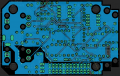
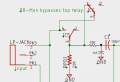
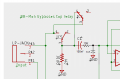
All the digital stuff is on the lower part of the board (JST connector and 5v regulator, etc). We separated the GP there to separate the digital and analog grounds. They eventually come together at the DC jack, star pattern.
According to AI:
The highest frequency a guitar can produce typically ranges from about 5 kHz to 15 kHz, with some harmonics and overtones potentially reaching up to 15 kHz, according to Neural DSP. However, the most common and practical frequency range for a guitar is generally considered to be from around 80 Hz to 5 kHz.
According to AI:
The highest frequency a guitar can produce typically ranges from about 5 kHz to 15 kHz, with some harmonics and overtones potentially reaching up to 15 kHz, according to Neural DSP. However, the most common and practical frequency range for a guitar is generally considered to be from around 80 Hz to 5 kHz.
Ok, agreed that a guitar wouldn't be creating something as high as 16Hz on its own. Something like a 4.7k or 7.5k paired with a 1nF would theoretically keep the audible hearing range untouched. Well, I can't hear past 16Hz anymore anyway.
What make is your TL072? Back in the 1990's when I used to work in professional audio, we always insisted in Motorola or Texas TL072s, because the SGS-Thomson ones were not unity-gain stable.

 Facebook
 Google
 GitHub
 Linkedin