TL072 audio buffer being loaded down by other gain stage opamp?

Thread Starter

joulupukki

Joined Sep 9, 2022
271
I'm working on a circuit and wondering if what I'm seeing is what I should expect.

I'm powering a TL072 with an audio signal with the opamp running at 9V. Then, I'm passing the output of that out to my guitar amplifier. At the same time, I'm feeding a MCP6002 opamp the same input signal and it has a couple of gain stages to then feed it into an ESP32 GPIO.

What I experienced earlier today is that my guitar signal sounded nice and bright directly plugged into my amplifier but when I plugged it into this circuit, the sound got noticeably darker and lost a little bit of volume and high end.

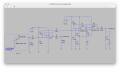
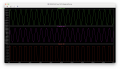
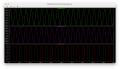
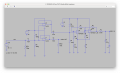
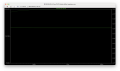
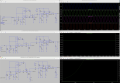
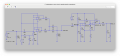
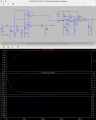
Here's the circuit (the plot in the middle is the Audio_OUT and going to my guitar amplifier):

1745120991407.png
1745121023790.png

Is that to be expected? Would the other part of the circuit after the 470nF coupling cap somehow loading down my signal?

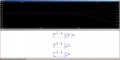
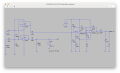
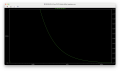
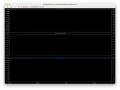
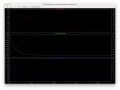
I wired in the other half of the TL072 as another unity buffer to feed the MCP6002 and then my Audio_OUT seemed to be normal. Since they are both opamps, I thought I would be able to use just one side of the TL072. Am I missing something? Here's the way I ended up wiring it up in my actual circuit board that seems to have no problem (for reference):
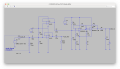
1745121198429.png
1745121218200.png
 

Ian0

Joined Aug 7, 2020
13,117
Your problem is the input impedance of the circuit.
You have an input impedance of just under 50k (100k, 100k and 1Meg in parallel). Most guitar amps have 1Meg. The ideal is about 220k.
The pickup is modelled as 6k series resistance and 6H inductance. The cable capacitance is modelled as 220pF
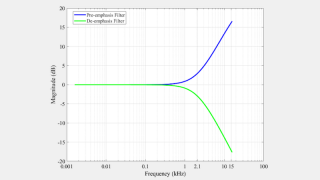
Screenshot from 2025-04-20 06-39-30.pngGreen is 50k, blue is 1Meg and red is 220k.
You can see that the interaction between the pickup inductance and the cable capacitance causes a big peak in the treble with 1M, which gives it a bright sound.
50k attenuates the treble and removes the peak.
220k is about neutral.
 

LowQCab

Joined Nov 6, 2012
5,101
C-2 and C-4, don't need to be anywhere near that large,
unless maybe this is for a Bass-Guitar or Keys.

~100Hz is the absolute lowest-Frequency that these RC-Networks, ( Input-Filters ),
need to pass for a standard 6-String-Electric-Guitar-Stomp-Box.
Most commercial Stomp-Boxes start Rolling-Off at around ~200Hz or sometimes even higher.

Bass-Frequencies are generally considered "unwanted-Noises" from an Electric-Guitar,
and can seriously "mess-with" what an "Effects-Box" is trying to achieve.

You don't want Low-Frequency "Noise" causing
Intermodulation-Distortion, ( IM-Distortion ), of Higher-Frequencies.

"IM-Distortion", "can be", very desirable when caused by Frequencies, ( Notes ),
that the Guitar is normally designed to produce,
the lowest of which is ~82Hz, or "E-2",
( if the Guitar is not "Tuned-Down" for special effects ).
But when it comes-down-to creating an excellent sounding "Final-Mix",
each Instrument needs to have "It's-own-Space" in the Mix,
and not "stomp-on" any of the other Instruments, ( like the Bass-Guitar ).

That final excellent "Tone" that You may be able to create while practicing,
may sound like warmed-over-crap when put into the context of an entire Band playing together.

Musicians tend to have some rather strange, ( for a Recording-Engineer ), vocabulary for describing
what an Instrument "Sounds-Like".
When You say it sounds "Dark" or "muffled" that may-well actually be too much Bass in the "Tone",
rather than the High-Frequencies being excessively Attenuated, or Rolled-Off.

You don't need 2-Gain-Stages,
You currently have a Gain of around 600X going into your Computer-Input,
with a ~5-Volt Power supply, You are sending your Computer a HARD-CLIPPED-SQUARE-WAVE at all times,
I'm guessing this was not your original intention.

And, 330R is just about the heaviest-Load that the MCP600X can comfortably deal with,
it will get Hot pushing that much unnecessary Current.

Why do You think that You "need" a ~one-half uF Capacitor on the Input to each Stage ????

Did You calculate what this amounts to as far as an Input-Filter ?

Did You calculate whether or not your TL072 could easily drive the Input-Resistance that You chose ?

The TL072 is an "Old-Skool" Low-Noise, Audio-Op-Amp that must have a
fairly High Power-Supply-Voltage to not be
trouble-prone and clip like crazy, and become somewhat unstable.
I would pick a much more modern Op-Amp for your application,
You don't need to be too concerned about Low-Distortion, but Low-Noise is always nice.
The TL072 is an excellent Audio-Op-Amp, but only when it has close to a ~20-Volt-Split-Power-Supply.

I also don't think the MCP600X is a particularly good choice either,
but for different reasons than the TL072.
.
.
.
 

Thread Starter

joulupukki

Joined Sep 9, 2022
271
Thanks for the comments so far. Sorry, I should have explained more. This is for a tuner that is running on an ESP32 using a zero-crossing algorithm. The signal going to the ESP32 (marked as GPIO_18) is shown in the bottom plot and clipping is exactly what I want there because the zero-crossing algorithm actually works a LOT better than with a clean signal. That part of the circuit is working perfectly.

In Buffered Bypass mode the audio actually going to the guitar amplifier is the plot in the middle, marked as Audio OUT on the schematic. The idea here is to do the least amount of coloring as possible to the input signal and just be a unity gain to convert from high impedance to low impedance.

@Ian0 the RPDI (pull-down resistor) should set the input impedance that the guitar sees to 1 Megaohm, exactly the same as what most guitar amplifiers use. I’ve tested this with my multimeter and it seems to be working great. Or, am I missing something? The circuit I’m using for the buffer starts outside of that dashed box on the left, starting with that 1 Meg resistor.
 

BobTPH

Joined Jun 5, 2013
11,488
In the original circuit there is a second load of 100K || 220K bringing the input impedance down to 28K. With the 6K output impedance and the 2K input resistor this gives us a divider with 8K and 28K so the signal is reduced to 28/36 or 78% which about what we see in the plot.
 

Thread Starter

joulupukki

Joined Sep 9, 2022
271
In the original circuit there is a second load of 100K || 220K bringing the input impedance down to 28K. With the 6K output impedance and the 2K input resistor this gives us a divider with 8K and 28K so the signal is reduced to 28/36 or 78% which about what we see in the plot.
So by using the 2nd TL072 as a unity gain buffer, that prevents that 28K load Being seen by the guitar?
 

Thread Starter

joulupukki

Joined Sep 9, 2022
271
I guess I must not understand this well enough. Using both sides of the TL072 and plugging a guitar cable into the circuit, I measure 1M resistance, the same as what my guitar amp has. I thought the input impedance is determined by the resistor that I have in the RPDI position. what am I missing?
 

Ian0

Joined Aug 7, 2020
13,117
@Ian0 the RPDI (pull-down resistor) should set the input impedance that the guitar sees to 1 Megaohm, exactly the same as what most guitar amplifiers use. I’ve tested this with my multimeter and it seems to be working great. Or, am I missing something? The circuit I’m using for the buffer starts outside of that dashed box on the left, starting with that 1 Meg resistor.
Indeed you are missing something.
C1 is effectively a short circuit at the frequencies you are interested in, so for AC signals R1 and R2 are in parallel with RDP1.
Of course, your multimeter will read 1Meg, because it is measuring the DC resistance, not the impedance.
 

schmitt trigger

Joined Jul 12, 2010
2,056
It is a good thing that you used the spare opamp for something useful.
Just a reminder;
Unused opamps shouldn’t have their inputs floating. Tie the inverting input directly to its output and the non inverting to ground.
There is an excellent TI app note explaining all of this.
 

Thread Starter

joulupukki

Joined Sep 9, 2022
271
Indeed you are missing something.
C1 is effectively a short circuit at the frequencies you are interested in, so for AC signals R1 and R2 are in parallel with RDP1.
Of course, your multimeter will read 1Meg, because it is measuring the DC resistance, not the impedance.
Ok, DC resistance, that makes sense. How does one measure impedance?
 

Ian0

Joined Aug 7, 2020
13,117
Ok, DC resistance, that makes sense. How does one measure impedance?
Use a signal generator, and place a known resistor in series with the output. Measure the signal on an oscilloscope and note how much AC voltage amplitude and phase changes when you connect the input to the amplifier. Then you can calculate it from the value of the resistor. If the voltage drops to half its original value and remains in phase, then the input impedance is resistive and is the same value as your test resistor.
However at audio frequencies, measuring it will just confirm that it is pretty close to the calculated value.
 

Thread Starter

joulupukki

Joined Sep 9, 2022
271
In LTspice, is this the right way to calculate input impedance?

If I change the pull down resistor to 2Meg, use both op amps in TL072, and change R1 and R2 to 2Meg each, it looks like the input impedance jumps up to 665K, right?

1745163455226.png
1745163470539.png

...and if I measure/calculate the output impedance of the TL072 going to my amp, it's getting close to 0...

1745163588640.png
1745163597070.png

Is that the right way to calculate with LTspice?
 

Thread Starter

joulupukki

Joined Sep 9, 2022
271
Ok, I did a bit more digging and using the AMZ Super Buffer as a reference, what if I were to change my circuit like this? The input impedance is now at 1 Meg and the output impedance at 0. Is it fine to siphon from the low impedance side to connect with the 5V MCP6002 driving my ESP32 GPIO pin (ADC) for pitch detection ... and at the same time allowing Audio OUT to my guitar amp (or other pedals "down the line")?

C5 I had at originally 470nF, but would it make a difference in this case to change it to 100nF?
1745189126775.png
 

sghioto

Joined Dec 31, 2017
8,634
Is it fine to siphon from the low impedance side to connect with the 5V MCP6002 driving my ESP32 GPIO pin (ADC) for pitch detection ... and at the same time allowing Audio OUT to my guitar amp (or other pedals "down the line")?

C5 I had at originally 470nF, but would it make a difference in this case to change it to 100nF?
Yes for the ESP
No for C5.
 

Thread Starter

joulupukki

Joined Sep 9, 2022
271
Thanks @sghioto!

Looks like changing C3 to 100n changes the HPF going into the MCP6002. Leaving it at 470n seems better.

Here it is with 470n:
1745196645238.png1745196650962.png
And here's C5 at 100nF:
1745196714877.png

Probably not much difference for guitar/instrument signals, but at least I understand it a little better.
 

Thread Starter

joulupukki

Joined Sep 9, 2022
271
What's the reason for U5 in parallel with U1?
According to the AMZ Super Buffer documentation (https://www.muzique.com/lab/superbuff.htm) it:
...parallel opamps ... boost the output drive.
I figure, we already have a dual op amp chip (because the TL072 is so common), that we might as well use it. Is there a detriment to doing that? Seems like it'd work better if it used both opamps in the chip. But, I could be wrong, and willing to admit that. :)

Thoughts?
 

sghioto

Joined Dec 31, 2017
8,634
If you needed the extra drive.
In this case I would use U5 as a separate buffer for the MCP6002. Connect the output of U5 directly to C5
Eliminate connection from R4 to R5.
Also why C4 (10uf) in parallel with C3?
 

Thread Starter

joulupukki

Joined Sep 9, 2022
271
If you needed the extra drive.
In this case I would use U5 as a separate buffer for the MCP6002. Connect the output of U5 directly to C5
Eliminate connection from R4 to R5.
Also why C4 (10uf) in parallel with C3?
Using the 2nd opamp in TL072 (U5 - forgot to renumber this) is what we have previously been doing.

C3 and C4... are you suggesting to just do it like this?

1745201482853.png
 
Top