TL074 Op amp normal, expected heat amount?

Status
Not open for further replies.

Thread Starter

synthlove

Joined Jun 4, 2025
6
I have two TL072 chips, that seem to run warmer than I thought they would. I'm trying to figure out if my results are typical.

In both chips, supply is +/- 15V. Each has two 0.1µF MLCCs, configured from + to GND, and - to GND, right next to the power pins. The power source rails have a couple fat electrolytics across them as well, and seems pretty quiet according to my scope. In other words, "normal" power. Signals being buffered are audio frequencies and slower, down to DC. Input signal maxes out at about 5Vpp. I am either driving nothing (for testing), or, driving a 10KΩ+ load, so, not driving very much. These are DIP-8s soldered to PCBs. Temperatures observed with a FLIR thermal imager, and then again separately with a laser temperature thermometer.

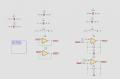
1st chip, configured as two separate 1:1 buffers. This chip runs at about 155F when driving nothing, and about 160ish when driving 10KΩ.

2nd chip is configured as two separate inverting amplifiers, gain of 2.2, and I do have a 22pF capacitor straddling the feedback resistor to in theory stop oscillations. This chip runs at about 165F when driving nothing, and almost 170F when driving 10KΩ.

I was under the impression that driving such light loads wouldn't create much heat at all above ambient. I have also tried LM833 and SA5532, with very similar heat results to within 10 degrees of each other. So are those just normal and expected temperatures for standard op-amp work?

(Apologies I typed TL074 in the title instead of TL072)
 

WBahn

Joined Mar 31, 2012
32,777
It would really help if you drew a schematic instead of trying to explain your circuit is words.

The first thing to look at, very carefully, is whether you have the correct pinouts. Be sure that you are looking at the pinout for the exact manufacturer and package that you are using.

If so, measure the quiescent current draw and compare that to the data sheet values?

Also, consider where you got the parts from -- was it a reputable dealer? If not, they might be counterfeit parts and who knows what happens to be inside that package.
 

MisterBill2

Joined Jan 23, 2018
27,362
The circuits shown do not appear to have any flaws. BUT we see nothing as a load or as the input.
My choice would be + and - 12 volts for the supply voltages.
A scope image of the input and output might reveal something that has been overlooked.
 

MisterBill2

Joined Jan 23, 2018
27,362
I am guessing that there is both a language issue and an understanding issue relative to this project. I doubt very much that the TS understands the circuit at all, and has no idea as to how it functions, or why any adjustment is required.
This particular scheme requires adjustment in order to function at all. And while it can provide full-duplex communication between the ends, it is not adequate to serve as an actual intercom. It has no output stage to drive a speaker nor adequate gain for most cheap microphones.
 

BobTPH

Joined Jun 5, 2013
11,488
Your question seems to be “is this heating normal?” The answer is no.

If everything you say is correct, there is no way the chips are producing that much heat.

Look for an error in wiring it. If you want help, post pictures good enough for us to determine the connections.
 

schmitt trigger

Joined Jul 12, 2010
2,056
Your question seems to be “is this heating normal?” The answer is no.

If everything you say is correct, there is no way the chips are producing that much heat.

Look for an error in wiring it.
Either that, or that these are defective devices being sold on Ebay, Alibaba, Amazon or worse online vendors.
 

Thread Starter

synthlove

Joined Jun 4, 2025
6
Thanks everyone for insights. I wasn't sure if the heating was normal and expected, it appears it is not. I'll double check all of my physical work. Thank you!
 

MisterBill2

Joined Jan 23, 2018
27,362
So now the big question: what are the IC devices driving??? To produce heat, current must flow. The idle state current of those devices is quite low, not nearly enough to produce heat to cause such a temperature rise. UNLESS you are operating them in a "HARD" vacuum, so that there is no air to conduct away the small amount of heat produced.
Have you checked the pin voltages?? Have you verified that the the devices are amplifying correctly? One suspect would be physical contamination with a conductive substance.
All voltage measurements should use the DC supply negative pin as the reference point.
One last guess would be that the ICs are inserted in the sockets backward so that pin 4 gets the +15 volts and pin 8 gets the negative 15 volts. THAT condition will result in overheating.
 

Thread Starter

synthlove

Joined Jun 4, 2025
6
So now the big question: what are the IC devices driving??? To produce heat, current must flow. The idle state current of those devices is quite low, not nearly enough to produce heat to cause such a temperature rise. UNLESS you are operating them in a "HARD" vacuum, so that there is no air to conduct away the small amount of heat produced.
Have you checked the pin voltages?? Have you verified that the the devices are amplifying correctly? One suspect would be physical contamination with a conductive substance.
All voltage measurements should use the DC supply negative pin as the reference point.
One last guess would be that the ICs are inserted in the sockets backward so that pin 4 gets the +15 volts and pin 8 gets the negative 15 volts. THAT condition will result in overheating.
Thank you! They appear to be amplifying correctly, the resulting voltages appears as expected, and the wave shape does not appear to be deformed just looking at the scope with the commoner's eye (not an overly accurate scientific measurement). Just getting hot.
Power is coming from a good Siglent power supply but it's coming across about 4 feet of wire, maybe I need to decouple the circuit even more than what's indicated on my schematic?
I do have a mess of uncleaned flux, I'll attempt to remove as much of that as possible and give it another go.
What's it driving? A few different tests are performed, all with about the same heat results: a) nothing b) a scope c) a 10K resistor to ground
Also you've mentioned +/- 12V as your preference over +/-15V, may I ask what informs the preference for that voltage?
Thanks!
 

MisterBill2

Joined Jan 23, 2018
27,362
My preference of +- 12 volts is based partly on battery availability, but also because that voltage is commonly easily available in automotive applications. Consider that we got the+- 15 volts standard when those were the voltages required to get linear opamp operation within the +- ten volt range used for analog signals.
So they are personal preferences without a scientific proof that they are better. And current op-amp technology does not require as much headroom as was needed 30 years ago.
And one more thought is that there might be a high frequency oscillation present resulting in the amplifiers working much harder than in the intended mode. HIGH FREQUENCY amplification does dissipate more power.
 

dl324

Joined Mar 30, 2015
18,289
you've mentioned +/- 12V as your preference over +/-15V, may I ask what informs the preference for that voltage?
Output voltage swing, available voltages, personal preference, ...

The opamp is designed for +/-18V max, so 12/15 doesn't make much difference.
 

MisterBill2

Joined Jan 23, 2018
27,362
Probably the voltage does not matter . TRUE. In this case! Is your power supply able to measure the current drawn by the IC? To generate that much heat takes a bit of power, and that includes current. When you make measurements, is the reference the supply negative terminal, or "GND", which might be the junction between the +15 and -15 volt supplies. Or some place else??
 

DickCappels

Joined Aug 21, 2008
10,661
Wait...how hot is it?

Often people panic when they feel a semiconductor get warm but often without a feel for what 100 feels like (boiling water). How hot does the chip get? Which package are you using?

From back in my teen-years before I had a any kind of thermometer to measure temperature, my friends and I decided that if a transistor (there were few IC's back then) got hot enough to "fry spit" it needed a heatsink. that worked pretty well back in those days.
 
Status
Not open for further replies.
Top