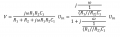
Hi, I'm having some trouble understanding how to get to Bode's normal form. What would the solution look like for this problem?
Thanks in advanceView attachment 337715
If you got the math right (I did not check that) it looks correct except I think we usually see this in terms of the 's' parameter, so you would replace occurrences of "j*w" with just 's'. That's unless you were taught to do it with "j*w" instead.
The whole reason for this is so you can draw or just inspect the different parts in terms of straight line (or second order curve) approximations, which is supposed to make it easier to view the total response.
Ok the math looks ok too as long as R1//R2 means R1 in parallel with R2 which is R1*R2/(R1+R2).
You should use parentheses around the 1/stuff though so you can tell you are dividing by 1/n rather than first dividing by 1 and then dividing by n.
Example: 1+s/(1/stuff) rather than 1+s/1/stuff.
You can also define constants first:
A=1/stuff
Term: 1+s/A
Oh ok. Well, you just try to get all the parts in the form like:
s*a+1
but that usually ends up being more like:
s/A+1
So if you have a term like:
s+a
you divide by 'a' and get:
s/a+1
and that takes the place of the original.
If that was in the denominator you would also divide that by 'a'.
You do that until all of the factors are in that form.
Try that with your original expression and see if you get the right result.
Not sure if this is correct, could you help me verfiy?
jwR1R2C / R1+R2 +jwR1R2C).
jwR1R2C / R1+R2 (1+jw(R1R2/R1+R2)C)
jw(R1R2/R1+R2)C / (1+jw(R1R2/R1+R2)C)
Not sure if this is correct, could you help me verfiy?
jwR1R2C / R1+R2 +jwR1R2C).
jwR1R2C / R1+R2 (1+jw(R1R2/R1+R2)C)
jw(R1R2/R1+R2)C / (1+jw(R1R2/R1+R2)C)
First thing is you have to use parentheses when required.
a*b/a+b is not the same as a*b/(a+b). That means that two parallel resistors does not come out to R1*R2/R1+R2 but rather comes out to R1*R2/(R1+R2).
Only when you do that can anyone be sure what you are calculating.
Example:
a*s/((s+b)*(s+c))
First note that:
((s+b)*(s+c))/(b*c)=((s/b+1)*(s/c+1))
and since we divided the bottom by (b*c) we have to divide the top by (b*c) and we get:
a*s/(b*c)
so the complete result is:
(a/(b*c))*s/((s/b+1)*(s/c+1))
To check we simplify all that and we again get:
a*s/((s+b)*(s+c))
So the result is:
(a/(b*c))*s/((s/b+1)*(s/c+1))
You can see we either got a factor that was (s/n+1) or n*s.

 Facebook
 Google
 GitHub
 Linkedin