How to make a simple TL072 based impedance buffer

Thread Starter

sunny_2000

Joined Oct 23, 2025
16
Hello all, this is my first post here.

I have designed a custom 12V battery, along with a LM386 amp circuit, which allows me to play my guitar through an 8ohm speaker fairly well

However, when switching pickups from humbuckers to single coils, the audio starts to clip and distort

How can I make an impedance matching circuit using a TL072 op amp?

All the relevant circuits that I found online seemed to be for applications much more powerful than mine.
My application is simply to have the electric guitar be clean when the default gain of the 386 is 20, and then distort ONLY when I manually increase the gain

From what I understand, a unity gain buffer must be made

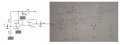
This is the 386 circuit I am using:
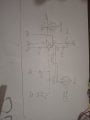
1000074314.jpg
 

Reloadron

Joined Jan 15, 2015
7,881
The LM386 dates back to the early / mid 80s. I would have gone with something newer. However, what you have is close. The clipping is a result of overdriving. I would go with a 10K pot on the input. I would use maybe a 220 uF cap on the output. Not sure what you have going on with Pin 6 and your Vcc? The 100 uF decoupling cap is fine assuming a good clean DC supply. You may want to give this a read. Yes, you can add a buffer using any old chip like a TL072 for the buffer. A Google of "tl072 buffer circuit" will give you some examples.

Ron
 

Thread Starter

sunny_2000

Joined Oct 23, 2025
16
The LM386 dates back to the early / mid 80s. I would have gone with something newer. However, what you have is close. The clipping is a result of overdriving. I would go with a 10K pot on the input. I would use maybe a 220 uF cap on the output. Not sure what you have going on with Pin 6 and your Vcc? The 100 uF decoupling cap is fine assuming a good clean DC supply. You may want to give this a read. Yes, you can add a buffer using any old chip like a TL072 for the buffer. A Google of "tl072 buffer circuit" will give you some examples.

Ron
Unfortunately I was not able to find a 10k pot where I live

With the VCC, the positive 12V battery goes to pin 6, and in parallel is a 100uF capacitor connected to the ground

For the TL072 circuit, I had a doubt,
I am using only a single battery source, whereas the TL072 diagrams I see indicate 2 batteries, what can I do to make this work with a single source?
 

sghioto

Joined Dec 31, 2017
8,634
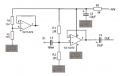
It's recommended that the positive input pin be biased at half the supply voltage which is the reason for R4 and R5.
I suppose it would be OK to connect pin5 to pin3 and eliminate R4 and R5
 

Thread Starter

sunny_2000

Joined Oct 23, 2025
16
It's recommended that the positive input pin be biased at half the supply voltage which is the reason for R4 and R5.
I suppose it would be OK to connect pin5 to pin3 and eliminate R4 and R5
So, directly connecting pin 5, to the two 1M resistors, R1 and R2?
 

Thread Starter

sunny_2000

Joined Oct 23, 2025
16
Hello!

I built the schematic that you provided, by connecting pin 5 of tl072 to pin 1, and then taking the output from pin 7 through the 10uf capacitor and to the lm386

However there is a problem, when I strum my guitar, the audio distorts, and disappears for a second and then comes back.

What can I do to fix this?
 

supermen

Joined Oct 24, 2025
1
The tl072 is a fet op-amp. I would design an extremely high input impedance pre-amp, almost infinite, that puts absolutely no load on your single coil or your humbucker coil. Under these conditions, your coil may develop some high voltages. This is a 30 volt device, and your coil may be producing 100's of volts. This is conjecture, but perhaps a impedance matching transformer, with an input winding that matches your pickup, and an output winding of much higher resistance, to match the input impedance of your op-amp.
 

Thread Starter

sunny_2000

Joined Oct 23, 2025
16
Did you connect pin6 to pin7 at the output?
Hello, yes, the pins are connected

And also, I tried another thing where I connected pin 5 to the ground, and took the output from pin 1

And that fixed the sputtering problem

But the distortion even at the lowest gain but full volume still persists
 

MisterBill2

Joined Jan 23, 2018
27,362
Clipping distortion is caused by driving a stage beyond it's linear range. Adding more gain in front of that stage will not solve te problem. Having the amplifier zero-signal output biased to other than the middle of the range will reduce the maximum amplitude that can be delivered without clipping.
Besides all of that, a low supply voltage will reduce the output voltage that can be delivered without clipping.
 
Top