Three stages power amplifier school project

Thread Starter

Lucky-Luka

Joined Mar 28, 2019
181
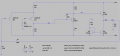
Which criteria should be used to choose R7 and R8 values? I've seen 150ohm in other similar circuits... There isn't a formula to choose them, right?
Do you think it's possible to have 0 DC at the input, so that I don't have to use C3?
Thanks
 

Jony130

Joined Feb 17, 2009
5,598
Which criteria should be used to choose R7 and R8 values? I've seen 150ohm in other similar circuits... There isn't a formula to choose them, right?
These resistor values are not critical. Also, you have a circuit simulator so you can play with the resistance values.

R7 = R8 = 50...20 * (Vbe_max - Vbe_min)/(IL_max/hfe_min)


Do you think it's possible to have 0 DC at the input, so that I don't have to use C3?
So, you want to amplify the DC voltage also?
 

Audioguru again

Joined Oct 21, 2019
6,826
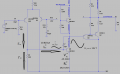
Without any negative feedback, your amplifier had a very high AC and DC gain. then the tops of the waveforms were squashed causing distortion and the high DC gain caused the output DC voltage to vary depending on mismatch of the biasing and the transistors. With AC negative feedback then the amplification and distortion are reduced and with DC negative feedback the DC gain can be 1.
 

Jony130

Joined Feb 17, 2009
5,598
No. I was just thinking of a solution like the one in the picture attached.
You can remove the input capacitor, but you must be aware that the R11 resistor not only "setting" the Rin of a amp but also provide a DC path for the input stage base current. And this current produces a small DC-offset at the input. Therefore you cannot remove the R11 resistor.
Of course, we can take some steps to minimize this DC-offset
 

Thread Starter

Lucky-Luka

Joined Mar 28, 2019
181
Hi all
I was looking at the input stage. I was trying to obtain the resistors value. I got negative value resistor.. Can someone help me?
I can't really understand how to obtain the maximum value of input voltage of the CE stage. I thought it was the maximum value of the voltage swing at the input of the output stage divided by the voltage gain of the CE stage. I think here lies somehow the reason of the mistake.
https://www.dropbox.com/s/quxxede2by531zv/formula dubt.docx?dl=0
 

Attachments

Ylli

Joined Nov 13, 2015
1,092
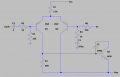
There are a number of considerations when designing the LTP (long tailed pair/input differential amp), but it is fairly common to set the current for each device to 0.5 mA - 5 mA. In this case, 1.0 mA is the nominal current.

The way to find that is to realize that the base current of the input PNPs will be near zero, so the base voltage will be near zero. That means the emitters will be nominally +0.6 volts. Determine the common emitter resistor by taking the drop across it (Vcc - Vbe) 16 - 0.6 = 15.4 and divide by the total desired current. Since in this case you want 1 mA per device, that is a total of 2 mA. 15.4/2 mA ~7.5K. So now we have 1 mA per device. We will be taking the signal off the left device to get the phase right,and we know it has an Ic of 1 mA. We know the next stage needs a Vbe of ~0.6 volts to bring it into it's active region. So R = E/I = 0.6/1 mA = 600 ohms. Nearest common value is 680 - hence the value you see.
 

Jony130

Joined Feb 17, 2009
5,598
I was looking at the input stage. I was trying to obtain the resistors value. I got negative value resistor.. Can someone help me?
So you didn't read this or you do not understand it?
https://forum.allaboutcircuits.com/...ign-basic-questions.104719/page-6#post-804580

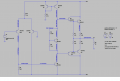
The quiescent current of the input stage is select based on Q8 base current (VAS stage - Voltage Amplifier Stage).
Since the input and the VAS work in class A we need to choose I_input_stage >> I_vas.
But in this case, I just pick a nice round number IcQ10 = 1mA.
 

Thread Starter

Lucky-Luka

Joined Mar 28, 2019
181
Nearest common value is 680 - hence the value you see.
I'm trying to follow your guidance.
680ohm is a preferred value fine. I've noticed that with 680ohm I have 3V dc offset at vo.
Choosing 683ohm I've noticed it's 300mV.
How can I allow that DC offset? How can I know that the feedback can bring dc offset to 0V?
 

Attachments

Last edited:

Ylli

Joined Nov 13, 2015
1,092
If you are going to try to design with extreme high precision parts, that are not obtainable in the real world, and you have access to resistors with zero tolerance, then proceed. If you have 1% resistors (or 5%) and are using transistors that have parameters that span a range, then get the values in the ballpark, close the loop (connect the feedback), then tweak part values as necessary. In this case, yes, you can tweak the value of the collector load resistor to set the output offset to zero, but it will be much easier (and practical) to do with the loop closed.

Oh, and changing the value of the emitter resistor, or either of the base 22K resistors, will also affect the output offset.
 

Audioguru again

Joined Oct 21, 2019
6,826
The two input transistors have different hFE and different Vbe. Therefore the have a input offset voltage that is amplified if there is no DC negative feedback. The transistors in an IC are matched so its input offset voltage is much less than your do-it-yourself bunch of parts.

The datasheet for a transistor does not list its minimum and maximum Vbe because a linear transistor is never used without negative feedback.
 

Ylli

Joined Nov 13, 2015
1,092
In the real world, if you need to change either of the input transistors in an amplifier and you want to keep the output offset to a minimum you start with 10, or 100 of the parts, and match them for hFE (beta) and Vbe. Then pick the closest two you find. There have been many discussions as to which of those two parameters is the most important. [Vbe may be the most important to minimize offset, but matching hFE might be most important to minimize distortion]

Anyway.. In this circuit, you can tweak the output offset by varying either the 680 collector resistor or the 7.5K emitter resistor.
 

Attachments

Thread Starter

Lucky-Luka

Joined Mar 28, 2019
181
Anyway.. In this circuit, you can tweak the output offset by varying either the 680 collector resistor or the 7.5K emitter resistor.
I don't get it: what has changed in the circuit you have just posted? Maybe I'm too tired and I don't see it.
btw one specifications of the project was no capacitor at the input (C3). It should be possible if I get rid of R11, right?
 

Audioguru again

Joined Oct 21, 2019
6,826
C3 is not at the input of the amplifier in post #95. C2 is the input capacitor.
C3 cuts high frequencies to prevent oscillation when negative feedback is used.
 

Ylli

Joined Nov 13, 2015
1,092
I don't get it: what has changed in the circuit you have just posted? Maybe I'm too tired and I don't see it.
btw one specifications of the project was no capacitor at the input (C3). It should be possible if I get rid of R11, right?
There have been so many circuits posted that I can't say that the one I just posted is different or the same as some of the others. I just wanted to put it all in one place.
Yes, you can remove the capacitor on the input, but the you need to realize there will be some offset due to the small but finite base currents of the input devices. Just for grins, you can try darlington pairs on the input.
 
Top