Theory of Everything

Thread Starter

Jennifer Solomon

Joined Mar 20, 2017
112
Lol, no one cares about digits of Pi. In its orbital calculations, the JPL rounds Pi to its 15th digit:https://www.jpl.nasa.gov/edu/news/2016/3/16/how-many-decimals-of-pi-do-we-really-need/
Dear Double-down-on-F*ck-you-Rene-because-you-REALLY-hate-the-term-REAL-lol,

Of course no one cares about the digits of pi in everyday mathematics beyond a few significant digits! (Btw, I deleted that one line before you responded to it that said 3.145 is less than 3.14 — it was not properly contextualized, please ignore.)

But you did not answer at least 50% of my question, and went into other... areas. ;)

Google "pi infinite" and you will find 10's of millions of pages on the topic. These people aren't insistent that the "base" has ANYTHING to do with pi's irrationality.

The thousands of mathematicians involved with calculating the digits of pi across server networks in binary grunts do not believe you. The programmers involved with all the multi-server algorithms.

If pi was finite, it would be a rational number. Lebesque integrals are still rationalizing things, no matter how you cut it.

In essence, you don't believe in irrational numbers because you don't believe infinity is something other than a process. This is why you kindly keep avoiding representing pi as the actual voltages and attempting to "resolve" it. It doesn't resolve, ever, as does any true irrational number, in any base, and the 2 quadrillionth in BINARY/UNARY is proof.

ℝ's INFINITUDE as a continuum is not a process. It is a stand-alone thing that is understood as a "thing" by the mind, because the true definition of a "thing" is first-order infinite, if R can be considered one. You even mentioned earlier on that understanding the ACTUAL infinite nature of ℝ was a dragon-esque situation that was "too complicated."

But no ℝ as infinity, no model for me.
 
Last edited:

Delta Prime

Joined Nov 15, 2019
1,311
What if it's made of Godel numbers?
Did someone say Gödel numbers?
That's my Que...
Hello there! Guy's & gal's.
I have a funny joke for you.
I have been waiting sooooo long to tell this one . Okay here it goes.

“Werner Heisenberg, Kurt Gödel, and Noam Chomsky walk into a bar. Heisenberg turns to the other two and says, ‘Clearly this is a joke, but how can we figure out if it’s funny or not?’ Gödel replies, ‘We can’t know that because we’re inside the joke.’ Chomsky says, ‘Of course it’s funny. You’re just telling it wrong.’ ”:p
 

Thread Starter

Jennifer Solomon

Joined Mar 20, 2017
112
"Just a finite number," he says. "Only irrational due to base-10," he says. "People don't care about them thar irrational digits in the most basic of unary/binary forms," he says.

How about the mathematicians at Google?
https://www.wired.co.uk/article/google-computing-pi-maths

How about scientists from IBM and the University of Newcastle and the Dept of Energy?
https://phys.org/news/2011-04-supercomputers-sixty-trillionth-binary-digit-pi-squared.html

In fact, here's an entire chronology of "those academicians who don't care about it":

https://en.wikipedia.org/wiki/Chronology_of_computation_of_π

Sooooo much work put into figuring out the irrational for such a fixed number.

You better shave off those said side-burn curlies, Rabpi, you might be excommunicated from the Association of Finite-Only Sages. ;--)
 

Thread Starter

Jennifer Solomon

Joined Mar 20, 2017
112
What if the dog is made of the roots of the Zeta function? What if it's made of algebraic sheaves? What if it's made of Godel numbers?
What if, in your own words, we know very little about R, and R is the infinite secret key that defeats the end-boss and unlocks the princess in Zelda?

Let me ask you a question. We don't know what the DOG is. What is physical space? We don't know what that is either. So then tell me, what is all this mathematics in our heads describing these things from, if it's not part of the same "set of unknowable monstrosity?"

ℝ is NOT a number set in any sense of the discrete, rational (or "sane," knowable) word.

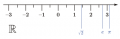
In the end, there is FU-ℝene's utterly incomprehensible, indivisible, infinite-whack-a-mole, fractoid ℝeal continurrhea (CONTINUOUS), and kroℕecker naturalized digitization of perceived intervals of that phenomena (DISCRETE), FTW. Real line, and the ℕ's are intervals of it, with infinite numbers in between each "ℕ" element:

Screen shot 2020-05-31 at 1.49.51 PM.png

The ℕ's are 1, 2, 3... above. The irrationals "computative" and algorithmic numeric expressions (and their sets) are in between each. It's all the REALity of REAL.

When you boil it down to their constitute "NON ABSTRACT CONCEPTS" elemental parts, the line is INFINITE UNARY-GRUNTS (or more compact-space binary grunts)! You can group the grunts into "concepts" and relate the grunts, one to another. But it's all one ascending magnitude phenomenon.

Numbers are numbers. They do NOT get defined by their set. They get "organized" and "analyzed" by them only.
 
Last edited:

Thread Starter

Jennifer Solomon

Joined Mar 20, 2017
112
Did someone say Gödel numbers?
That's my Que...
Hello there! Guy's & gal's.
I have a funny joke for you.
I have been waiting sooooo long to tell this one . Okay here it goes.

“Werner Heisenberg, Kurt Gödel, and Noam Chomsky walk into a bar. Heisenberg turns to the other two and says, ‘Clearly this is a joke, but how can we figure out if it’s funny or not?’ Gödel replies, ‘We can’t know that because we’re inside the joke.’ Chomsky says, ‘Of course it’s funny. You’re just telling it wrong.’ ”:p
:D That's funny :--)
 

bogosort

Joined Sep 24, 2011
696
Google "pi infinite" and you will find 10's of millions of pages on the topic.
Please understand that I say this with kindness: anyone who believes that Pi is an infinite number is a mathematical idot.

I promise you that no (zero!) mathematician believes or claims that Pi is infinite. Pi is LESS THAN FOUR. You are confusing the value of Pi with the number of digits in its decimal representation.

Maybe a different tactic will help you see the light. Did you know that we can write any number as an infinite series? Here's the number 3: \[ 2 + \frac{1}{2} + \frac{1}{4} + \frac{1}{8} + \frac{1}{16} + \cdots = 3 \] We can also write any number as a non-terminating decimal expension: \[ 2.999 . . . = 3 \] We can do this in any base. Does this mean that 3 is infinite? No, of course not. Does this mean that 3 = Pi? No, of course not.

Pi is a finite number. I'm embarrassed for anyone who thinks otherwise.

These people aren't insistent that the "base" has ANYTHING to do with pi's irrationality.
Sigh. I never said that base determines irrationality, I said that base determines whether a number has a terminating representation. That you confuse these distinct notions should be a big red flag to you that you're out of your depth. I have zero doubt that you are fully capable of grokking this stuff (otherwise I wouldn't bother), but you're arguing from a position of profound ignorance.

The thousands of mathematicians involved with calculating the digits of pi across server networks in binary grunts do not believe you.
Lol, you seem to think that mathematicians are huddled around servers desperately trying to find the next digit of Pi. Too funny. Actual mathematicians don't give a f*ck about the digits of Pi. The only people who care about the digits of Pi are the people who get a kick out of memorizing the digits. Programmers and hardware engineers sometimes use Pi to test their toys. But mathematicians couldn't care less.

If pi was finite, it would be a rational number. Lebesque integrals are still rationalizing things, no matter how you cut it.
Sweet lord.

Is 1/3 a rational number? Yup. Is 1/3 finite? Duh. Does 1/3 have an infinite decimal expansion in base-10? Yup.

Is root-2 an irrational number? Yup. Is root-2 finite? Duh. Does root-2 have an infinite decimal expansion in base-10? Yup.

Saying that L integrals "rationalize things" tells me that you don't have the foggiest idea of what a Lebesgue integral is.

In essence, you don't believe in irrational numbers because you don't believe infinity is something other than a process.
Now you're telling me what I believe?

This is why you kindly keep avoiding representing pi as the actual voltages and attempting to "resolve" it.
I've spent a considerable amount of time and energy trying to help you understand the difference between numbers and our representations for them, yet you say that I'm avoiding the subject? Bleh.

ℝ's INFINITUDE as a continuum is not a process.
Oh yeah? Then how is it that we get the continuum when we take the powerset of ℕ? Forming subsets is a process. We literally define the reals in terms of Cauchy sequences, which are processes.

You even mentioned earlier on that understanding the ACTUAL infinite nature of ℝ was a dragon-esque situation that was "too complicated."
I believe my exact words were "too technical". It took the thousands of years for the finest mathematical minds to get a firm hold of what ℝ is. Even today, the analysis of ℝ is typically a graduate-level mathematics course. The "nature" of ℝ is extremely technical and, frankly, beyond the scope of a discourse in which the finitude of Pi has been called into question.
 

bogosort

Joined Sep 24, 2011
696
Did someone say Gödel numbers?
That's my Que...
Hello there! Guy's & gal's.
I have a funny joke for you.
I have been waiting sooooo long to tell this one . Okay here it goes.

“Werner Heisenberg, Kurt Gödel, and Noam Chomsky walk into a bar. Heisenberg turns to the other two and says, ‘Clearly this is a joke, but how can we figure out if it’s funny or not?’ Gödel replies, ‘We can’t know that because we’re inside the joke.’ Chomsky says, ‘Of course it’s funny. You’re just telling it wrong.’ ”:p
LOL. That's the first joke I've ever heard using Godel numbers. Loved it!
 

bogosort

Joined Sep 24, 2011
696
"Just a finite number," he says.
Yup, and so does literally every other reasonable person.

"Only irrational due to base-10," he says.
Never said this; you're confusing irrationality (a property of numbers) with non-terminating decimal expansion (a property of bases).

"People don't care about them thar irrational digits in the most basic of unary/binary forms," he says.
There's no such thing as an "irrational digit".

Did you even read the article? The Google employe is a high-performance computing (HPC) researcher. He's exploring hardware and algorithms, not math.

How about scientists from IBM and the University of Newcastle and the Dept of Energy?
https://phys.org/news/2011-04-supercomputers-sixty-trillionth-binary-digit-pi-squared.html
Same thing, HPC research. You're not even reading the articles that you're providing as "evidence".

'According to Bailey, one application for computing the digits of Pi is to test the integrity of computer hardware and software, which is a focus of Bailey’s research at Berkeley Lab. “If two separate computations of digits of Pi, say using different algorithms, are in agreement except perhaps for a few trailing digits at the end, then almost certainly both computers performed trillions of operations flawlessly,” he says.'

https://en.wikipedia.org/wiki/Chronology_of_computation_of_π

Sooooo much work put into figuring out the irrational for such a fixed number.
Humans like records. And?

You better shave off those said side-burn curlies, Rabpi, you might be excommunicated from the Association of Finite-Only Sages. ;--)
In all seriousness, you don't know what you're talking about. :)
 

Thread Starter

Jennifer Solomon

Joined Mar 20, 2017
112
<cue boldarrhea>
Why do you think I'm insistent on getting BENEATH the issue of representation??


You keep saying I'm talking about "terminating representations" and such. I am not!

I'm dealing with this stuff at the zero and one foot pedal level, not the 4GL math!!


You do not address my core question... talk to me about pi in terms of VOLTAGES. The digits of PI are high or low flip flops NOT representing base 10, they are ELEMENTAL and non-terminating in a BASELESS underlying phenomenon! We employ algorithms to show how these unary and binary things keep expanding because it is NOT finite.

For the record, I insist, like I believe the mystic Pythagoras thought, all numbers are in fact derivative of "1", and ALL infinite, as I asserted early on. They just have different names, and man-made ordinalities and cardinalities.
 
Last edited:

bogosort

Joined Sep 24, 2011
696
What if, in your own words, we know very little about R, and R is the infinite secret key that defeats the end-boss and unlocks the princess in Zelda?
When did I say that we know very little about ℝ? We know a sh!t ton about ℝ. Just because we can't label most of its elements doesn't mean we don't know the properties of those elements.

I strongly feel that we need to get away from ℝ and get back to the basic ontology. Either that, or we go full on into number theory 101 and fix all those misconceptions you're grasping on to. But mixing ontology and half-baked notions of ℝ is a no-go.
 

bogosort

Joined Sep 24, 2011
696
You keep saying I'm talking about "terminating representations" and such. I am not!

I'm dealing with this stuff at the zero and one foot pedal level, not the 4GL math!!


You do not address my core question... talk to me about pi in terms of VOLTAGES. The digits of PI are flip flops NOT representing base 10, they are ELEMENTAL and non-terminating in a BASELESS underlying phenomena!
The digits of Pi cannot be base-less, by definition of what a digit is!
 

Thread Starter

Jennifer Solomon

Joined Mar 20, 2017
112
In all seriousness, you don't know what you're talking about. :)
You know I'm just giving you a hard time. ;--) To reiterate, I read ALL of your painstaking explanations and very much appreciate them! Do NOT think otherwise! You are the greatest explainer of such phenomena at that abstraction level I've ever seen, and I'm not kidding! You convinced me unary was an even MORE elementary way to look at it, beyond binary, and it's hella relevant to this discourse!

ALL of what you are describing is correct from the mathematical 4GL level, of course. But you and I can have very productive, even-playing-field conversation on this grunt level and build from this. I want to cannibalize ℝ and in terms of grunts.

I'm so utterly insistent on getting down to grunts so we can truly attempt to unify all phenomena at the lowest of rational levels. Pi is grunts. Groupings of grunts. If we see the unary/binary "numberless" element, we can build a definition for digits themselves from the hardware, as in some kind of presence of a voltage for unary representation. This is what a computer is doing (and why I believe truth states and numbers are related through the "grunt"), and why they are calculating "grunt digits."

For the record, I do know what I'm talking about in terms of the importance of getting *beneath* the abstraction and complexification. In the same way you want to compare a "red blood" cell to a human. Exact same simplification angle. Does a "red blood cell" feel? If consciousness and life is a function of a metaphysical property, and not a function of nth order physical complexity, then "conceivably" based on that, but the way we use "feel" in a human sense is way more telling because there's way more detail on how it behaves with respect to information.
 
Last edited:

Thread Starter

Jennifer Solomon

Joined Mar 20, 2017
112
Using Grunt OS again, where a grunt is a blast of voltage, what is the most elementary way any Shannon-sanctioned binary digital computer (assuming binary is just "unary with spatial efficiency") is "seeing a digit?"

The state of one flip-flop as high or low.

Therefore, I propose, intra-model:

DIGIT A discernible state of a physical something discrete from all other physical states so as to be able to define it as an independent state unique and distinctive of others. This is is called "unary." One can reference more than one digit by giving them a unique name for the group of them. The first name given to the most elementary group is "two." The next elementary group after that is "three," etc. to no limit (infinity).

In a binary computer, a more compact definition of unary digit is "binary" which permits one discrete space to hold two different states or digits. This affords higher spatial efficiency in computation using digits.

Yes?
 

bogosort

Joined Sep 24, 2011
696
What, TRULY, is a digit other than the UNARY GRUNT from our most elemental place where we build on???
A digit is a symbol. In base-10, the third digit of Pi = 3.1415... is "4". The digit "4" is not the number 4, nor is it a representation of the number 4. You can grok this, yes? The value of Pi itself is less than 4, so there can be no 4 in Pi.

So then what the f*ck is that "4" doing in there? Let's look at it from a different though equivalent perspective: \[ 3.1415 = 3 + \frac{1}{10} + \frac{4}{100} + \frac{1}{1000} + \frac{5}{10000} \] In other words, the "4" tells us how many hundredths do we need to add to 3 to get to the value of Pi. The "5" tells us how many ten-thousandths we need to include, and so on.

This is precisely what a base-10 representation is: a sum of multiples of 10 written using a concise, convenient notation. Notice that every single term in our sum is a rational number. By definition, however, an irrational number cannot be written as a ratio of two rational numbers. We know that ℚ, the set of rational numbers, is closed under addition, i.e., for any rational p and q, the sum p + q is also a rational number. Therefore, an irrational number cannot be written as a sum of rational numbers, as any such a sum is always rational.

Therefore, every rational base (e.g., base-10) is incapable of expressing irrational numbers.

Them's the facts. But, nothing is stopping us from trying anyway! And that process is precisely what we do when we write Pi as a decimal expansion. But -- and this is the crucial part -- notice that as we keep adding terms (digits) to Pi, each digit represent a smaller quantity than the digit before. All of those "infinite" digits going off to the right are trying to capture the fineness of a number that is too fine to be expressed by a ratio. More digits don't make Pi "bigger", they express Pi more finely -- more accurately. But, since there are more numbers in ℝ than can be associated with numbers in ℚ (and Pi is one such number), we're out of luck.

This isn't a big deal in any way. First, note that there are numbers in ℚ whose decimal expansion could never be represented in our universe. For example, \( 10^{(10^{10})} \) is a perfectly finite rational number with a perfectly terminating base-10 decimal expansion. But there are not nearly enough atoms in the universe to write it down! Who cares? Second, what makes Pi important is its properties, not its precise value. The 928349th digit of Pi can be 8 or 9 or 2 and it doesn't matter!
 

Thread Starter

Jennifer Solomon

Joined Mar 20, 2017
112
A digit is a symbol. In base-10, the third digit of Pi = 3.1415... is "4". The digit "4" is not the number 4, nor is it a representation of the number 4. You can grok this, yes? The value of Pi itself is less than 4, so there can be no 4 in Pi.

So then what the f*ck is that "4" doing in there? Let's look at it from a different though equivalent perspective: \[ 3.1415 = 3 + \frac{1}{10} + \frac{4}{100} + \frac{1}{1000} + \frac{5}{10000} \] In other words, the "4" tells us how many hundredths do we need to add to 3 to get to the value of Pi. The "5" tells us how many ten-thousandths we need to include, and so on.

This is precisely what a base-10 representation is: a sum of multiples of 10 written using a concise, convenient notation. Notice that every single term in our sum is a rational number. By definition, however, an irrational number cannot be written as a ratio of two rational numbers. We know that ℚ, the set of rational numbers, is closed under addition, i.e., for any rational p and q, the sum p + q is also a rational number. Therefore, an irrational number cannot be written as a sum of rational numbers, as any such a sum is always rational.

Therefore, every rational base (e.g., base-10) is incapable of expressing irrational numbers.

Them's the facts. But, nothing is stopping us from trying anyway! And that process is precisely what we do when we write Pi as a decimal expansion. But -- and this is the crucial part -- notice that as we keep adding terms (digits) to Pi, each digit represent a smaller quantity than the digit before. All of those "infinite" digits going off to the right are trying to capture the fineness of a number that is too fine to be expressed by a ratio. More digits don't make Pi "bigger", they express Pi more finely -- more accurately. But, since there are more numbers in ℝ than can be associated with numbers in ℚ (and Pi is one such number), we're out of luck.

This isn't a big deal in any way. First, note that there are numbers in ℚ whose decimal expansion could never be represented in our universe. For example, \( 10^{(10^{10})} \) is a perfectly finite rational number with a perfectly terminating base-10 decimal expansion. But there are not nearly enough atoms in the universe to write it down! Who cares? Second, what makes Pi important is its properties, not its precise value. The 928349th digit of Pi can be 8 or 9 or 2 and it doesn't matter!
Ok, "digit" as "symbol" is 4+GL though. And I fully understand all that, though some of the terminology is a bit strange when you don't call "4" a number and JUST a symbol (In my estimation, there are only unary grunts... "4" is symbol for 4 TRUE digits, the numbers don't exist without a summation/group of grunts). I want to investigate the lowest ontological, physical level (i.e., red blood cell vs. human). No ℝ's, no ℚ's, etc... yet.

See my 1274-1275 posts above about getting zoomed in further.

Also, "expressing pi more finely" is 100% true, between .14 and .15, there is infinite fineness. That infinite fineness is PART of Pi, and is in my estimation makes Pi NOT finite. Only the integer portion is "finite" (in a way, but in my estimation, each grunt stands for a unique infinity anyway, lol).
 
Last edited:

Thread Starter

Jennifer Solomon

Joined Mar 20, 2017
112
So just to be clear... what you're considering persona non-grokkus, is not me not grokking what you're saying. It's me fighting for a different zoom level tooth and nail. Because this whole "pi" issue is the exact same discussion we've been having, in a different way.

See here:

The digit "4" is not the number 4, nor is it a representation of the number 4.

You will call "4" a concept. The concept is "stored" in the brain to you (not to me, but you, but I want to work with your assumption level first because it's proper to start from what is observable). The concept 4 is comprised of 3 potential other concepts, seen through factorization: two 2's, or a 3 and a 1. All of those are also "concepts."

But then 2 and 3 are composed of 1 (for 2) and 1 & 2 (for 3). In the end, all just unary 1's. Back to "grunts" again. The "1" is the grunt. This is Kronecker on steroids, because ℕ is just added 1's. There are really, at the most lowest abstract level, only "grunt-grunt-grunt-grunt." The amalgamater calls that "4."

Does 4 or any other number exist without its constituent concepts? If you want to call "4" a member of set ℕ, then clearly not. It gets its ordinality and cardinality from the 3 numbers that came before it or after it.

You will say "there are no numbers in a computer," but you ARE a computer. So you must say the same thing—what's good for the goose-computer is good for the gander-human: There are "no numbers in you."

But that makes no sense. There ARE numbers in you, or you wouldn't be calling anything a number. What you call "concept" is really an arbitrary amalgamater of discrete bits. So the concept "4" in you is either this:

@@@@ (unary)
or
100 (binary)​

Where those symbols are standing for either the same voltage level for all 4 @@@@ states, or 2 contrasting voltage levels as 3 states or binary "100."

THAT is the only "concept" I'm seeing. Right there. Are you grok-following me?

Therefore, what is a number in YOU, if you are strictly a computer? At their very most elementary, a computer works with unary or binary voltage states.

So pi in base 10 has 10 symbols to work with to represent elements of itself, but that is NOT elementary thinking, NOT in a computer at the hardware level, and we are NOT going to uncover the connection of core phenomena from that zoom level. You say "pi" can't be baseless, but it most certainly can be with unary "1's" alone! UNARY is not base-1, it is its own foundational deal.
 
Last edited:

Thread Starter

Jennifer Solomon

Joined Mar 20, 2017
112
Sigh. I never said that base determines irrationality, I said that base determines whether a number has a terminating representation. That you confuse these distinct notions should be a big red flag to you that you're out of your depth. I have zero doubt that you are fully capable of grokking this stuff (otherwise I wouldn't bother), but you're arguing from a position of profound ignorance.
Nothing to grok, this is 101 awareness. I hope you can get that I understand this well enough to know we have to get past it because it isn't the essence of what's going on here? In all fairness, who in their right mind truly gives a flying maxi-pad about the "representation?" I'm not talking about this with respect to the infinitude of pi. You could draw a literal apple pie on the screen, cut it in half and call it 2 pieces of "pi." "It terminates at piece 2." The underlying order, or information, is independent of how it is represented! I've been trying to tell you that for weeks. (lol)

But you are calling PI a FINITE number independent of the base. You want to call pi a finite number even at the unary or binary levels. It is an expression. It is NOT a finite number, and it is NON-terminating expression at the UNARY and BINARY levels where sh*t gets REAL.

With a circumference of 22 and a diameter of 7, the result is 3 AND "something else." The something else is in a state of stuck-on growth to create higher resolutions of HELL itself. If it was 3.14 it would be FINITE: THREE "and" FOURTEEN HUNDREDTHS. Period, end of story. Pi is not a number, it is an arithmetic expression (that REALLY does NOT belong in a NUMBER SET or LINE... it belongs in an ARITHMETIC ENTITIES set). It is legit NUMBER 3 "AND" (whatever the hell that is) Kronecker's embalming fluid of expanding resolution in Alter St Matthäus Kirchhof cemetery.

The remainder is hell's kitchen between 21 and 22 where the nature of reality is infinite-bit, and we are "in the joke" as that other poster's joke mentioned.
 
Last edited:
Top