Theory of Everything

Thread Starter

Jennifer Solomon

Joined Mar 20, 2017
112
100% disagree! A single flip-flop cannot encode all of the information necessary to express the notion of digit. Digits, like alphabets, are symbols in high level languages, which are far too complex to encode in some small amount of flip-flops.

I think it's very important we come to agreement on this, as it gets to the heart of what I consider a big source of confusion.
The notion of the current definition of the nth order abstract digit you are using, it certainly cannot, of course.

If the notion of a digit is simplified in definition to a unary element, where logic 0 stands for integer 0, and logic 1 stands for integer 1, with no regard for "sets," why can it not? It is certainly done on paper that way. Using that interrelation, you can represent any number with the one-to-one bijected logic state set {0,1} and integer set {0,1}.

A 0 or 1 must be stored in the computer discretely somewhere in order to compute with these 2 values. There are of course n other flip-flops required to manage that digit and its contextualization with others, how it's displayed in geo-2D on the screen, etc. But there must be a discrete piece of hardware to store that core value.

Yes?
 
Last edited:

bogosort

Joined Sep 24, 2011
696
The problem I have with "finite" as I do with "real" or "countable" (for other reasons), etc. is that you seem to be saying the "expansion" element has nothing to do with its underlying properties. But at the same time you're say each term is "adding additional precision" forever. The number 3 is static. It's not in any kind of "flux."
The number Pi is also static! Its value does not change with time. Pi is not in flux. Pi is always and forever the same point on the number line.

Whereas the portion of pi that is "in a perpetual state of adding more precision" cannot semantically be described as "finite" whatsoever to me.
This is a key misconception. When a computer program spits out "3.1415..." it is not writing Pi, it is writing a rational approximation to Pi. The more digits it spits out, the closer this rational number gets to the value of Pi, but the program is NOT writing Pi.

The value of Pi is static, what's in flux is the rational approximation. And it is only in flux because the program keeps changing the rational number. 3.14 is different from 3.141 is different from 3.1415 is different from 3.14151 (and so on).

Do you grok that distinction?
 

bogosort

Joined Sep 24, 2011
696
So then all information shouldn't be called "1D" or "2D" or... at all?
Yes, exactly. Information has no geometry.

What about a matrix you describe above as being called a 2D array in comp. sci. space?
Great example. As programmers, we tend to think of arrays as one-dimensional data structures -- a row (or column) of data that we access along a single dimension. e.g., array[7]. Likewise, we tend to think of a matrix as a two-dimensional array -- rows and columns of data that we access along two dimensions: matrix[3][4].

Are these not examples of "1D" and "2D" information? Well, consider how the data is actually stored in RAM.

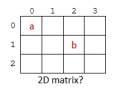
Let's say we set matrix[0][0] = 'a' and matrix[1][2] = 'b'. We visualize the matrix looking something like this:

2Dmatrix.png

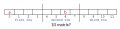
But to the CPU, RAM is just a long linear array of addresses, so the matrix is stored more like this:

1Dmatrix.png

To the CPU, the data is entirely "1D". That a programmer (or compiler) can interpret the data as being "2D" is simply the programmer/compiler applying another level of abstraction. The information itself has no such structure.

Indeed, we can create abstract structures with any number of dimensions, -- e.g., a "4D" matrix[0][1][2][4] (which would be very difficult to draw) -- that all reside on the same "1D" structure of RAM.

Note that even the "1D"ness of RAM is an abstraction of the CPU, as the information itself has no geometrical dimension.
 

Thread Starter

Jennifer Solomon

Joined Mar 20, 2017
112
The number Pi is also static! Its value does not change with time. Pi is not in flux. Pi is always and forever the same point on the number line.


This is a key misconception. When a computer program spits out "3.1415..." it is not writing Pi, it is writing a rational approximation to Pi. The more digits it spits out, the closer this rational number gets to the value of Pi, but the program is NOT writing Pi.

The value of Pi is static, what's in flux is the rational approximation. And it is only in flux because the program keeps changing the rational number. 3.14 is different from 3.141 is different from 3.1415 is different from 3.14151 (and so on).

Do you grok that distinction?
Wait wait... real number line, each point is a separate numerical result correct?

So point 3 is different than point 3.1 which is different than 3.12, correct?

If 3.14 is not accurate enough for rocket use, and IT is a point on the line, 3.141 is another POINT and also not sufficient, and 12 more digits are needed, that means 3.14 and 3.14159 are NOT considered “pi” for this application and point 3.14159265358979 finally has utility AS pi rationalized, then who is to say it doesn’t have higher utility at resolutions we can’t conceive? It has no resolution! Other than just “placing it in context on a contrived “resolved” numeric function line.”

(This is why I argue ℝ is not a “linear line” or a “real number set”... it has 2 or more dimensions per computed “result”, and needs room to expand in another direction.)
 
Last edited:

Thread Starter

Jennifer Solomon

Joined Mar 20, 2017
112
Yes, exactly. Information has no geometry.


Great example. As programmers, we tend to think of arrays as one-dimensional data structures -- a row (or column) of data that we access along a single dimension. e.g., array[7]. Likewise, we tend to think of a matrix as a two-dimensional array -- rows and columns of data that we access along two dimensions: matrix[3][4].

Are these not examples of "1D" and "2D" information? Well, consider how the data is actually stored in RAM.

Let's say we set matrix[0][0] = 'a' and matrix[1][2] = 'b'. We visualize the matrix looking something like this:

View attachment 208743

But to the CPU, RAM is just a long linear array of addresses, so the matrix is stored more like this:

View attachment 208746

To the CPU, the data is entirely "1D". That a programmer (or compiler) can interpret the data as being "2D" is simply the programmer/compiler applying another level of abstraction. The information itself has no such structure.

Indeed, we can create abstract structures with any number of dimensions, -- e.g., a "4D" matrix[0][1][2][4] (which would be very difficult to draw) -- that all reside on the same "1D" structure of RAM.

Note that even the "1D"ness of RAM is an abstraction of the CPU, as the information itself has no geometrical dimension.
Yes yes yes! One of my own personal discursive rocket thrusters since page 10. Excellent post... let’s frame it. Lol :)
 

bogosort

Joined Sep 24, 2011
696
The notion of the current definition of the nth order abstract digit you are using, it certainly cannot, of course.

If the notion of a digit is simplified in definition to a unary element, where logic 0 stands for integer 0, and logic 1 stands for integer 1, with no regard for "sets," why can it not? It is certainly done on paper that way. Using that interrelation, you can represent any number with the one-to-one bijected logic state set {0,1} and integer set {0,1}.
Even if what you just wrote was the minimal description necessary to define a digit (and it's not, by any stretch), that would still require much more than a single bit.

It seems that you are forgetting that any encoding necessarily includes the entire description of the encoding, otherwise information could not be encoded and subsequently decoded! You say it's "done on paper that way", but if someone handed you a piece of paper with encoded data, with no explanation for how it was encoded and how it should be decoded, you wouldn't tabula rasa be able to extract information from the data. Cryptographers do this all the time, but they don't do it tabula rasa -- they bring with them enormous amounts of encoding-specific details and mathematics to the table.

A 0 or 1 must be stored in the computer discretely somewhere in order to compute with these 2 values.
There are no 0s or 1s anywhere inside a computer. Numbers are abstract -- you can't visualize what a number looks like, right? What happens in a computer is that we interpret the circuit states as if they were numbers, or as if they were logic values.

And none of this works without all the accompanying theories that were used to design the computer in the first place, and a description of these requires a huge amount of bits. You say that "a computer can represent any number" and attribute that to simple unary elements. But the computer cannot do anything without all the electrical theory that was used in designing and integrating its components, all the logical theory that was used in deciding how to arrange those components, and all the arithmetic theory that was used to figure out how to get it to actually compute stuff.

Computers are enormously complex devices. The only reason that we can reliably pretend that the state of a flip is a "1" or a "0" is because all of that complexity was designed specifically to allow for such an abstraction. It's not a simple thing.
 

Thread Starter

Jennifer Solomon

Joined Mar 20, 2017
112
I say 0 and 1 again, but I mean a “two state machine.”

Boolean, binary computers are doing boolean algebra as computation with 2 states, complexly organized, no?

Let’s pretend there’s only two digits, 0 and 1... How would you represent them in the machine?
 

bogosort

Joined Sep 24, 2011
696
Wait wait... real number line, each point is a separate numerical result correct?
The number line is a geometric object. Each point is not a "result", it's just a point on the line. There is a bijective map between the elements in ℝ and the points on a line, so we call such a map "the real number line". It's as if we labeled each point on a line. That's it; no computations involved, no results.

So point 3 is different than point 3.1 which is different than 3.12, correct?
Of course.

If 3.14 is not accurate enough for rocket use, and IT is a point on the line, 3.141 is another POINT and also not sufficient, and 12 more digits are needed, that means 3.14 and 3.14159 are NOT considered “pi” for this application and point 3.14159265358979 finally has utility AS pi rationalized, then who is to say it doesn’t have higher utility at resolutions we can’t conceive? It has no resolution! Other than just “placing it in context on a contrived “resolved” numeric function line.”
You're talking about applications ("rocket use"), but that's an (n+m)th order affair. The number Pi -- an nth order abstraction -- has nothing to do with rockets; there are no properties of Pi that include "rockets". Lol.

From the application perspective, the rocket guidance system doesn't use the number Pi. Instead, it uses a rational approximation that is sufficient for the application. This is no different than any other number used in an application. If, at some particular stage of flight, the engineers calculate that the rocket's acceleration will be 5 km/s^2, they know that the probability of it being exactly 5 km/s^2 is zero, because the number 5.0000000... has FAR more precision than the system is capable of. This is why careful scientists and engineers don't specify numbers, they specify ranges. The acceleration is not 5, it's 5.0 +/- 0.5.

(This is why I argue ℝ is not a “linear line” or a “real number set”... it has 2 or more dimensions per computed “result”, and needs room to expand in another direction.)
ℝ is not a line (its elements can be mapped to one), but it is a set. Sets do not have geometric dimensions. The numbers in ℝ are not results, and they are not computed -- indeed, the vast majority of numbers in ℝ cannot be computed!
 

Thread Starter

Jennifer Solomon

Joined Mar 20, 2017
112
You're talking about applications ("rocket use"), but that's an (n+m)th order affair. The number Pi -- an nth order abstraction -- has nothing to do with rockets; there are no properties of Pi that include "rockets". Lol.
I was just referencing one application of pi, not any kind of baked in app like “rockets”. Lol.

So pi as a number is finite on the “number line.”

But when you break down pi into what it REALLY is, it’s uncomputable, correct?

Therefore pi “under the hood” is like any uncomputable, irrational number, free energy machine, requiring infinite bits at its core to “fully” represent, correct?
 

bogosort

Joined Sep 24, 2011
696
I say 0 and 1 again, but I mean a “two state machine.”

Boolean, binary computers are doing boolean algebra as computation with 2 states, complexly organized, no?
Same problem, different formulation. We have two states, great. But without the boolean algebra aspect, the states have no significance, right? In other words, the only way we know how to interpret the states is by applying a model of boolean algebra. And clearly the description of boolean algebra does not fit into a single bit.

It's not enough to have a set of states. We need a formal system, too.

Let’s pretend there’s only two digits, 0 and 1... How would you represent them in the machine?
There are innumerable ways to represent them. For example, let voltages in the range (1.3, 1.8) represent "0" and voltages in the range (-0.8, 0.3) represent "1". We can replace those ranges with any values we find convenient.
 

Thread Starter

Jennifer Solomon

Joined Mar 20, 2017
112
Same problem, different formulation. We have two states, great. But without the boolean algebra aspect, the states have no significance, right? In other words, the only way we know how to interpret the states is by applying a model of boolean algebra. And clearly the description of boolean algebra does not fit into a single bit.

It's not enough to have a set of states. We need a formal system, too.


There are innumerable ways to represent them. For example, let voltages in the range (1.3, 1.8) represent "0" and voltages in the range (-0.8, 0.3) represent "1". We can replace those ranges with any values we find convenient.
Ok, this is good, and touches very much on the problem of the mystery “meaning” mechanism, because meaning, feeling, and grokkability is the very interpretation mystery of all of this issue. We have to attempt a triangulation of this consciousness element from toddler-level. Let me write something and see what you think...
 

bogosort

Joined Sep 24, 2011
696
How many bits do you need to represent the totality of ℕ?
We can do it in 32 bits: 16 bits for Unicode "aleph" and 16 bits for Unicode 'subscript-zero'.

We can do it in 13 bytes: "{0,1,2,3,...}".

We can do it in however many ASCII bits is required for the English version of Peano's axiomatization.
 

Thread Starter

Jennifer Solomon

Joined Mar 20, 2017
112
We can do it in 32 bits: 16 bits for Unicode "aleph" and 16 bits for Unicode 'subscript-zero'.

We can do it in 13 bytes: "{0,1,2,3,...}".

We can do it in however many ASCII bits is required for the English version of Peano's axiomatization.
How about 3000 years ago, what would be the answer?
 

Thread Starter

Jennifer Solomon

Joined Mar 20, 2017
112
What if INFINITY had another definition, that of a stand-alone, pre-universe repository of points, energy, and information, a theoretical substance where “1” can characterize it, T that it ontologically exists, and ∞ or infinity would describe it. And it’s the year 1710. (Incidentally, I’m not making that up, this is Pythagorean reasoning, and it’s another way of saying “God”).

Humor me a second... how would this affect your reasoning about everything?
 

bogosort

Joined Sep 24, 2011
696
So pi as a number is finite on the “number line.”
Pi is a finite number. Mapped to a point on the real number line, the point corresponding to Pi is also finite.

But when you break down pi into what it REALLY is, it’s uncomputable, correct?
No! Pi is computable -- we have thousands of algorithms for computing the digits of Pi.

Computable only means that there is a finite algorithm for producing digits from the number to any precision we wish. If no such algorithm exists for a number, then the number is not computable.

I suspect that this definition of computability seems wack to you. If we can't computer the last digit of a number, then how can we say that we are computing the number? The key thing to realize is that, since the algorithm can produce as many digits as we want -- including an infinite amount of them if we let it run forever -- the algorithm itself is an encoding for all the digits of the number. Can you see this?

We can use an analogy in terms of patterns. Patterns contain information that is compressible -- no matter how long a sequence is (perhaps infinitely long), once you see the pattern, you can describe it using much fewer symbols than would be required to express the entire sequence. Patterns have regularity, typically in the form of repetition, but the key is that they are not random. The digits of Pi are not random; they have a very strong pattern. It's not a simple pattern -- there is no continuously repeating sequence in Pi -- nonetheless the pattern is so strong that it's easy to describe it using only a handful of symbols (a formula).

And once you know the pattern, you don't need to physically see the rest of the sequence (digits) to know the whole thing.
 

Thread Starter

Jennifer Solomon

Joined Mar 20, 2017
112
Three millenia ago they had no concept of ℕ and no concept of bits. You're asking the equivalent of "How big did ancient Egyptians think nuclear reactors would be?"
But clearly numbers existed before they were made into sets. And a bit is basically an single quantity. So why can’t you say that it was simply infinite-bit?

Pi is a finite number. Mapped to a point on the real number line, the point corresponding to Pi is also finite.


No! Pi is computable -- we have thousands of algorithms for computing the digits of Pi.

Computable only means that there is a finite algorithm for producing digits from the number to any precision we wish. If no such algorithm exists for a number, then the number is not computable.

I suspect that this definition of computability seems wack to you. If we can't computer the last digit of a number, then how can we say that we are computing the number? The key thing to realize is that, since the algorithm can produce as many digits as we want -- including an infinite amount of them if we let it run forever -- the algorithm itself is an encoding for all the digits of the number. Can you see this?

We can use an analogy in terms of patterns. Patterns contain information that is compressible -- no matter how long a sequence is (perhaps infinitely long), once you see the pattern, you can describe it using much fewer symbols than would be required to express the entire sequence. Patterns have regularity, typically in the form of repetition, but the key is that they are not random. The digits of Pi are not random; they have a very strong pattern. It's not a simple pattern -- there is no continuously repeating sequence in Pi -- nonetheless the pattern is so strong that it's easy to describe it using only a handful of symbols (a formula).

And once you know the pattern, you don't need to physically see the rest of the sequence (digits) to know the whole thing.
But if it’s infinitely long, why would you say it’s finite? Because you classify it in terms of ℝ, no?
 
Last edited:

Thread Starter

Jennifer Solomon

Joined Mar 20, 2017
112
The issue is this: You exclusively define infinity as a process, and not a stand-alone element, am I right? This means you essentially insist all is finite in my estimation, no? Every number is finite to you.

If infinity is not a number, what does it really have to do with numbers from your perspective? ℕ essentially terminates somewhere, no?
 

Thread Starter

Jennifer Solomon

Joined Mar 20, 2017
112
Digit 13 of pi “means” something more than digit 100, right? When we are not using it as a symbol, and breaking into various levels of resolution?
 
Top