"Pure" reactive circuits exist only in theory?

Thread Starter

ArchdukeFerdinand

Joined Jun 9, 2026
4
I see a lot of reference to a purely inductive circuit being one that only has an inductive load. But in practice, does the resistance of the coil itself make it an R-C circuit? I was recently analyzing a real circuit with no other load than an AC relay coil, and found measurable resistance in the coil (70.1 ohms) itself, and ended up with an angle Theta of 67.6 degrees.

Are there inductive circuits in the real world that have a corresponding phase shift that approaches 90 degrees? Searching the forum didn't result in any conclusive answer.
 

Thread Starter

ArchdukeFerdinand

Joined Jun 9, 2026
4
Hi Arch,
Welcome to AAC.
Is this problem a college or homework assignment.?
E
I'm taking some classes in industrial automation. We're starting with basic electric theory and have been analyzing AC circuits. In this particular instance, I noticed the rating for the relay I was working with was given in VA and I was curious. To solve the circuit I measured the resistance of the coil, and then just treated it like an RC circuit that had a resistor with that value. Which got me wondering and lead to me searching this forum, then joining it so I could ask this question. Thanks.
 

Papabravo

Joined Feb 24, 2006
22,083
The better way to think of a "real" inductor is to consider it as an R-L circuit. These are the dominant parameters the govern its behavior. Yes, there is a very small capacitance between adjacent windings, but the effects of this capacitance do not show up until you get well into the RF range of frequencies.

There is an instrument that you can use to characterize reactive components called a VNA (Vector Network Analyzer). It will display the impedance on a 2D plot with resistance on the real (horizontal) axis and reactance on the imaginary (vertical) axis. For an inductor the plot will be in the upper half plane at low frequencies and progress down to the negative half plane as the interwinding capacitance becomes the dominant effect. The current at high frequencies prefers to take the path of least impedance which is from winding to winding instead of following the wire of the coil. It was a true epiphany the first time I saw it.
 

Thread Starter

ArchdukeFerdinand

Joined Jun 9, 2026
4
The better way to think of a "real" inductor is to consider it as an R-L circuit. These are the dominant parameters the govern its behavior. Yes, there is a very small capacitance between adjacent windings, but the effects of this capacitance do not show up until you get well into the RF range of frequencies.

There is an instrument that you can use to characterize reactive components called a VNA (Vector Network Analyzer). It will display the impedance on a 2D plot with resistance on the real (horizontal) axis and reactance on the imaginary (vertical) axis. For an inductor the plot will be in the upper half plane at low frequencies and progress down to the negative half plane as the interwinding capacitance becomes the dominant effect. The current at high frequencies prefers to take the path of least impedance which is from winding to winding instead of following the wire of the coil. It was a true epiphany the first time I saw it.
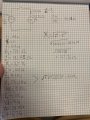
Yes, R-L is what I meant. I was referring to the wrong type of reactance. Here is how I calculated the inductive reactance of the relay coil. My question was more about expecting to see a phase shift of closer to 90 degrees given that the only load on the circuit was an inductor.
 

Attachments

Thread Starter

ArchdukeFerdinand

Joined Jun 9, 2026
4
AC relays usually operate at the low 50-60Hz AC main's frequency, so the coil winding resistance is often comparable to its AC reactance.
In this case, 60 hz. I measured a resistance of 70.1 ohms for the coil, but given the current and voltage in the circuit, the total impedance was 181.82 Ohms.
I figured the inductive reactance by taking the square root of the squared resistance subtracted from the squared impedance, resulting in an inductive reactance of 167.76 ohms.

I then figured the rest of the circuit as an R-L circuit as if it had a resistor with that value in it. Entirely possible I made a mistake or that's not the correct method, which is why I'm here asking. Def appreciate you helping me through it.
 

WBahn

Joined Mar 31, 2012
32,872
I see a lot of reference to a purely inductive circuit being one that only has an inductive load. But in practice, does the resistance of the coil itself make it an R-C circuit? I was recently analyzing a real circuit with no other load than an AC relay coil, and found measurable resistance in the coil (70.1 ohms) itself, and ended up with an angle Theta of 67.6 degrees.

Are there inductive circuits in the real world that have a corresponding phase shift that approaches 90 degrees? Searching the forum didn't result in any conclusive answer.
All components in the real world have parasitic components to their behavior. A straight piece of wire has inductance. Everything is capacitively coupled to everything else in the universe. With the exception of superconducting elements (which are only lossless at DC), everything has resistance. The issue is which, if any, of these are significant enough that we need to take them into account in order to get our design calculations close enough to be considered good enough.
 

BobTPH

Joined Jun 5, 2013
11,523
If you want to see a line powered circuit that approaches pure reactance, use the primary of a step-down transformer with the secondary left open.
 
Top