Radio Dipole Antenna From Pure Copper Rod

Thread Starter

meowsoft

Joined Feb 27, 2021
666
Hi, anyone have idea its great to make dipole antenna for HAM radio using pure copper rod instead using wires that usually done ?, I can even join those dipoles to jumper that then connect to RG58 female using exothermic molding
What do you think ?, its such will be a great dipole antenna to have for HAM radio ?, my transceiver is ICOM IC-2300H
 

nsaspook

Joined Aug 27, 2009
16,250
Hi, anyone have idea its great to make dipole antenna for HAM radio using pure copper rod instead using wires that usually done ?, I can even join those dipoles to jumper that then connect to RG58 female using exothermic molding
What do you think ?, its such will be a great dipole antenna to have for HAM radio ?, my transceiver is ICOM IC-2300H
What do you mean, exactly by 'pure copper rod'? What diameter? What do you expect to be better? Due to skin effect, most of the bulk interior of a 'pure' copper rod will have no RF current in it, only the surface.
 
Last edited:

Thread Starter

meowsoft

Joined Feb 27, 2021
666
What do you mean, exactly by 'pure copper rod'? What diameter? What do you expect to be better? Due to skin effect, most of the bulk interior of a 'pure' copper rod will have no RF current in it, only the surface.
What about 1" diameter ?, what do you think ?
 

SamR

Joined Mar 19, 2019
5,470
Increased diameter should give you wider bandwith at low SWR. Since you are in the VHF region, I assume 2M, you should be able to build a Full Wavelength dipole. If I did, I'd want to rotate it as well. Why stop there? Go for full blown 3 element full wavelength Yagi design using copper tubing! There is no real advantage in using copper instead of aluminum other than price of material. Copper is preferred for wire antennas due to material strength, preferably 14 or 12AWG stranded as it gives a bit more surface area and easier to work with. Dielectric jacketing or bare will give the same result. Get an antenna book from the ARRL and there are several to choose from.
 

nsaspook

Joined Aug 27, 2009
16,250
Increased diameter should give you wider bandwith at low SWR. Since you are in the VHF region, I assume 2M, you should be able to build a Full Wavelength dipole. If I did, I'd want to rotate it as well. Why stop there? Go for full blown 3 element full wavelength Yagi design using copper tubing! There is no real advantage in using copper instead of aluminum other than price of material. Copper is preferred for wire antennas due to material strength, preferably 14 or 12AWG stranded as it gives a bit more surface area and easier to work with. Dielectric jacketing or bare will give the same result. Get an antenna book from the ARRL and there are several to choose from.
Sure, if it's tubing. The OP was talking about a 'pure copper ROD'. I've talked across the planet as a profession Navy communicator using steel wire rope for HF and from over the ocean horizon at sea to jungle with Ground Pounders with 'Green Gear' on VHF/UHF using a discone. As you say, there is no real advantage in using copper instead of aluminum.
 
Last edited:

nsaspook

Joined Aug 27, 2009
16,250
I only mentioned tubing cause I figured he'd run out of the rod pretty quick for one reason or another.
I don't blame the OP for thinking it might be better if they only had a beginners level of electrical science training (without knowing the details of electromagnetic interactions with conductors) but if it truly was better, we would already be using 'pure copper rods' for antennas.
 

Lightium

Joined Jun 6, 2012
320
I don't blame the OP for thinking it might be better if they only had a beginners level of electrical science training (without knowing the details of electromagnetic interactions with conductors) but if it truly was better, we would already be using 'pure copper rods' for antennas.
I thought the OP just doesn't know that wires have copper in them or they have very bad english.
 

nsaspook

Joined Aug 27, 2009
16,250
I thought the OP just doesn't know that wires have copper in them or they have very bad english.
That's not my take, his english is fine. IMO the OP was likely thinking about DC resistance, knows that good wires have copper (the purer the better ;)) and that larger, thicker wires have lower resistance and would be better. Unfortunately electromagnetics says otherwise at RF. The EM energy travels, surrounds the wire and doesn't travel in it, so the EM field and conductor current interactions at higher frequencies due to skin effect limit currents to the surface of conductors leaving the deeper inner area useless as a RF conductor of current.
 
Last edited:

Thread Starter

meowsoft

Joined Feb 27, 2021
666
I don't blame the OP for thinking it might be better if they only had a beginners level of electrical science training (without knowing the details of electromagnetic interactions with conductors) but if it truly was better, we would already be using 'pure copper rods' for antennas.
I has some abandoned pure copper rod, which is usually for earth electrode in a grounding system, and just has idea to experiments with it for making dipole antenna from it, will not it has better durability too ?, what do you think ?

Waste of copper if solid.
Yes, but not really a waste, as I just got some left unused, and its 1" of pure copper which is usually used for earth electrodes
 

nsaspook

Joined Aug 27, 2009
16,250
I has some abandoned pure copper rod, which is usually for earth electrode in a grounding system, and just has idea to experiments with it for making dipole antenna from it, will not it has better durability too ?, what do you think ?
It will work but it won't work better. It is a waste of good copper that would be better used as grounding electrode (used someone that needs a better grounding system) as intended.

Much greater antenna losses arise due to variation in height, or distance from support structures and other things more important.
 
Last edited:

nsaspook

Joined Aug 27, 2009
16,250
and there is some has already make it too, exactly like this, but I think exothermic welding for connecting wire to rod maybe better
https://www.para.org.ph/para-diy-dual-band-vhf-uhf-dipole-by-anthony-urbano-du1au.html
If you really want to make it better, plate it with silver.

"Silver on a copper wire, @ 50°C, 400Mhz, pen depth= 3.38/10⁸, the 99.999% of current will be concentrated on periferic 23um of the Silver coating"

Reference: https://www.physicsforums.com/threads/electrical-rf-conductivity-of-copper-oxide.982371/
 

Thread Starter

meowsoft

Joined Feb 27, 2021
666
No, you would only need a 60 watt soldering iron. Those soldering joints only look bad, because the author rushed the job or didn't have a hot enough iron.
Yes, but I has already have exothermic welding kit, so its not a problem for me, better thank soldering I think

If you really want to make it better, plate it with silver.

"Silver on a copper wire, @ 50°C, 400Mhz, pen depth= 3.38/10⁸, the 99.999% of current will be concentrated on periferic 23um of the Silver coating"

Reference: https://www.physicsforums.com/threads/electrical-rf-conductivity-of-copper-oxide.982371/
Great idea

I thought the OP just doesn't know that wires have copper in them or they have very bad english.
No, I do jobs overseas and all using english, I has spoke to about two dozens countries in asia and east europe with my english and no problem so far, can do Russian too but not good
 

Danko

Joined Nov 22, 2017
2,135
and there is some has already make it too, exactly like this, but I think exothermic welding for connecting wire to rod maybe better
Those soldering joints only look bad, because the author rushed the job or didn't have a hot enough iron.
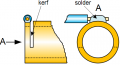
Easiest way to solder wire to copper tube versus 1/4 in diameter copper tube solder connection by TS's link:

1740286894278.png______________1740287407948.png
 
Last edited:
Top