Closed Loop Gain Formula Derivation - Why Superposition Theory is valid for the inverting amp.

Thread Starter

BlackMelon

Joined Mar 19, 2015
173
Hi,

I am reading about the closed loop gain formula for the inverting amp. The nonideality of the op-amp is only finite loop gain:
1. V+ ≠ V-
2. Vo = A*vid , where vid =V+ - V- and A is the op amp's open loop gain
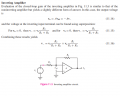
On the 5th page, the author find the formula for V- of the inverting amp by using the superposition theorem. How can he apply it since Vo is not an independent voltage source?

Best Regards,
BlackMelon
 

Attachments

WBahn

Joined Mar 31, 2012
32,702
Hi,

I am reading about the closed loop gain formula for the inverting amp. The nonideality of the op-amp is only finite loop gain:
1. V+ ≠ V-
2. Vo = A*vid , where vid =V+ - V- and A is the op amp's open loop gain
On the 5th page, the author find the formula for V- of the inverting amp by using the superposition theorem. How can he apply it since Vo is not an independent voltage source?

Best Regards,
BlackMelon
I'm assuming this is the portion of the text you are referring to:

1746959798003.png

I understand your confusion, since normally we would be trying to find V_ as a function of Vi via a superposition analysis of the entire circuit, including the dependent source that models the opamp output.

Here, the approach that is being taken is essentially a two step approach.

In this circuit, there is a voltage at Vi and there is a voltage at Vo. Forget where they come from, they are simply the voltages that happen to be at those two nodes.

From the standpoint of the voltage at V_, it doesn't matter how those voltages get to be what they are, so you can envision them as being two independent sources driving those two nodes and use superposition (or any other analysis technique you want) to find V_ as a function of Vi and Vo.

At his point, we have completely ignored that fact that Vo is determined by V_. Instead, we have simply established a relationship between Vi, Vo, and V_ that must be satisfied.

But now we apply the constraint in (11.14), which must also be satisfied, to (11.16) in order to eliminate V_ from the mix so that we can solve for the ratio of Vo/Vi, which is what we are interested in.

You can get the same result without using superposition.

The current flowing in R1 and R2 is

I = (Vi - Vo)/(R1 + R2)

The voltage at V_ is

V_ = Vi - I·R1

or, alternatively,

V_ = Vo + I·R2

Take your pick.

In either case, replace I with what it is equal to and you get

V_ = Vi - (Vi - Vo)·R1/(R1 + R2)

V_ = Vi·(1 - R1/(R1 + R2)) + Vo·R1/(R1 + R2)

V_ = Vi·R2/(R1 + R2) + Vo·R1/(R1 + R2)
 
Top