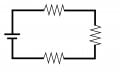
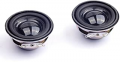
For any number of speakers, you want to wire them in a series/parallel combination so that the resultant impedance matches that of a single speaker (or close enough).
For example, suppose that a single channel is rated for 4Ω speakers and all you have are 8Ω speakers.
Two speakers in parallel will give you 4Ω.
Two speakers in series, then in parallel with two more such series connections (for a total of 6 speakers) will give you about 5Ω.
Sorry for my lack of technical language here, but do you mean to wire them in sequence like the attached image and in turn this will ensure that each of the speakers has the same audio output? Would doing 2 series of 3 speakers each work?
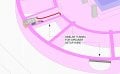
The speakers wont be rotating, I decided to put them on the static base since there's room here for me to use better speakers. (the rotating top would only allow me to use a speaker 0.5cm lol)
hi J,
That makes sense.
BTW: Note on the speaker connection tags they are marked with '-' and a '+' symbol,
When you decide which and how many speakers, we can tell you how to 'phase' them correctly.
E
There are a number of parameters you have to take into consideration besides physical size.
1) Speaker impedance and matching to the audio amplifier
2) Power output and matching to the audio amplifier.
3) Quality of the sound and type of audio (I assume that it will be a music file).
4) Acoustical loudness of the sound. 1W output is very loud for some people. For a dance party of 6 to 10 persons, 5W-15W is probably sufficient. If you are under 25y, 100W is probably not enough.
5) Size of the room and ambient background noise level.
6) Power consumption of the amplifier. (Class D amplifiers are more efficient that Class A, AB and B).
7) Do you need stereo output or mono output?
Besides the physical size of the speaker driver (i.e. the loudspeaker) the speaker enclosure is the most important factor in the quality of the sound and frequency range.
hi J,
That makes sense.
BTW: Note on the speaker connection tags they are marked with '-' and a '+' symbol,
When you decide which and how many speakers, we can tell you how to 'phase' them correctly.
E
There are a number of parameters you have to take into consideration besides physical size.
1) Speaker impedance and matching to the audio amplifier
2) Power output and matching to the audio amplifier.
3) Quality of the sound and type of audio (I assume that it will be a music file).
4) Acoustical loudness of the sound. 1W output is very loud for some people. For a dance party of 6 to 10 persons, 5W-15W is probably sufficient. If you are under 25y, 100W is probably not enough.
5) Size of the room and ambient background noise level.
6) Power consumption of the amplifier. (Class D amplifiers are more efficient that Class A, AB and B).
7) Do you need stereo output or mono output?
7)(updated) I just looked at the difference between stereo and mono, I think if stereo would not create much more complexity it would be good to use that
Besides the physical size of the speaker driver (i.e. the loudspeaker) the speaker enclosure is the most important factor in the quality of the sound and frequency range.
Thanks for the breakdown, some of these points are slightly confusing to me.
1) is matching this is just a case of checking compatibility with the speaker and audio amplifier?
2) as for the power output, this will be specified on the audio amplifier and I just need to make sure that the speakers I use are also to the same power output? (in W) Keith mentioned in a previous thread to use a 3-terminal 7805 linear regulator to drop 12V down to 5V, but this would depend on the audio amplifier I assume?
3) Its a light piano tune or
to be specific
4) So I know I understand this, the higher the W value will mean the loudness of the speaker is increased? Is this the only factor to consider when accounting for speaker volume or do the Ohms also impact the volume/output?
5) It would probably be in a bedroom/living room and used in quieter settings.
6) I haven't seen any classes specified on the amplifiers I've been looking at
7) Sorry I'm not sure what the difference is?
8) Would adding a volume adjustment dial help to resolve the speaker volume issues? If the speakers are too loud they could be turned down?
7)(updated) I just looked at the difference between stereo and mono, I think if stereo would not create much more complexity it would be good to use that
Let me see if I can address each issue along with your recent questions.
1) Speaker impedance and matching to the audio amplifier
Audio amplifiers are generally designed to match the impedance of the loudspeaker for best efficiency and power output.
8Ω used to be a standard speaker impedance. Solid state amplifiers have moved to lower impedance in order to gain higher output. Power output is inversely proportional to resistance. P = V x V / R. The lower the resistance, the more power you can output. Speaker impedance of 4, 3, 2Ω are now very common.
2) Power output and matching to the audio amplifier.
If the amplifier power is much greater than the rating of the speaker you are in danger of blowing the speaker. If the speaker power rating is much higher than that of the amplifier you may not get enough sound output. In both cases, you are wasting money for paying more than what is needed.
3) Quality of the sound and type of audio (I assume that it will be a music file).
Light piano tune vs professionally recorded song
A commercially available mp3 recording would be high quality stereo (two channels).
For a DIY recording of a piano you only need mono (one channel) and wouldn't be too fussy with the quality and frequency range of the recording.
4) Acoustical loudness of the sound. 1W output is very loud for some people. For a dance party of 6 to 10 persons, 5W-15W is probably sufficient. If you are under 25y, 100W is probably not enough.
5) Size of the room and ambient background noise level.
For a quiet bedroom setting 1W output is plenty loud.
6) Power consumption of the amplifier. (Class D amplifiers are more efficient that Class A, AB and B).
Most compact audio amplifiers on the market today are Class D because they are more efficient and less heat is generated. There are still small linear amplifiers being sold and they will tend to require more current (power) and the ICs would run at higher temperatures and may require heat sinks.
7) Do you need stereo output or mono output?
Stereo (two channel) output is required for proper bi-aural separation and enhanced listener enjoyment. This requires that two loudspeakers be spaced apart by a sufficient distance. Stereo recording and playback becomes important when you are trying to reproduce the ambiance of an orchestral performance in a large concert hall. Since you are planning on using six speakers and there is no bi-aural content from many digital pianos I suggest that you stick with mono (one channel).
Many audio amplifier modules sold are intended for two channel stereo output. You can split the power output so that each channel drives half of your speakers, e.g. one channel drives three speakers. If you have 2-channel audio source driving a 1-channel amplifier then you need to sum two channels into one. If you have a 1-channel source feeding a 2-channel amplifier you simply connect the two channels together. You should make sure that the loudspeakers are all in phase. If one loudspeaker is mounted facing backwards you have to wire it so that the sound is in-phase with the forward facing speakers. For a small project as you have described at lot of this is nit-picking.
8) Would adding a volume adjustment dial help to resolve the speaker volume issues? If the speakers are too loud they could be turned down?
This is mandatory. You need a way to control the loudness of the sound output. This is done via a volume control which may already be included with the amplifier module.
Let me see if I can address each issue along with your recent questions.
1) Speaker impedance and matching to the audio amplifier
Audio amplifiers are generally designed to match the impedance of the loudspeaker for best efficiency and power output.
8Ω used to be a standard speaker impedance. Solid state amplifiers have move to lower impedance in order to gain higher output. Power output is inversely proportional to resistance. P = V x V / R. The lower the resistance, the more power you can output. Speaker impedance of 4, 3, 2Ω are now very common.
2) Power output and matching to the audio amplifier.
If the amplifier power is much greater than the rating of the speaker you are in danger of blowing the speaker. If the speaker power rating is much higher than that of the amplifier you may not get enough sound output. In both cases, you are wasting money for paying more than what is needed.
3) Quality of the sound and type of audio (I assume that it will be a music file).
Light piano tune vs professionally recorded song
A commercially available mp3 recording would be high quality stereo (two channels).
For a DIY recording of a piano you only need mono (one channel) and wouldn't be too fussy with the quality and frequency range of the recording.
4) Acoustical loudness of the sound. 1W output is very loud for some people. For a dance party of 6 to 10 persons, 5W-15W is probably sufficient. If you are under 25y, 100W is probably not enough.
5) Size of the room and ambient background noise level.
For a quiet bedroom setting, 1W output is plenty loud.
6) Power consumption of the amplifier. (Class D amplifiers are more efficient that Class A, AB and B).
Most compact audio amplifiers on the market today are Class D because they are more efficient and less heat is generated. There are still small linear amplifiers being sold and they will tend to require more current (power) and the ICs would run at higher temperatures (and may require heat sinks).
7) Do you need stereo output or mono output?
Stereo (two channel) output is required for proper bi-aural separation and enhanced listener enjoyment. This requires that two loudspeakers are spaced apart by a sufficient distance. Stereo recording and playback becomes important when you are trying to reproduce the ambiance of an orchestral performance in a large concert hall. Since you planning on using six speakers and there is no bi-aural content in many digital pianos I suggest that you stick with mono (one channel).
Many audio amplifier modules sold are intended for two channel stereo output. You can split the power output so that each channel drives half of your speakers, e.g. one channel drives three speakers.
8) Would adding a volume adjustment dial help to resolve the speaker volume issues? If the speakers are too loud they could be turned down?
This is mandatory. You need a way to control the loudness of the sound. This is done via a volume control which may already be included with the amplifier module.
I haven't selected a 12V power supply yet, as I thought it would be better to select it after all of the power-draining components were specified. I did try to specify the power button and jack, which are as follows:
Given all of these components and your guidance, I was looking at the following possible options for the final electrical components if you feel these work work with the other components:
The sound amplifier and volume adjustment are the areas I'm most unsure of, I'm unsure is it possible to simply have a sound amplifier that will play a song on loop when a USB is plugged in to it or is there more to it than that?
These are essentially all of the electrical components I'm trying to use in my system though, there shouldn't be any other components after these have been finilized.
Based on the information you have provided:
Motor 1A @12V
LEDs 1A @12V
You are pushing 2A @12V.
Your power jack and switch are under-rated.
You will need a power supply that can deliver 3A @ 12V, or about 36W, on the conservative side. You might get away with a 1A @12V wall adapter. These are readily available at second hand stores at low prices. Try it before you pay for a more expensive solution.
If you are planning on using a 12V battery, you will need one with at least 3Ah capacity if you want to run the display for 1 hour. This is not an unreasonable size for a sealed lead acid battery.
Ok, thanks for the info, I'll look for a higher rated power jack and switch, so I need to look for a power jack and switch that can handle 3A?
I'll take a look for that size of power supply as well, I'm hoping to use a mains power supply to avoid disassembling the assembly every time a battery runs out. The space available for a battery is very limited.
Do you know if there is a specific type of sound amplifier I should look for based on the above power requirements? Will I also need to get a specific sound volume adjustment dial?
I'm just wondering, is my thinking correct that it is possible to simply have a USB stick/micro sd card connected with the sound board and as long as the wiring of the speakers and power is all correct then it will theoretically play the song stored on the usb/micro sd card repeatedly whilst the power is applied?
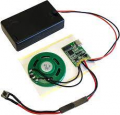
I've been looking into these but am wondering, would it be possible to connect something like this with the rest of my circuit (same power source and button) and add additional speakers?

 Facebook
 Google
 GitHub
 Linkedin