The 67 Chevy likely has a mechanical fuel pump on the left side of the engine, below the exhaust manifold. If you want to go with an electric fuel pump you'd remove the mechanical fuel pump and put a cover over the opening.
I have no intention to retrofit an electric fuel pump. My Response 'How would you do it?' Was intended for ThePanMan's ' I think temporarily applying starting power OR preventing it seems like the wrong way to go.' Comment.
We seem to have gone off on a tangent here gents!
Thank you all for your input. I'm aware that there are many different options. If this was a modern car, I would be interrupting fuel pump and ignition. This is how the customer wants it, simple, and non intrusive. Sure, if some one knew what they were doing, they would be able to get around it. But it will be an additional hurdle for an unknown member attempting to start the vehicle, and for this it will serve the purpose well.
It seems a few haven't quiet grasped what my issue was, but that is most likely on me for my lack luster explanation/s.
The only item I wish to address, it the timed Redarc relay from switching off when the voltage drops whilst cranking.
Another option that would not require a time-out to reset the crank-enable latch would be to reset it from the brake light circuit. My thinking is that the timer is only to assure that the timer intent was to provide an automated reset rather than a time-out to inhibit starting the engine. So resetting the latched enable the first time the brake was used will achieve results close enough to the original intent, I think.
The scheme would still require the same relay to enable the cranking motor, but it would also require two more lower power relays, the first to be latched on by the hidden button, and the second, with a normally closed contact, to release the first relay when the brake light circuit was powered. Both of those functions could be done with transistors but it would be more complex, and it would require a lot more construction effort.
Another option that would not require a time-out to reset the crank-enable latch would be to reset it from the brake light circuit. My thinking is that the timer is only to assure that the timer intent was to provide an automated reset rather than a time-out to inhibit starting the engine. So resetting the latched enable the first time the brake was used will achieve results close enough to the original intent, I think.
The scheme would still require the same relay to enable the cranking motor, but it would also require two more lower power relays, the first to be latched on by the hidden button, and the second, with a normally closed contact, to release the first relay when the brake light circuit was powered. Both of those functions could be done with transistors but it would be more complex, and it would require a lot more construction effort.
Sounds like a bit more work for not much gain. And this would most likely cause issues when the brake pedal is applied during start or an applied mid start.
Sounds like a bit more work for not much gain. And this would most likely cause issues when the brake pedal is applied during start or an applied mid start.
NOBODY applies the brake while cranking the engine! AND, more importantly, ONLY those folks who were supposed to be using the car would know the secret of the button, to which the secret of the reset could be mentioned. Consider that the only purpose of the whole project IS TO MAKE THE CAR HARDER TO START for those who are not supposed to be starting it.
The alarm system on my vehicle makes it less user-friendly to those trying to steal it. And the removable shift lever on my van made it difficult for thieves to drive away.
The whole purpose of any security system IS to "Cause Issues" for those bad actors.
I do. My wife does. I'm sure hundreds of thousands of others also do so. Modern cars can not be started unless you depress the brake pedal. That's pretty much a safety standard requirement for all automotive manufacturers today. Granted, the TS has a 67 vehicle which never had one of those safety devices. But to say NOBODY applies the brake while cranking the engine is a mis-speak.
I assume you are being facetious.
The relay consumes about 2W.
Assuming an alternator efficiency of 60%, the added engine load is 3.5W
A car typically requires about 20HP (15kW) at cruising speed.
The mileage will thus be reduced by about 0.02%.
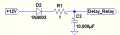
I think the single latched relay I proposed is the simplest solution to keep the car from starting, but it you must have the delay relay, then using a 1A diode in series with a 1Ω resistor from the 12V going to the delay relay with a large capacitor (e.g. 10,000μF) to ground would likely be the best solution (below).
Over here (Aus) we have a lot of theft by the youth, it’s almost all opportunistic. Keys left out, keys in car, keys left on the bench with the house unlocked ect.
Mostly the requirement is to apply the brake to shift into gear. Of course, many simply start and immediately shift into drive and go. My process is to start the engine and let it idle while I buckle-up. That allows the oil pressure to rise to normal and is recommended by some engine builders. And that few seconds of idling does not waste much fuel.
You will probably discover that the engine cranks and starts without the brake, but that the lack of brake application inhibits shifting into gear to move. And preventing the uninformed from starting the car is, after all, the whole intent of the addition.
Mostly the requirement is to apply the brake to shift into gear. Of course, many simply start and immediately shift into drive and go. My process is to start the engine and let it idle while I buckle-up. That allows the oil pressure to rise to normal and is recommended by some engine builders. And that few seconds of idling does not waste much fuel.
You will probably discover that the engine cranks and starts without the brake, but that the lack of brake application inhibits shifting into gear to move. And preventing the uninformed from starting the car is, after all, the whole intent of the addition.
May I ask what car you drive? Almost every passenger vehicle post 2013 requires either a brake pedal input or a clutch pedal input to start the vehicle.
May I ask what car you drive? Almost every passenger vehicle post 2013 requires either a brake pedal input or a clutch pedal input to start the vehicle.
I drive Dodges. Brake to start makes no sense at all, because with most cars the trans must be in neutral to crank the engine. And most cars will not move with the trans in PARK. Manual transmission vehicles may be different today, I have not driven a current production manual tranny vehicle. Of course, the rules might be different in California.
2017 Tacoma, V6, 6 speed automatic. Can not take it out of park unless the engine is running. Can not start it unless the brake pedal is depressed. Don't know off hand if after it's been started and still in park whether you have to step on the brake to shift out of park or not; my guess is yes, you still have to. When in all shift-positions the driver has the ability to shut the engine off. Park, Reverse, Neutral, Drive (or manual shifting using the up/down shift lever). You can shut it off in neutral then restart it but ONLY if you step on the brake pedal. Same thing is true for the Toyota Venza. Wife drives a 2009.
I've never tried to shut the engine off while moving. There may be some feature that will not allow you to shut the engine off while driving and in gear.
"Brake to start" is a safety feature so that you don't accidentally start the car while in gear. If for some mechanical reason the transmission IS NOT in park (or neutral), starting with your foot on the brake pedal makes it very unlikely you will start the car and hit something directly in front or behind you; be it a car, a wall or another person. "Brake to start" is an idiot proofing method to prevent accidental damage or injury to person or property.
My 2017 Camry starts just fine without brake pedal depressed. Do it every morning when reaching in from passenger side. As do all my Camrys going back to 1998. BUT, these cars require a KEY to start. A 2014 Camry XLE with keyless entry/ignition has a KEY FOB (i.e. no keyed ignition) and requires the driver to depress the brake pedal and then push the Start button. Shifting the transmission is a different story and not pertinent to original problem.
Brake to start is common on most new vehicles with key fobs. If you just press the start button by itself, it is the equivalent of turning it to IGN on the older vehicles. Key is on, but it does not start.

 Facebook
 Google
 GitHub
 Linkedin