Smoothing voltage drops when cranking with a capacitor

ronsimpson

Joined Oct 7, 2019
4,704
what is it that you are trying to achieve with the timer
We don't know but, in high crime areas people put a kill switch on cars. Usually killing the spark or something unless you know the secret button. It would nice to have a button that interrupted the starter relay. Push the button and have 30 seconds where the engine will crank. After that no starter.
What are your DIP Switch settings?
The switches set the time of delay.
 

wraujr

Joined Jun 28, 2022
260
We don't know but, in high crime areas people put a kill switch on cars. Usually killing the spark or something unless you know the secret button. It would nice to have a button that interrupted the starter relay. Push the button and have 30 seconds where the engine will crank. After that no starter.

The switches set the time of delay.
To TS, what are your DIP Switch settings?
 

MisterBill2

Joined Jan 23, 2018
27,615
The solution is reallysimple, which is to use a timer that does not use an RC (analog) time constant. A digital counter will provide the same delay every time, as long as the supply voltage stays withing the specified requirements.
 

Thread Starter

jawdoss

Joined Apr 25, 2023
27
I don't think your use of "kill switch" is correct as you are starting not "killing" a running engine. I think this is confusing many. Sounds like a momentary (i.e. 30 sec) start switch.
I guess a better way to describe it would be a start prerequisite. Much like a neutral safety switch The second relay not engage the starter for 30 seconds, it engages allowing the trigger from the ignition barrel to pass through.
 

LesJones

Joined Jan 8, 2017
4,511
As it is not practical to have a capacitor large enough to power the relays during a voltage dip I suggest reverse engineering the timer and post the schematic. We need to seperate the power feed to the timer electronics from the power that is switced by the timer relay contacts. The timer electronics will probably take very little current so a reasonable size capacitor would be able to power it during voltage dips.

Les.
 

wraujr

Joined Jun 28, 2022
260
How about a more descriptive timeline approach such as (this may not be what you are thinking, so please adjust.
(1) At time 0, user presses momentary switch and TIM05 output goes to 12V and therfore starter relay engaged.
(2) At time 1 sec, user releases momentary switch and TIM05 output remains at 12V.
(3) At time 31 sec, TIM05 timer expires and its output goes off and at this time the starter relay goes off.
 

wraujr

Joined Jun 28, 2022
260
Since this timer was designed to operate in an auto environment and manual specifically talks about engine starting and running, it seems likely that it is designed for harsh environment. Still not sure what TS is trying to achieve and how its wired and configured.
 

wraujr

Joined Jun 28, 2022
260
As I posted above, I beleive you want both SW1 and SW2 OFF.
SW2 OFF for seconds.
SW1 OFF so 30 sec delay starts when momentary push switch released.

SW1 ON, indicates that your INPUT from momentary switch must be on for longer than the time delay. In other words, user holds down switch for more than 30 seconds, but relay cuts out after 30 seconds preventing overcranking.
 

Thread Starter

jawdoss

Joined Apr 25, 2023
27
Since this timer was designed to operate in an auto environment and manual specifically talks about engine starting and running, it seems likely that it is designed for harsh environment. Still not sure what TS is trying to achieve and how its wired and configured.
 

Attachments

Thread Starter

jawdoss

Joined Apr 25, 2023
27
As I posted above, I beleive you want both SW1 and SW2 OFF.
SW2 OFF for seconds.
SW1 OFF so 30 sec delay starts when momentary push switch released.

SW1 ON, indicates that your INPUT from momentary switch must be on for longer than the time delay. In other words, user holds down switch for more than 30 seconds, but relay cuts out after 30 seconds preventing overcranking.
I apologise, you are correct, I do believe I have them both set to off. Cant verify right at this moment as I am not in front of the vehicle
 

wraujr

Joined Jun 28, 2022
260
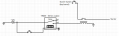
Thanks for diagram.
So operation is as follows:
(1) User starts by briefly pressing your momentary switch, which engages TIM05 and starts 30 sec timer, also starter relay is engaged allowing the user to start engine.
(2) User must then press and hold starter switch to crank engine and if user attempts to crank engine for more than thirty seconds the TIM05 timer will expire and engine cranking will cease.
 

Thread Starter

jawdoss

Joined Apr 25, 2023
27
Thanks for diagram.
So operation is as follows:
(1) User starts by briefly pressing your momentary switch, which engages TIM05 and starts 30 sec timer, also starter relay is engaged allowing the user to start engine.
(2) User must then press and hold starter switch to crank engine and if user attempts to crank engine for more than thirty seconds the TIM05 timer will expire and engine cranking will cease.
Correct!
 

wraujr

Joined Jun 28, 2022
260
Well if SW1 is OFF and the TIM05 is not holding output when cranking, then sure does sound like it is too sensitive to a voltage drop on its input (pin 30).
Quite frankly for a relay that appears to cost $150 USD, has DIP switches to configure, I would have expected digital (think LM555) insides with a decent power filter and power supply as a dip to 11V is not that large (although as others mentioned, you don't always see quick dip with a voltmeter).
So then the diode and capacitor on pin 30 might be a solution but everything needs to be sized to accommodate the current of the TIM05 and the current of the 30A starter relay.
As others said, that starter relay coil will probably be 80-100 ohm at 12V is 150ma.
We could guess the TIM05 as also 150ma.
So your current looks to be round 300ma, but add safety/fudge and call it 500ma.
Are you then looking to hold up for the full 30 seconds.
It also looks like you want no more than 1 - 1.5V drop.
So you need cap that starts at say 12.5V and drops to no less than 11.5V under a 30 sec, 0.5A current draw...
Anybody got that calc?
 

Thread Starter

jawdoss

Joined Apr 25, 2023
27
During cranking the voltage can drop to very little. Much lower than 11V you see. This depends on the temperature, battery age, conditions of battery wires, etc. Using a diode and large capacitor as stated above should work. The diodes catches the highest voltage and stores it on the capacitor, then keeps current from flowing from the capacitor back to the starter.

I do not know how much power the timer uses. That will determine how long the timer can run using only the capacitor as a source of power. The capacitor should only power the "brains" of the time.

Measuring with a meter, you are seeing an average voltage. The voltage probably has very fast dips and hills that range from 6V to 15V. I did automotive design years ago. As the motor turns over, on the compression stroke the starter works very hard and pulls down the voltage, on the power stroke (even when the motor has no spark) energy is pushed back into the starter. There is a short time where there is no load on the starter.

I cannot remember the RPMs during cranking. I think I wanted 1 second of storage on the auto computers I designed. But I think 0.1 sec will work.

I can't find a good data sheet on your timer.

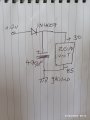
I would put a diode in series with the relay coil supply , like a 1N4007 and a 470uF capacitor across the coil supply to gnd to suppress the starter motor pulse.

When you say across the coil supply, should I not put it across the supply to pin 30 as this is the constant battery supply? Could can you possibly show me how you would lay it out on a diagram? I'm fluent with all things automotive, but this is another level and I'd rather learn from a diagram than three hours of fault finding after the fact ;)
 

Thread Starter

jawdoss

Joined Apr 25, 2023
27
Well if SW1 is OFF and the TIM05 is not holding output when cranking, then sure does sound like it is too sensitive to a voltage drop on its input (pin 30).
Quite frankly for a relay that appears to cost $150 USD, has DIP switches to configure, I would have expected digital (think LM555) insides with a decent power filter and power supply as a dip to 11V is not that large (although as others mentioned, you don't always see quick dip with a voltmeter).
So then the diode and capacitor on pin 30 might be a solution but everything needs to be sized to accommodate the current of the TIM05 and the current of the 30A starter relay.
As others said, that starter relay coil will probably be 80-100 ohm at 12V is 150ma.
We could guess the TIM05 as also 150ma.
So your current looks to be round 300ma, but add safety/fudge and call it 500ma.
Are you then looking to hold up for the full 30 seconds.
It also looks like you want no more than 1 - 1.5V drop.
So you need cap that starts at say 12.5V and drops to no less than 11.5V under a 30 sec, 0.5A current draw...
Anybody got that calc?
It wouldn't need to hold up for 30 seconds, more so 2-3 seconds whilst cranking or even 5 seconds at most. 30 seconds is simply the widow they have to start it, not the total time cranking.
 

wraujr

Joined Jun 28, 2022
260
Battery+ ---> Diode(Anode) / Diode(Cathode) ----> Cap(+ terminal) ----> TIM05 (pin 30)
and
Cap(- terminal) to chassis/ground
 

wraujr

Joined Jun 28, 2022
260
BTW, one quick test to see if SW1 is set properly.
Have user press AND hold your momentary switch down AND while holding this switch down, crank the engine and see if TIM05 cuts out or stays active.
 

Dodgydave

Joined Jun 22, 2012
11,395
When you say across the coil supply, should I not put it across the supply to pin 30 as this is the constant battery supply? Could can you possibly show me how you would lay it out on a diagram? I'm fluent with all things automotive, but this is another level and I'd rather learn from a diagram than three hours of fault finding after the fact ;)
Like this.. it's worth a try..


16824931496206596502291770974839.jpg
 
Top