Ripple Blanking Technique For CD4511s

Status
Not open for further replies.

sarahMCML

Joined May 11, 2019
698
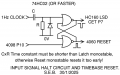
After some experimenting and a few false starts, here's the circuit. Irealised when I looked at the schematics you sent me before that your oscillator module was feeding into the CD4060, unlike my CD4536, which self oscillates. So you CAN reset the internal counters within it, and my circuit takes this into account. It stops the input signal by holding the CEP pin of the first HC160 low briefly.
What held me up was the RC time constant of my circuit was way too long, and I wasn't getting a pulse on the CEP output pin. It took me quite a while to realise that the differentiated timebase pulse was still high long after the 4098 tried to trigger the other side, so nothing happened! So make sure it's shorter than the Latch pulse and you should be fine.
I don't give any values because I had to use a 74LS27 Triple 3 Input unit, it was all I had, and the pulldown resistor was just 2k2 with that!
Thanks for the new schematics, by the way. I like your Alert circuit, with the CD4063's. I used some of those a year or so back making a stepper motor exerciser all in hardware.

Anyway, here's the very simple circuit. You might ask, why not use the other half of the unused 4013? You could probably, if you cannot get your circuit to run any faster than it currently does, but at 30 to 40MHz, two simple cross-coupled gates are faster.
NOR-Latch.png
 

Thread Starter

NapSolo

Joined Oct 29, 2024
115
After some experimenting and a few false starts, here's the circuit. Irealised when I looked at the schematics you sent me before that your oscillator module was feeding into the CD4060, unlike my CD4536, which self oscillates. So you CAN reset the internal counters within it, and my circuit takes this into account. It stops the input signal by holding the CEP pin of the first HC160 low briefly.
What held me up was the RC time constant of my circuit was way too long, and I wasn't getting a pulse on the CEP output pin. It took me quite a while to realise that the differentiated timebase pulse was still high long after the 4098 tried to trigger the other side, so nothing happened! So make sure it's shorter than the Latch pulse and you should be fine.
I don't give any values because I had to use a 74LS27 Triple 3 Input unit, it was all I had, and the pulldown resistor was just 2k2 with that!
Thanks for the new schematics, by the way. I like your Alert circuit, with the CD4063's. I used some of those a year or so back making a stepper motor exerciser all in hardware.

Anyway, here's the very simple circuit. You might ask, why not use the other half of the unused 4013? You could probably, if you cannot get your circuit to run any faster than it currently does, but at 30 to 40MHz, two simple cross-coupled gates are faster.
View attachment 341570
Thanks very much for the circuit. I'll order a couple HC02s which may take a while. The freight charges
on small orders are brutal. In order to get 74F02s I would need to order from the US.

I think that I will try 1/2 of a CD4001 with a 2.2K resistor and a 100 pF cap just for fun. That should result in a 220 ns
pulse compared to the Latch pulse of 560 ns. I find it odd that my scope said both the reset and the latch pulse
width were1.24 us.

Cheers
 
Last edited:

sarahMCML

Joined May 11, 2019
698
You need the 'Two gate' FF to produce its output response to the timebase timeout within less than one cycle of your fastest input signal. Hence my use of the LS NOR gates (or HC ones!)

Did you sort out the misbehaving counting at frequencies below 400Hz? Mine shows no sign of that problem.
Currently I only have six digits of resolution (including the two added HC161's), but I know it's counting to the highest speeds because the calculated remainders agree with the displayed values on the LED's. If/when I get some HC160's I may breadboard another four proper stages and get to your design.
 

Thread Starter

NapSolo

Joined Oct 29, 2024
115
You need the 'Two gate' FF to produce its output response to the timebase timeout within less than one cycle of your fastest input signal. Hence my use of the LS NOR gates (or HC ones!)

Did you sort out the misbehaving counting at frequencies below 400Hz? Mine shows no sign of that problem.
Currently I only have six digits of resolution (including the two added HC161's), but I know it's counting to the highest speeds because the calculated remainders agree with the displayed values on the LED's. If/when I get some HC160's I may breadboard another four proper stages and get to your design.
Hi:

No, I wasn't able to figure out the 400Hz issue. I didn't have that problem when all the counters were 4510s nor did I have the LSD always displaying either an "8" or a "9". I am going to check the wiring again in case I messed up. I checked the jumpers for continuity. I did read that iron or steel jumper wires can wreak havoc with frequencies above 100KHz. Don't if that is correct or not.

I found a place that has some 74F02s. Are there any other HC or F chips that might be useful as I need to get a large
enough order to avoid a huge freight charge?

Have a good day!
 

Thread Starter

NapSolo

Joined Oct 29, 2024
115
You need the 'Two gate' FF to produce its output response to the timebase timeout within less than one cycle of your fastest input signal. Hence my use of the LS NOR gates (or HC ones!)

Did you sort out the misbehaving counting at frequencies below 400Hz? Mine shows no sign of that problem.
Currently I only have six digits of resolution (including the two added HC161's), but I know it's counting to the highest speeds because the calculated remainders agree with the displayed values on the LED's. If/when I get some HC160's I may breadboard another four proper stages and get to your design.
Hi:

No, I wasn't able to figure out the 400Hz issue. I didn't have that problem when all the counters were 4510s nor did I have the LSD always displaying either an "8" or a "9". I am going to check the wiring again in case I messed up. I checked the jumpers for continuity. I did read that iron or steel jumper wires can wreak havoc with frequencies above 100KHz. Don't if that is correct or not.

I have ordered some 74F02s. They should arrive next week.

Have a good day!
 

Thread Starter

NapSolo

Joined Oct 29, 2024
115
Hi:

No, I wasn't able to figure out the 400Hz issue. I didn't have that problem when all the counters were 4510s nor did I have the LSD always displaying either an "8" or a "9". I am going to check the wiring again in case I messed up. I checked the jumpers for continuity. I did read that iron or steel jumper wires can wreak havoc with frequencies above 100KHz. Don't know if that is correct or not.

I have ordered some 74F02s. They should arrive next week.

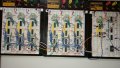
Just for fun I have attached a photo of Frequency Counter 2.0. It uses 4510s, 4511s, 4072s and 40174s. LSD is stable
and the readings are spot on until 100 KHz and then they deviate a little. In the photo, the input was 1.2 MHz. I still
have the original circuit that we have been working on! Of course the limit is approx. 1.25 MHz.
 

Attachments

Thread Starter

NapSolo

Joined Oct 29, 2024
115
OK, I'll see if I can spot anything. Incidentally, where did you get your HC160's from? I'm having a hard time finding somewhere!
I got them from Jameco Electronics in Belmont (San Francisco area). They ended up costing me about $10 Cdn
each with all the duty, tax, Freight etc. Don't think I will order stuff from the states until we see what is going
to happen, if you know what I mean. Jameco does show 229 pieces in their stock status today. I tried Futurlec
initially but they seem to be flakey. They don't show a stock status on their web site. I gave up on them.
 

sarahMCML

Joined May 11, 2019
698
Well, I had a good look over the photo you sent and can't spot anything that shouldn't stop it working the way mine does. As I think I said before, all my 4029 chips (the four slower ones) are still wired in synchronous mode, whereas the two HC161's are wired Ripple clocked. But even when they were wired synchronous they still ran just as fast.

The one thing I did notice was that the two unused inputs on all your CD40174's are floating, when they should for safety be tied up or down. but I don't think that is making any operational difference! And your board layout is great compared to my original breadboard one!

As to the 74F02 chip, I suggest that when you get them you test one for it's low level input voltage. Put a 2k2 resistor on an input to ground and check that the voltage is less than 0.8V. If not you'll have to lower the resistor until it is. If it's lower, you can increase the resistor, and use that pin with a correspondingly smaller capacitor for the trigger input from the 1Hz timebase.

One thing that just struck me is that your input conditioning circuit may not be fast enough. Have you tried inputting your signal generator straight into the first HC160. I put a 1k to ground from my first input (one reason being because my generator tends to swing a little below gnd), and drive it from the TTL/CMOS output. Even at the 20MHz end, where the square wave looks more like a sine, it still reads correctly.

Are you intending to build this properly, on a PCB or stripboard eventually?
 

Thread Starter

NapSolo

Joined Oct 29, 2024
115
Well, I had a good look over the photo you sent and can't spot anything that shouldn't stop it working the way mine does. As I think I said before, all my 4029 chips (the four slower ones) are still wired in synchronous mode, whereas the two HC161's are wired Ripple clocked. But even when they were wired synchronous they still ran just as fast.

The one thing I did notice was that the two unused inputs on all your CD40174's are floating, when they should for safety be tied up or down. but I don't think that is making any operational difference! And your board layout is great compared to my original breadboard one!

As to the 74F02 chip, I suggest that when you get them you test one for it's low level input voltage. Put a 2k2 resistor on an input to ground and check that the voltage is less than 0.8V. If not you'll have to lower the resistor until it is. If it's lower, you can increase the resistor, and use that pin with a correspondingly smaller capacitor for the trigger input from the 1Hz timebase.

One thing that just struck me is that your input conditioning circuit may not be fast enough. Have you tried inputting your signal generator straight into the first HC160. I put a 1k to ground from my first input (one reason being because my generator tends to swing a little below gnd), and drive it from the TTL/CMOS output. Even at the 20MHz end, where the square wave looks more like a sine, it still reads correctly.

Are you intending to build this properly, on a PCB or stripboard eventually?
The circuit in post #98 (Vers 2.0) is using all 4510s as I was hesitant to try the HC160s in that version since it works so well
despite the limited range. I will tie all CD40174 used inputs to ground as I missed that. I found that using all CD4072s rather
than some CD4071s and some CD4072s and using the CD40174s rather than the 74HC574s made the layout simpler in my
case. I may replace two of the 4510s with fingers crossed.

Thanks for the suggestion regarding the 74F02s.

I have been feeding the signal directly into the counter lately because I wasn't sure about my input circuit.

The 4510s are wired in ripple mode in the orginal circuit without the CD4571s connecting the COs and CLKs. Could that be
a problem?

I am also thinking about wiring the 4510s on the orginal circuit in synchronous mode rather than ripple just to see if that
makes a difference.

I hope to do a permanent of build the circuit. A psb would be great but I think that it might be expensive so I will
likely do a stripboard version.

Were you able to source the HC160s?
 
Last edited:

Thread Starter

NapSolo

Joined Oct 29, 2024
115
The circuit in post #98 (Vers 2.0) is using all 4510s as I was hesitant to try the HC160s in that version since it works so well
despite the limited range. I will tie all CD40174 used inputs to ground as I missed that. I found that using all CD4072s rather
than some CD4071s and some CD4072s and using the CD40174s rather than the 74HC574s made the layout simpler in my
case. I may replace two of the 4510s with fingers crossed.

I have been feeding the signal directly into the counter lately because I wasn't sure about my input circuit.

I hope to do a permanent of build the circuit. A psb would be great but I think that it might be expensive so I will
likely do a stripboard version.

Thanks for the info re the

Were you able to source the HC160s?
 

sarahMCML

Joined May 11, 2019
698
The circuit in post #98 (Vers 2.0) is using all 4510s as I was hesitant to try the HC160s in that version since it works so well
despite the limited range. I will tie all CD40174 used inputs to ground as I missed that. I found that using all CD4072s rather
than some CD4071s and some CD4072s and using the CD40174s rather than the 74HC574s made the layout simpler in my
case. I may replace two of the 4510s with fingers crossed.

Thanks for the suggestion regarding the 74F02s.

I have been feeding the signal directly into the counter lately because I wasn't sure about my input circuit.

The 4510s are wired in ripple mode in the orginal circuit without the CD4571s connecting the COs and CLKs. Could that be
a problem?

I am also thinking about wiring the 4510s on the orginal circuit in synchronous mode rather than ripple just to see if that
makes a difference.

I hope to do a permanent of build the circuit. A psb would be great but I think that it might be expensive so I will
likely do a stripboard version.

Were you able to source the HC160s?
I can't figure out how to quote between paragraphs on the forum so I'll answer at the bottom.

No, you don't need the 4071's connecting the /CO's to the following Clock's in ripple mode, not when connecting like to like anyway.

My 4029's are wired in sync mode because that's how I originally did them, and it's too much trouble altering the board to try them in Ripple mode. But given that they are in the slower parts of the circuit anyway, and the fact that I didn't see much difference when changing the HC161's from sync to ripple mode, I don't think it's worth it. But if you want to,it's a fairly quick fix!

I have found a place over here that seems to have a few, and will accept private orders, so I'm looking through their website to see what else they have before doing so.
 

Thread Starter

NapSolo

Joined Oct 29, 2024
115
I can't figure out how to quote between paragraphs on the forum so I'll answer at the bottom.

No, you don't need the 4071's connecting the /CO's to the following Clock's in ripple mode, not when connecting like to like anyway.

My 4029's are wired in sync mode because that's how I originally did them, and it's too much trouble altering the board to try them in Ripple mode. But given that they are in the slower parts of the circuit anyway, and the fact that I didn't see much difference when changing the HC161's from sync to ripple mode, I don't think it's worth it. But if you want to,it's a fairly quick fix!

I have found a place over here that seems to have a few, and will accept private orders, so I'm looking through their website to see what else they have before doing so.
Sounds good. I am going to experiment with 74HC160s if I can figure out how to wire one up as a simple divide by 10
counter like the old 7490s. I want to see what happens if I take a 20 MHz input signal and divide it by 10 before it goes
to the counters. Just for fun.
 

Thread Starter

NapSolo

Joined Oct 29, 2024
115
I can't figure out how to quote between paragraphs on the forum so I'll answer at the bottom.

No, you don't need the 4071's connecting the /CO's to the following Clock's in ripple mode, not when connecting like to like anyway.

My 4029's are wired in sync mode because that's how I originally did them, and it's too much trouble altering the board to try them in Ripple mode. But given that they are in the slower parts of the circuit anyway, and the fact that I didn't see much difference when changing the HC161's from sync to ripple mode, I don't think it's worth it. But if you want to,it's a fairly quick fix!

I have found a place over here that seems to have a few, and will accept private orders, so I'm looking through their website to see what else they have before doing so.
Sounds good.
 
Last edited:

MrChips

Joined Oct 2, 2009
34,829
You are interpreting datasheet specifications incorrectly.
FMAX is a minimum of 30 MHz.
This means that the device is guaranteed to operate at that frequency under the given conditions.
It does not state that the device will not work at higher frequencies. It would not suddenly stop working if you exceed fMAX. It means that your device is likely to operate at higher frequencies. Your mileage will vary.
 

Thread Starter

NapSolo

Joined Oct 29, 2024
115
You are interpreting datasheet specifications incorrectly.
FMAX is a minimum of 30 MHz.
This means that the device is guaranteed to operate at that frequency under the given conditions.
It does not state that the device will not work at higher frequencies. It would not suddenly stop working if you exceed fMAX. It means that your device is likely to operate at higher frequencies. Your mileage will vary.
I guess they should call it Fmin. Well, that works in my favour anyway.

Thanks MrChips!
 

MrChips

Joined Oct 2, 2009
34,829
I guess they should call it Fmin. Well, that works in my favour anyway.

Thanks MrChips!
No. FMAX is the proper notation.
Just keep in mind that you are pushing the device's operation beyond its design capabilities at your own peril.

Like all limits, how far do you risk pushing your luck?

There could be excess capacity here.

1738861824700.png


This is a hard limit.

1738861700483.png
 

sarahMCML

Joined May 11, 2019
698
One thought just occurred to me. You are latching your LSD directly into the CD4511 without going through an HC574 or HC174, correct? If so, it may be that the device is far too slow at setting up and latching in the correct count from the HC160 or HC390. You could easily lose a few counts, depending on where you catch the various states in their cycles! Hence the need to immediately stop the input signal when the timebase times out!

The company over here that was advertising HC160's turned out to import them from the States, and wanted to charge £50 just for P&P, so that's a non starter. I'll get some SOIC ones from DigiKey instead!

Interesting about the HC390, I think I have a few of those. I may try one out!
 

Thread Starter

NapSolo

Joined Oct 29, 2024
115
One thought just occurred to me. You are latching your LSD directly into the CD4511 without going through an HC574 or HC174, correct? If so, it may be that the device is far too slow at setting up and latching in the correct count from the HC160 or HC390. You could easily lose a few counts, depending on where you catch the various states in their cycles! Hence the need to immediately stop the input signal when the timebase times out!

The company over here that was advertising HC160's turned out to import them from the States, and wanted to charge £50 just for P&P, so that's a non starter. I'll get some SOIC ones from DigiKey instead!

Interesting about the HC390, I think I have a few of those. I may try one out!
Yes, I am latching the LSD directly into the CD4511. I will try an HC174 in there and see how that works. Thanks for
that idea!

I have now wired the HC174 into LSD circuit. The Counter works up to just over 15 MHz but the LSD always
displays a zero. You would almost think that it was hard-wired to do that. I have checked the wiring and the integrity
of the connections and everything appears to be ok.

Man, £50 is about $89 Cdn. That is criminal. Those bandits at Jameco charged me about $10 Cdn each for the HC160s.
 
Last edited:

Thread Starter

NapSolo

Joined Oct 29, 2024
115
One thought just occurred to me. You are latching your LSD directly into the CD4511 without going through an HC574 or HC174, correct? If so, it may be that the device is far too slow at setting up and latching in the correct count from the HC160 or HC390. You could easily lose a few counts, depending on where you catch the various states in their cycles! Hence the need to immediately stop the input signal when the timebase times out!

The company over here that was advertising HC160's turned out to import them from the States, and wanted to charge £50 just for P&P, so that's a non starter. I'll get some SOIC ones from DigiKey instead!

Interesting about the HC390, I think I have a few of those. I may try one out!
Yes, I am latching the LSD directly into the CD4511. Thanks for that idea!

I have now wired the HC174 into LSD circuit. The Counter works up to just over 15 MHz but the LSD always
displays a zero. You would almost think that it was hard-wired to do that. I have checked the wiring and the integrity
of the connections and everything appears to be ok.

Man, £50 is about $89 Cdn. That is criminal. Those bandits at Jameco charged me about $10 Cdn each for the HC160s.

I am still tinkering with Version 2.0 and the HC390 as a prescaler. I came up with a circuit that is supposed to switch
in a divide by 100 prescaler if the input is 1 MHz or higher. The trigger is the carry out of the MSD's (digit number 7
of 7 in this in Version 2.0) carry out signal. I was concerned that the timing might not be right even though the logic
works in a Spice simulation. I would really not like to have a range selector switch even if it is a toggle on / toggle
off deal. Not sure what to do yet.

Cheers!
 

Attachments

Status
Not open for further replies.
Top