Reducing Ripple on a buck-boost converter powered with a battery.

Thread Starter

hoyyoth

Joined Mar 21, 2020
528
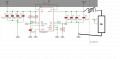
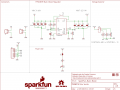
I am using this buck boot converter for Powering my microcontroller development board.The buck boost converter board will be powered using a battery.The schematic of buck boost controller is given below.
1763484142266.png

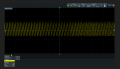
I am getting a ripple voltage of 33 mV and ripple frequency is 1.7 Khz before starting the measurement I kept two 0.1uF parallel with the 22uF already present in the board.But no use I am getting the same value without 0.1uF.

Ripple voltage with two 0.1 uF Parallel with 22 uF
1763484194337.png

I a using this oscilloscope first time.I believe my settings are correct.(Coupling AC,BW--> 20 MHz).

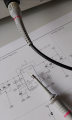
I am using the below probe.
1763484226399.png

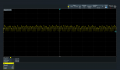
I did one more experiment after that. I removed the two 0.1uF placed in parallel with the 22uF. Then I kept an RC filter at the output R= 330K and C = 470pF. The output of the RC filter output is given below. Here I can see that the ripple is reduced.Peak to pkeak ripple now became 16.2 mV and ripple frequency is 1.55 Khz.
1763484289032.png


Still my ripple voltage is very high. My ADC is 12 bit and reference voltage is 3.3V.

Can you suggest some methods to reduce ripple on this board?.

Also may I know is there any error in my measurement,I mean in my method of measurement.
 
Last edited:

crutschow

Joined Mar 14, 2008
38,316
Are you grounding the probe directly at the converter ground?

Is this ripple affecting your ADC measurement?

The ripple could be reduced, if really needed, by adding a series inductor at the converter output.
 

Thread Starter

hoyyoth

Joined Mar 21, 2020
528
I am connecting the probe ground at capacitor ground.I am measuring parallel with the capacitor.

Ripple can affect the ADC measurement.

The ripple could be reduced, if really needed, by adding a series inductor at the converter output.
Can I keep an inductor at the output of 22uF capacitor.
 

ronsimpson

Joined Oct 7, 2019
4,645
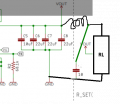
I added another capacitor.
The L opens up the wire (at high frequency) going to RL and reduces the high frequency noise.
The C shorts out the high frequency noise.
Alone they can only do so much. Doing both really helps.
1763493391285.png
 

schmitt trigger

Joined Jul 12, 2010
2,027
Wait a minute!
The TPS63070 switches at a minimum frequency of 2.4Mhz.
Yes, Megahertz!
Where are you observing 1.55 Khz???

Two scenarios:
1- the scope is aliasing. You require to reduce the timebase at least 1000 times to 5us, or even better to 1us.
2- you are suffering from sub harmonic oscillation. Increase the load to at least 1/2 of its rated capacity.
 

crutschow

Joined Mar 14, 2008
38,316
you have any suggestions for inductor value
Generally pick one that can carry the maximum load current without saturating, and the largest inductance you have room for.
But you do need to be aware of any resonant peaking that can occur at the resonant frequency of the inductor value and the total value of the capacitance in series with the input and output of the inductor to ground.
 

ronsimpson

Joined Oct 7, 2019
4,645
Are we looking at 1.55khz or 2.4mhz?
For 2.4mhz there are many beads that have 100 ohm or 1,000 ohms at 2mhz. That will open up the wire. For the cap. you should look for something smaller. You want capacitance so the impedance is 1 ohm or lower at 2mhz but the self-resonant frequency is way above 2mhz.
If you really have 1.5khz noise under load, you probably should look at the stability of the error amplifier. (or) Use a large inductor.
 

Ian0

Joined Aug 7, 2020
13,097
How close is your input decoupling capacitor to the IC?
I have used TI's buck regulators, and they are particularly sensitive to the correct placement of input decoupling.
 

Thread Starter

hoyyoth

Joined Mar 21, 2020
528
Did you read the data sheet section which I posted?
What does it say, with respect to the minimum load, to avoid entering the power-save mode?
Yes I finished that section.
" Depending on the load current, in order to provide the best efficiency over the complete load range, the device works in PWM mode at an inductor current of approximately 650 mA or higher. At lighter load, the device switches automatically in to Power Save Mode to reduce power consumption and extend battery life. The PFM/PWM pin can be used to select between the two different operation modes. To enable Power Save Mode, the PFM/PWM pin must be set high "

My output voltage is 3.3V .I need to keep a resistor of value 5.1 Ohm or less for PWM
 

MisterBill2

Joined Jan 23, 2018
27,159
An invisible cause of some amounts of supply output voltage ripple is ground side resistance. All of those multiple capacitors are there to provide the current during the inverter operation, but if the resistance in series on the low side is excessive then a voltage is developed which leads to ripple in the output. Those "ground" symbols imply a zero resistance, seldom the case.
 
Top