Ripple Blanking Technique For CD4511s

Status
Not open for further replies.

Thread Starter

NapSolo

Joined Oct 29, 2024
115
Having just taken another look at the Carry Out signals of the two devices, I think you may need to put an inverter between the output of the last HC160 and the first CD4510, because the levels are the reverse of each other!
I have the counter working up to 1.7 MHz with a 74HC160 for the LSD, athough, digit #6 and digit #7
occasionally display a weird number briefly. The LSD always displays for example "2" then "3"
alternately or any other two consecutive numbers.

You were spot on with your suggestion about the inverter.

I did find that I need to pull the latch signal off of pin #7 of the monostable otherwise the LSD just
flashes wildly.

I guess I'll have to replace the "Tens" CD4510 with a 74HC160 as well. Hopefully that will
increase the range to 30 MHz and eliminate the weird digit #6 and #7 thing.
 

sarahMCML

Joined May 11, 2019
698
I have the counter working up to 1.7 MHz with a 74HC160 for the LSD, athough, digit #6 and digit #7
occasionally display a weird number briefly. The LSD always displays for example "2" then "3"
alternately or any other two consecutive numbers.

You were spot on with your suggestion about the inverter.

I did find that I need to pull the latch signal off of pin #7 of the monostable otherwise the LSD just
flashes wildly.

I guess I'll have to replace the "Tens" CD4510 with a 74HC160 as well. Hopefully that will
increase the range to 30 MHz and eliminate the weird digit #6 and #7 thing.
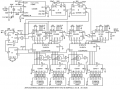
I take it you means digits #6 and #7 are the next least significant ones? I haven't tried the HC161 addition to my system yet, but will do if you wish. I've enclosed the schematic of my adaptation of my circuit, with a 74HC160 as the LSD.

HC160Blank.png

The pin numbers on the monostables are different to yours since I used the opposite sides when I laid out the board.
Note: Amended circuit from earlier version.
 
Last edited:

Thread Starter

NapSolo

Joined Oct 29, 2024
115
I take it you means digits #6 and #7 are the next least significant ones? I haven't tried the HC161 addition to my system yet, but will do if you wish. I've enclosed the schematic of my adaptation of my circuit, with a 74HC160 as the LSD.

View attachment 341083

The pin numbers on the monostables are different to yours since I used the opposite sides when I laid out the board.
I take it you means digits #6 and #7 are the next least significant ones? I haven't tried the HC161 addition to my system yet, but will do if you wish. I've enclosed the schematic of my adaptation of my circuit, with a 74HC160 as the LSD.

View attachment 341083

The pin numbers on the monostables are different to yours since I used the opposite sides when I laid out the board.
Sorry for any confusion that I caused, digit #6 => 100,000s and digit#7 => 1,000,000s. I numbered them from
LSD to MSD. I would be great if you could try the HC161 if it isn't too much bother. Since I am only able to get up
to 1.7 MHz with one HC160 is it feasible to replace the "tens" digit counter with an HC160? Thanks for posting the
schematic.
 
Last edited:

sarahMCML

Joined May 11, 2019
698
Sorry for any confusion that I caused, digit #6 => 1,000,000s and digit#7 => 100,000s. I numbered them from
LSD to MSD. I would be great if you could try the HC161 if it isn't too much bother. Since I am only able to get up
to 1.7 MHz with one HC160 is it feasible to replace the "tens" digit counter with an HC160? Thanks for posting the
schematic.
I'll have to do it tomorrow, since it's time for me to make inner now (7pm here). I have 5 of the HC161's so I may as well hook up 2, put some LED's on the outputs as well to check that they do the 16's counts properly, and see what's happening further down the line. Bye!
 

Thread Starter

NapSolo

Joined Oct 29, 2024
115
I'll have to do it tomorrow, since it's time for me to make inner now (7pm here). I have 5 of the HC161's so I may as well hook up 2, put some LED's on the outputs as well to check that they do the 16's counts properly, and see what's happening further down the line. Bye!
Thanks. Enjoy your dinner and evening!
 

sarahMCML

Joined May 11, 2019
698
Thanks. Enjoy your dinner and evening!
Well, I wired two HC161's up and found exactly the same problem as you had. I could only get up to about 1.8MHz. Then it dawned on me. We are still clocking the slower counter stages, synchronously, at the full input speed, so once we go above about 1.8MHz or so, at 5V they won't work!
The answer is to convert the slower stages to Ripple Carry mode, a fairly simple change. Then the 4510's will only see about 250KHz max at 25MHz input. Just wire is a per the Ripple clocking diagram, without the OR gates. You'll still need that inverter. Sorted!
 

sarahMCML

Joined May 11, 2019
698
Just a quick note. Did you implement anything like my Overflow circuit?
I think if the circuit was altered to Ripple Carry mode, the last stage would still need the clock to be wired to the OR gate in the same way as it is currently along with the Carry Out signal, to avoid the glitch pulse affecting the overflow FF.
 

sarahMCML

Joined May 11, 2019
698
I have no idea why I didn't see the synchronous clock problem before I breadboarded the HC161 version of your circuit.It should have been obvious to me from the start. I'm definitely getting old!
I've amended the circuit in post #72 to what (I think) it should be.

Edit: I've just noticed that my replacing the schematic in post #72 has messed up your post #73, so you may wish to re-edit that. Sorry!
 
Last edited:

sarahMCML

Joined May 11, 2019
698
Hi

Thanks for the update. I corrected my post #73. I 'm sure you just have a lot on your mind. Age is only a number as I keep getting told.

I have attached a schematic just for the counters as I understand it. I am about to start modifying my
circuit with my fingers crossed!
Looks good to me! See you on the other side.
 

Thread Starter

NapSolo

Joined Oct 29, 2024
115
Looks good to me! See you on the other side.
I have wired in 2 of the HC160s. When I input a 15 MHz signal I get a reading of
14,999,82?. The LSD keeps changing.

I thought the range might be a little higher. The input signal should be divided down
to 100 KHz when it reaches the first 4510 so I don't think adding a third HC160
will make any difference.

Since the limit seems to be 15 MHz, I will have to use magnitude comparators to
build an overflow detector since the Carry Out of the MSD 4510 won't work unless
I accept 10 MHz minus one as the limit.
 

sarahMCML

Joined May 11, 2019
698
I have wired in 2 of the HC160s. When I input a 15 MHz signal I get a reading of
14,999,82?. The LSD keeps changing.

I thought the range might be a little higher. The input signal should be divided down
to 100 KHz when it reaches the first 4510 so I don't think adding a third HC160
will make any difference.

Since the limit seems to be 15 MHz, I will have to use magnitude comparators to
build an overflow detector since the Carry Out of the MSD 4510 won't work unless
I accept 10 MHz minus one as the limit.
I'm surprised that it won't go any higher. Can you swap the chips around to see if some are faster than others?
What make are they? I've looked at three different manufacturers versions, and noticed that those from Philips were guaranteed to run at 30MHz at 4.5V, typically 55MHz. Whereas those from ON Semi and TI are about 30MHz Max at 4.5V, a little more at 5 Volts.

As for adding a third HC160, the old 1987 Texas datasheet explains why it definitely isn't a good idea to go more than two chips synchronously, because of those glitch pulses.

Reading the note at the bottom of the AC Electrical Characteristics section of the ON Semi datasheet, I can't quite determine whether they are saying it's better to connect the chips Synchronously clocked or Ripple clocked, for the best speed. I always read that Synchronous was fastest.

As for your readings changing, how stable are your timebase and your input signals?
 

Thread Starter

NapSolo

Joined Oct 29, 2024
115
I'm surprised that it won't go any higher. Can you swap the chips around to see if some are faster than others?
What make are they? I've looked at three different manufacturers versions, and noticed that those from Philips were guaranteed to run at 30MHz at 4.5V, typically 55MHz. Whereas those from ON Semi and TI are about 30MHz Max at 4.5V, a little more at 5 Volts.

As for adding a third HC160, the old 1987 Texas datasheet explains why it definitely isn't a good idea to go more than two chips synchronously, because of those glitch pulses.

Reading the note at the bottom of the AC Electrical Characteristics section of the ON Semi datasheet, I can't quite determine whether they are saying it's better to connect the chips Synchronously clocked or Ripple clocked, for the best speed. I always read that Synchronous was fastest.

As for your readings changing, how stable are your timebase and your input signals?

I'm surprised that it won't go any higher. Can you swap the chips around to see if some are faster than others?
What make are they? I've looked at three different manufacturers versions, and noticed that those from Philips were guaranteed to run at 30MHz at 4.5V, typically 55MHz. Whereas those from ON Semi and TI are about 30MHz Max at 4.5V, a little more at 5 Volts.

As for adding a third HC160, the old 1987 Texas datasheet explains why it definitely isn't a good idea to go more than two chips synchronously, because of those glitch pulses.

Reading the note at the bottom of the AC Electrical Characteristics section of the ON Semi datasheet, I can't quite determine whether they are saying it's better to connect the chips Synchronously clocked or Ripple clocked, for the best speed. I always read that Synchronous was fastest.

As for your readings changing, how stable are your timebase and your input signals?
The highest reading is actually 15.7 MHz. These chips are from Harris. My input signal is a 5 vpp squarewave from a
Siglent SDG-1062 Arbitrary Waveform Generator (new). For my timebase, I am using a DS32KHZ oscillator module.
I hope they are stable enough. Per your suggestion, I swapped the two HC160s around but unfortunately, the result
is the same. Not sure what to try next.

I see what you mean regarding the data sheet. "NOTE: When used in these cascaded configurations the clock fmax guaranteed limits may not apply. Actual performance will depend on number of stages. This limitation is due to set up times between Enable (Port) and Clock."

I have not placed 0.1 uF bypass caps across each chip yet since I have changed component placement multiple
times.
 
Last edited:

sarahMCML

Joined May 11, 2019
698
Tomorrow I'll see how fast I can get my HC161's to go. My signal generators only go to 10MHz, but I do have some faster Xtal oscillator modules I can try. I may also be able to multiply up a sig gen output with luck! I'll try synchronous and ripple clocking to see which is quicker.
 

sarahMCML

Joined May 11, 2019
698
Right, a follow up to the earlier post.
I tested two HC161's and had them dividing a 40MHz Crystal Oscillator module down to 156,200Hz, the correct figure, but only if I measured this using the lower dividers QD output. If I used the /CO I got twice the frequency because of the bogus spike! This was in Synchronous mode.

So I re-arranged the counters into Ripple clocking mode, and they still work quite happily at 40MHz, with no sign of the glitch pulse on the /CO output. Looking at the internal circuitry of the two counters (at least as given in the Philips datasheets), there's not much difference, so I can't see why it wouldn't work for you.

One thing I though of about the LSD changing. It's possible that, at high input signal speeds, the LSD counter gets a varying number of inputs before the timebase latches the count. Are you still using pin 7 (/Q) of the monostable to latch the count? It really needs to be the initial Low to High leading edge (Q).
It may be worth taking an output from there and using it to gate the input signal Off, so that no more counts can get through until another cycle starts. A better way would be to use the Timebase output itself, but that may need another FF, which we don't have spare. Also, check to see if you can ensure that your signal input is as near 50% mark/space as possible, you may need a different input stage.

Time to go, Bye.
 

Thread Starter

NapSolo

Joined Oct 29, 2024
115
Right, a follow up to the earlier post.
I tested two HC161's and had them dividing a 40MHz Crystal Oscillator module down to 156,200Hz, the correct figure, but only if I measured this using the lower dividers QD output. If I used the /CO I got twice the frequency because of the bogus spike! This was in Synchronous mode.

So I re-arranged the counters into Ripple clocking mode, and they still work quite happily at 40MHz, with no sign of the glitch pulse on the /CO output. Looking at the internal circuitry of the two counters (at least as given in the Philips datasheets), there's not much difference, so I can't see why it wouldn't work for you.

One thing I though of about the LSD changing. It's possible that, at high input signal speeds, the LSD counter gets a varying number of inputs before the timebase latches the count. Are you still using pin 7 (/Q) of the monostable to latch the count? It really needs to be the initial Low to High leading edge (Q).
It may be worth taking an output from there and using it to gate the input signal Off, so that no more counts can get through until another cycle starts. A better way would be to use the Timebase output itself, but that may need another FF, which we don't have spare. Also, check to see if you can ensure that your signal input is as near 50% mark/space as possible, you may need a different input stage.

Time to go, Bye.
My counters are wired in the ripple counting mode.

I am now taking the latch signal off of pin 6 (Q). With input frequencies below approx. 400 Hz, the display goes berzerk
but the LSD is rock solid now as long as the input is above 400 Hz..

I am not quite sure how to gate the input signal off until another cycle starts. I will have to ponder that idea.

The signal generator duty cycle is set to 50%. I confirmed it with my scope. So that s/b okay.
I am feeding the 5 vpp input directly into the counter. I don't have an input circuit at this point.

I have attached a schedule of input signal versus reading which is rather interesting.

Cheers
 

Attachments

Last edited:

Thread Starter

NapSolo

Joined Oct 29, 2024
115
Right, a follow up to the earlier post.
I tested two HC161's and had them dividing a 40MHz Crystal Oscillator module down to 156,200Hz, the correct figure, but only if I measured this using the lower dividers QD output. If I used the /CO I got twice the frequency because of the bogus spike! This was in Synchronous mode.

So I re-arranged the counters into Ripple clocking mode, and they still work quite happily at 40MHz, with no sign of the glitch pulse on the /CO output. Looking at the internal circuitry of the two counters (at least as given in the Philips datasheets), there's not much difference, so I can't see why it wouldn't work for you.

One thing I though of about the LSD changing. It's possible that, at high input signal speeds, the LSD counter gets a varying number of inputs before the timebase latches the count. Are you still using pin 7 (/Q) of the monostable to latch the count? It really needs to be the initial Low to High leading edge (Q).
It may be worth taking an output from there and using it to gate the input signal Off, so that no more counts can get through until another cycle starts. A better way would be to use the Timebase output itself, but that may need another FF, which we don't have spare. Also, check to see if you can ensure that your signal input is as near 50% mark/space as possible, you may need a different input stage.

Time to go, Bye.
[/QUOTE

My counters are wired in the ripple counting mode.

I am now taking the latch signal off of pin 6 (Q). With input frequencies below approx. 400 Hz, the display goes berzerk
but the LSD is rock solid now as long as the input is above 400 Hz. Fmax is approx. 15 MHz which is lower than
yesterday even though I have made no changes (Oops, I lied. Only the latch signal).

I am not quite sure how to gate the input signal off until another cycle starts. I will have to ponder that idea.

The signal generator duty cycle is set to 50%. I confirmed it with my scope. So that s/b okay.
I am feeding the 5 vpp input directly into the counter. I don't have an input circuit at this point.

I have attached a schedule of input signal versus reading which is rather interesting especially when I input
10,130,000 Hz. The LSD is always an "8" or a "9" which seems odd.

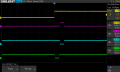
I have also attached a screenshot of my control signals. The Latch signal occirs 0.16 us after the rising edge of the
timebase signal. And the pulse width is 1.24 us. The reset signals occur 0.16 us after the Latch signal and the pulse
width is 1.24 us.

Ch1 => timebase
Ch2 => Reset 1 (CD4510s)
Ch3 => Reset 2 (HC160s)
Ch4 => Latch

Cheers
 

Attachments

Last edited:

sarahMCML

Joined May 11, 2019
698
Very odd readings indeed. They almost look like one or more bad connections somewhere, or noise pickup. How many decoupling capacitors do you have dotted around? I have to admit I only have a single 100uF electro on my veroboard for the CD4019 counter build, and a 0.1uF directly across the 40MHz oscillator module on the HC161 breadboard.

I think I've found a fairly simple way of gating Off the input signal when the timebase times out, but it involves getting either a 74HC02 NOR package or one of the other, faster ones.
You take the Q2, 1Hz output from the timebase, and connect it, via a series capacitor with a pulldown resistor and parallel diode to ground, to one input of the NOR gate, two of which are connected as a FF pair. That FF gate's output goes to the CEP (pin 7) of the LSD HC160.
The other unattached input of the other gate is connected to the 4098 Q2 Reset pulse.
I can draw it out if you wish, but it's fairly straight forward.
That should stop the first counter immediately!

Another thing that could possibly be a problem is the fact that the timebase never stops counting, so it's possible that delays in various parts of the circuit could cause slightly varying minor counts in the LSD's at high speeds. You could try stopping the timebase oscillator itself using the reset pin, but there's no guarantee that that won't give problems due to startup delays in the oscillator section! I cannot account for the wildly different values you got though!

Looking at the control signals you've posted, they're different from mine. My Reset pulse to the latches (#3?) is positve going, and starts after the negative going edge of the Latch pulse (#2?). Is #4 the Reset pulse for the HC160's?

I've attached the breadboarded HC161's to my 4029 board, and as far as I can tell it runs perfectly, with no problems at any speeds from 0 to 20MHz on my sig gen, and with the 40MHz Xtal. I realised that I could leave the 4029 section in Synchronous mode and just feed it the Ripple carry output from the HC161 section without having to alter the board.

Any chance of photos of your board?
 

Thread Starter

NapSolo

Joined Oct 29, 2024
115
Very odd readings indeed. They almost look like one or more bad connections somewhere, or noise pickup. How many decoupling capacitors do you have dotted around? I have to admit I only have a single 100uF electro on my veroboard for the CD4019 counter build, and a 0.1uF directly across the 40MHz oscillator module on the HC161 breadboard.

I think I've found a fairly simple way of gating Off the input signal when the timebase times out, but it involves getting either a 74HC02 NOR package or one of the other, faster ones.
You take the Q2, 1Hz output from the timebase, and connect it, via a series capacitor with a pulldown resistor and parallel diode to ground, to one input of the NOR gate, two of which are connected as a FF pair. That FF gate's output goes to the CEP (pin 7) of the LSD HC160.
The other unattached input of the other gate is connected to the 4098 Q2 Reset pulse.
I can draw it out if you wish, but it's fairly straight forward.
That should stop the first counter immediately!

Another thing that could possibly be a problem is the fact that the timebase never stops counting, so it's possible that delays in various parts of the circuit could cause slightly varying minor counts in the LSD's at high speeds. You could try stopping the timebase oscillator itself using the reset pin, but there's no guarantee that that won't give problems due to startup delays in the oscillator section! I cannot account for the wildly different values you got though!

Looking at the control signals you've posted, they're different from mine. My Reset pulse to the latches (#3?) is positve going, and starts after the negative going edge of the Latch pulse (#2?). Is #4 the Reset pulse for the HC160's?

I've attached the breadboarded HC161's to my 4029 board, and as far as I can tell it runs perfectly, with no problems at any speeds from 0 to 20MHz on my sig gen, and with the 40MHz Xtal. I realised that I could leave the 4029 section in Synchronous mode and just feed it the Ripple carry output from the HC161 section without having to alter the board.

Any chance of photos of your board?
I don't currently have any decoupling caps but I will add them.

I made a mistake in post #89 wrt the signals and I have corrected the error.

I wouldn't mind seeing a diagram for the 74HC02 NOR fix. I would have to order these.

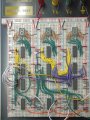
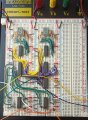
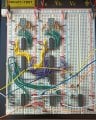
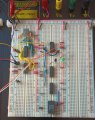
I have attached photos. Board #1 is the MSDs and #4 is the LSD, timebase and control circuitry.

I can check all the jumper wires for faulty connections. I have found that 10 to 20% of the jumpers
are defective. I also read somewhere that some jumpers are made from iron instead of copper.
I will get a magnet and check that out too. And guess what? The jumpers are iron ... not copper.
 

Attachments

Last edited:

sarahMCML

Joined May 11, 2019
698
I'd forgotten that you have a purpose made timebase module, so as it doesn't have any Reset pin, you can forget that suggestion.
I haven't tried the NOR gate fix, I'm not even sure whether I have one! I'll have a look later and try it if I do.
I see your boards have HC174's in places, so the schematics I have aren't quite as the boards. And am I correct in thinking that the LSD's 4511 latches the data itself?
I'll draw up the NOR fix anyway.
Must order some more chips while they're still available!
 

Thread Starter

NapSolo

Joined Oct 29, 2024
115
I'd forgotten that you have a purpose made timebase module, so as it doesn't have any Reset pin, you can forget that suggestion.
I haven't tried the NOR gate fix, I'm not even sure whether I have one! I'll have a look later and try it if I do.
I see your boards have HC174's in places, so the schematics I have aren't quite as the boards. And am I correct in thinking that the LSD's 4511 latches the data itself?
I'll draw up the NOR fix anyway.
Must order some more chips while they're still available!
The LSD (units) 4511 does latch the data itself. I used the latches in order to implement the blanking.
 

Attachments

Status
Not open for further replies.
Top