Facebook
 Google
 GitHub
 Linkedin
I'm trying to calculate a reasonable value for a filter capacitor on a full wave rectifier setup. I'm expecting a load of about 4 amps. I know it's backwards, but I started with a 4700uf capacitor just to see what the ripple voltage would be.
My application can tolerate a decent amount of ripple - the actual output of this circuit will be fed into a Recom DC-DC switching converter that can take a pretty wide range of DC input voltage and produce 12V (essentially a more efficient version of an L7812 regulator).
I ran an LTspice simulation (only the second time I've tried LTspice):
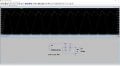
The simulation shows a ripple voltage variation of about 2V.
I also calculated the ripple using the following formula:
dV = (I * dt)/C (4 * .0083)/ .0047 = 7.1V
I'm certainly missing something here, but I can't see what. I know that according to the simulation, the average current is closer to 3.4 A in this setup, but that doesn't account for the big difference between the sim and the calculation.
What aren't I seeing?
Thank you.
My application can tolerate a decent amount of ripple - the actual output of this circuit will be fed into a Recom DC-DC switching converter that can take a pretty wide range of DC input voltage and produce 12V (essentially a more efficient version of an L7812 regulator).
I ran an LTspice simulation (only the second time I've tried LTspice):
The simulation shows a ripple voltage variation of about 2V.
I also calculated the ripple using the following formula:
dV = (I * dt)/C (4 * .0083)/ .0047 = 7.1V
I'm certainly missing something here, but I can't see what. I know that according to the simulation, the average current is closer to 3.4 A in this setup, but that doesn't account for the big difference between the sim and the calculation.
What aren't I seeing?
Thank you.