Ripple Blanking Technique For CD4511s

Status
Not open for further replies.

Thread Starter

NapSolo

Joined Oct 29, 2024
115
Without seeing your circuit I can't say, but those chips won't be any faster at 10V than the CD4510's! Your best bet would be to replace the first one or two least significant CD4510's with CD74HC4510's, then you would be able to count at up to 30MHz minimum at 5V!

I built up a 4 stage version of your CD4510 counter after realising that the CD4029 counter is almost identical, except it doesn't have a Reset input, but has a Binary/Decade pin there instead. So by using the Preset Enable input as a Reset input, and setting it to Decade counting, it works exactly like the 4510!
The Overload circuit worked just fine, but I added the extra OR gate in line with the final Carry Out, and OR'red it with the Input Clock signal, as per the datasheet suggestion about spurious glitch pulses, noted in figure 13 in the CD4029 sheet, and the CD4510 one!
I did notice that you used pin 7 (/Q) as the Latch signal to the 574's. This means that they don't latch the count value until about 1us after the true timeout of the timebase. This won't matter for slow inputs, but will add counts if you make measurements above 1MHz. It also means that it is latching at the same time as the Reset pulse is happening! I'd move it back to the Q output.
Hi

The 74HC4510 sounds ideal. I can't find anyone that sells them.

I should clarify that I was trying out the CD40174BEs initially because they can be used with a supply
of up to 20 volts. But then I thought I would use 1 for each digit (only using 4 of 6 latches) rather
than using the 74HC574s (where I used only 1 for every 2 digits). It would make the wiring a lot
neater especially when I build this thing on perfboard. The thing is, the CD40174BEs don't seem to
work at all. I also used CD4072BEs in place of the CD4071BEs in an attempt to reduce component
layout issues later. See attached.

I realize now why I thought that the overload wasn't working. My 7-digit counter only works up to
about 1.2 Mhz. The LED won't come on until the MSB counter "carry out" tells it to. That can't happen
because the count will never get that high.
 

Attachments

Last edited:

sarahMCML

Joined May 11, 2019
698
Hi

The 74HC4510 sounds ideal. I can't find anyone that sells them.

I should clarify that I was trying out the CD40174BEs initially because they can be used with a supply
of up to 20 volts. But then I thought I would use 1 for each digit (only using 4 of 6 latches) rather
than using the 74HC574s (where I used only 1 for every 2 digits). It would make the wiring a lot
neater especially when I build this thing on perfboard. The thing is, the CD40174BEs don't seem to
work at all. I also used CD4072BEs in place of the CD4071BEs in an attempt to reduce component
layout issues later. See attached.

I realize now why I thought that the overload wasn't working. My 7-digit counter only works up to
about 1.2 Mhz. The LED won't come on until the MSB counter "carry out" tells it to. That can't happen
because the count will never get that high.
I can't find anywhere that sells them either. It's a real curse the number of these chips that are unavailable now. If I had known 10 or 15 years ago I'd have stocked up.
Your CD40174's aren't working because you need to tie the Reset pins High to disable them!
I don't see how using 4072's in place of 4071's makes thing easier, I have just 2 4072's and 1 4071 on my board for 4 digits, with a few gates left over!
 

Thread Starter

NapSolo

Joined Oct 29, 2024
115
I can't find anywhere that sells them either. It's a real curse the number of these chips that are unavailable now. If I had known 10 or 15 years ago I'd have stocked up.
Your CD40174's aren't working because you need to tie the Reset pins High to disable them!
I don't see how using 4072's in place of 4071's makes thing easier, I have just 2 4072's and 1 4071 on my board for 4 digits, with a few gates left over!
Thanks for your help on the CD40174 reset thing. I will change that as well as the source of
the latch signal, per your earlier post.

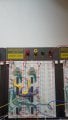
I only put 2 digits on each protoboard rather than 3 in order to avoid so many jumper wires.
See attached.
 

Attachments

sarahMCML

Joined May 11, 2019
698
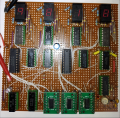
Here's a pic of my board.

FreqCounterBoard2b.png

The bottom row, from left to right, the first chip is the 4013 Overflow FF with LED, the next 4 are 4029 counters, and the last is a CD4536 Xtal oscillator generating the 1Hz timebase.
The next row up are the 74HC574's and OR gates, and the last being the CD4098 Latch and Reset monostable.
Then we have the Decoders and those horrible 7 Segment displays! They're actually brighter in reality, but wouldn't win any prizes!
 

Thread Starter

NapSolo

Joined Oct 29, 2024
115
Here's a pic of my board.

View attachment 339581

The bottom row, from left to right, the first chip is the 4013 Overflow FF with LED, the next 4 are 4029 counters, and the last is a CD4536 Xtal oscillator generating the 1Hz timebase.
The next row up are the 74HC574's and OR gates, and the last being the CD4098 Latch and Reset monostable.
Then we have the Decoders and those horrible 7 Segment displays! They're actually brighter in reality, but wouldn't win any prizes!
Here's a pic of my board.

View attachment 339581

The bottom row, from left to right, the first chip is the 4013 Overflow FF with LED, the next 4 are 4029 counters, and the last is a CD4536 Xtal oscillator generating the 1Hz timebase.
The next row up are the 74HC574's and OR gates, and the last being the CD4098 Latch and Reset monostable.
Then we have the Decoders and those horrible 7 Segment displays! They're actually brighter in reality, but wouldn't win any prizes!
I like that! Does the other side of the board have strips are round pads? I am just curious since I haven't built a
permanent board in many years. I will have to perfect my project before building a permanent board. I wish Radio
Shack was still around as they had a universal display PCB that would have been handy now.
 

sarahMCML

Joined May 11, 2019
698
I like that! Does the other side of the board have strips are round pads? I am just curious since I haven't built a
permanent board in many years. I will have to perfect my project before building a permanent board. I wish Radio
Shack was still around as they had a universal display PCB that would have been handy now.
It's real Vero stripboard, tracks cut with an original Veroboard "drill", and probably about 40 years old. I used to buy the 16 by 8 inch sized boards, which I cut in half and used to build my original Motorola MC6800/6809 computer system. They all plug into a 19 inch rack system.
 

Thread Starter

NapSolo

Joined Oct 29, 2024
115
It's real Vero stripboard, tracks cut with an original Veroboard "drill", and probably about 40 years old. I used to buy the 16 by 8 inch sized boards, which I cut in half and used to build my original Motorola MC6800/6809 computer system. They all plug into a 19 inch rack system.
Thanks for the info. By the way, I got the CD40174s working. I will soon have two 7-digit versions
of the frequency counter on protoboards. I will post pics and schematics at that time.

Cheers
 

Thread Starter

NapSolo

Joined Oct 29, 2024
115
Thanks for the info. By the way, I got the CD40174s working. I will soon have two 7-digit versions
of the frequency counter on protoboards. I will post pics and schematics at that time.

Cheers
I have an LM78L05 100 mA voltage regulator set up for the DS32KHZ Oscillator. I am going to
increase the supply voltage to 10 volts and then 15 volts to see if the frequency range can be
expanded somewhat. The HDSP-F503s display have 1.5KΩ current limiting resistors (49 of them)
and the 5mm (green LED that indicates that the time base is functioning) has a 150Ω current
limiting resistor. I am wondering if these resistor values are sufficient.

Thanks!


7-Segment CC Display - HDSP-F503 - Green - 0.4"
 

sarahMCML

Joined May 11, 2019
698
The display datasheet specifies the brightness at 10mA current, so 1K5 resistors will be much too large at 5V, reasonable though at 15V. Of course, it's worth testing one for actual brightness at the voltage you decide to use. The 150 Ohm resistor for the single timebase LED is possibly too low for a modern one: I used an 18k for mine, they're super bright!
It may also be worth considering using DIL resistor packs rather than individual resistors for ease of construction.
 
Last edited:

Thread Starter

NapSolo

Joined Oct 29, 2024
115
The display datasheet specifies the brightness at 10mA current, so 1K5 resistors will be much too large at 5V, reasonable though at 15V. Of course, it's worth testing one for actual brightness at the voltage you decide to use. The 150 Ohm resistor for the single timebase LED is possibly too low for a modern one: I used an 18k for mine, they're super bright!
It may also be worth considering using DIL resistor packs rather than individual resistors for ease of construction.
Thanks
 

sarahMCML

Joined May 11, 2019
698
Hi

I completed the build of the 7-digit frequency counter with ripple blanking. I am using a 15 volt
supply. After some tinkering I found that the maximum frequency is 3.4 MHZ and the optimal
signal voltage is 9 volts.

Before posting a complete schematic etc., I want to add a circuit to alert the user if the frequency
exceeds 3.4 MHZ. I have designed this circuit but it is untested at this point.

The last piece will be an input conditioning circuit. I want the circuit to force the input voltage to
be 9 volts exactly, no matter what the signal source voltage is. Also the circuit should handle any
waveform. I am not sure if my thinking on this is correct or not.

Cheers!
If you substituted one (or possibly two) 74HC160 counters for the two least significant counters that would get you into the 30MHz area. Their Reset pins would need inverting, but that would merely be a matter of connecting them to the /Q output of the second monostable, instead of the Q output that the others connect to! Then everything would need to be 5V powered of course!
 

MrChips

Joined Oct 2, 2009
34,829
I have used Futurlec. They are legit.

Read my post #31.
If you go with 74LS series and 74LS47 decoder/driver, all your issues with ripple blanking will be solved.
By adding a high speed first decade counter such as 74F160 or 74F161 (with extra circuitry for 0-9 counter), you can count to 120 MHz.

I have built a direct frequency readout for my DX receiver that measures the local oscillator frequency and removes the IF both ways (add or subtract IF).
 

Thread Starter

NapSolo

Joined Oct 29, 2024
115
I have used Futurlec. They are legit.

Read my post #31.
If you go with 74LS series and 74LS47 decoder/driver, all your issues with ripple blanking will be solved.
By adding a high speed first decade counter such as 74F160 or 74F161 (with extra circuitry for 0-9 counter), you can count to 120 MHz.

I have built a direct frequency readout for my DX receiver that measures the local oscillator frequency and removes the IF both ways (add or subtract IF).
Hi MrChips. Thanks. It looks like the
I have used Futurlec. They are legit.

Read my post #31.
If you go with 74LS series and 74LS47 decoder/driver, all your issues with ripple blanking will be solved.
By adding a high speed first decade counter such as 74F160 or 74F161 (with extra circuitry for 0-9 counter), you can count to 120 MHz.

I have built a direct frequency readout for my DX receiver that measures the local oscillator frequency and removes the IF both ways (add or subtract IF).
Hi MrChips. Thanks for the info. . It looks like the 74F160 is not available any more.

What additional circuitry would be required for the 74F161s? These are still available.
 
Last edited:

Thread Starter

NapSolo

Joined Oct 29, 2024
115
I've only ever used Mouser or DigiKey in the States, so I wouldn't know, sorry!
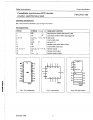
I am trying to match up the pins of the 74HC160 Versus CD4510 Pins as I am going to order some.
At this point I am not going to switch to LS Series TTL although the thought of attaining 120 MHZ
is tempting.

Here is my attempt (attached) although I am not sure it is correct.
 

Attachments

sarahMCML

Joined May 11, 2019
698
I am trying to match up the pins of the 74HC160 Versus CD4510 Pins as I am going to order some.
At this point I am not going to switch to LS Series TTL although the thought of attaining 120 MHZ
is tempting.

Here is my attempt (attached) although I am not sure it is correct.
CEP of one or both HC160's should be tied High, CET of Least Significant counter should also be tied High, RC of Least Sig. should go to CET of next HC160. Load and Clear as previous post.
 

Thread Starter

NapSolo

Joined Oct 29, 2024
115
CEP of one or both HC160's should be tied High, CET of Least Significant counter should also be tied High, RC of Least Sig. should go to CET of next HC160. Load and Clear as previous post.
Thanks! Once the HC160s arrive and I get them installed I will post the results.

Cheers
 

sarahMCML

Joined May 11, 2019
698
Hi:

The 74HC160s finally arrived. I wired one up for the LSD only. That displays the correct value but the
digits controlled by the CD4510s show incorrect values. I set pin #9 to a high logic level since the LSD
only displayed a zero if it was set low. Not sure what the issue is. I have attached a schematic for the
timebase and control circuit as well as the LSD.

Thanks!
I think your Latch pulse is coming after your Reset pulses due to you taking it from pin 7 instead of pin 6, as I do. Currently it is waiting for the later rising edge of the first monostable's /Q output, which happens after the second half of the monostable has reset the counters!
Unfortunately, I don't have any HC160's to try the new circuit, although I do have some HC161's. They are binary counters, but otherwise identical, so although it'll count to 16, that wouldn't matter, the output functions would be the same. So I might try to connect one to my rig, if the above latch mod doesn't fix your problem. Let me know if it does?
 

sarahMCML

Joined May 11, 2019
698
Having just taken another look at the Carry Out signals of the two devices, I think you may need to put an inverter between the output of the last HC160 and the first CD4510, because the levels are the reverse of each other!
 

Thread Starter

NapSolo

Joined Oct 29, 2024
115
Having just taken another look at the Carry Out signals of the two devices, I think you may need to put an inverter between the output of the last HC160 and the first CD4510, because the levels are the reverse of each other!
I have the counter working up to 1.7 MHz with a 74HC160 for the LSD. You were spot on with your suggestion
about the inverter. I did find that I need to pull the latch signal off of pin #7 of the monostable otherwise the
LSD just flashes wildly. I guess I'll have to replace the "Tens" CD4510 with a 74HC160 as well. Hopefully that
will increase the range to 30 MHz.
 
Last edited:
Status
Not open for further replies.
Top