Reversing DC motor controll

MisterBill2

Joined Jan 23, 2018
27,584
Finding a reasonable limit switch that can carry 60+ amps reliably will be a challenge. And getting two of them for a low cost will probably not happen. Besides that, the 65 amp wiring to and from the two switches will be a big pain, because at that current #6 wire is used.
So YES, for that circuit the limit switches would be a big problem.
The other rather big problem is that now the motor control relay has become a double pole-double-throw relay with one set of contacts good for at least 65 amps. That is an expensive item, and the application would require two of them.
 

eetech00

Joined Jun 8, 2013
4,705
Finding a reasonable limit switch that can carry 60+ amps reliably will be a challenge. And getting two of them for a low cost will probably not happen. Besides that, the 65 amp wiring to and from the two switches will be a big pain, because at that current #6 wire is used.
So YES, for that circuit the limit switches would be a big problem.
The other rather big problem is that now the motor control relay has become a double pole-double-throw relay with one set of contacts good for at least 65 amps. That is an expensive item, and the application would require two of them.
the limit switches are not carrying 60+ amps of current in the second version.

And yes the relays for the motor drive would be expensive. But that’s the price for safety.
 

Tonyr1084

Joined Sep 24, 2015
9,744
NO, it is not a good design.
Perhaps you should read the entire post. The TS has moved the limit switches to controlling the relays. That's low current. Also, the TS has an ON/OFF switch. In the case of a runaway condition all the operator has to do is - um - shut it off. Good design? Maybe there's better, but for what the TS wants, this satisfies the need - as you so often point out "That's what the TS wants. All other options are out!".
 

MisterBill2

Joined Jan 23, 2018
27,584
I have not seen where the TS is now wanting the system to latch on in the up or down modes now. Given the additional cost and complexity, and the ability for things to go wrong, it is still not a wise choice.
 

Tonyr1084

Joined Sep 24, 2015
9,744
That's because - as has been explained rather clearly - the TS doesn't want it to latch. He wants to hold the button to full up or full down. It's his desire to hold the button so that if he runs into an issue, be it any kind of unexpected response he can let go of the button and stop all motion. Read the thread carefully.
 

Tonyr1084

Joined Sep 24, 2015
9,744
First I wat to go all the way up and down. There is no reason to stop short in either direction. I figured momentary switches woul add a level of safety in the event the limit switch failed. As for the motor it is 12 Vdc. Max draw at lockup is 900 watt. The power supply is rated for 85 amps
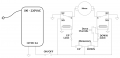
I like your design. I have made a change to it to get the limit switches out of the high current path. let me know if this will work. See attached diagram.
 

eetech00

Joined Jun 8, 2013
4,705
So I am wondering why so many are showing methods of latching the drive on until it hits the limit switches.
Because the TS made this statement:

Capt. Brett said:

First I wat to go all the way up and down. There is no reason to stop short in either direction. I figured momentary switches woul add a level of safety in the event the limit switch failed. As for the motor it is 12 Vdc. Max draw at lockup is 900 watt. The power supply is rated for 85 amps

Further, there's no point in holding the button down if the safety is in the limit switch.

Now...if the TS is intending to operate the buttons in a "dead man's switch" fashion, then that's different and the TS needs to state that.
 

MisterBill2

Joined Jan 23, 2018
27,584
Given that the TS has picked a one horsepower DC motor with a 90:1 reduction gearing to lift a load of about 100 pounds, I am thinking that depending on the limit switches for an application like this is not a good choice at all. The excess power built into the system is capable of doing a lot of damage if anything goes even a bit wrong. And the fact that the intention is to run full up and full down is not an adequate reason to automate the whole thing.
 

MisterBill2

Joined Jan 23, 2018
27,584
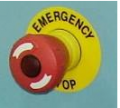
Although, I don't see anything wrong with automation, as long as there is something to take care of any eventuality, AKA a big Red button.
Max.

View attachment 226767
Right On, Max. That BRB that is mandated on almost every piece of machinery in almost every production plant.
But I have discovered a really disturbing failure mode that can happen with that 800T series that is enough to give one the cold shakes. Fortunately there is also a fix, but while it is simple and fairly cheap it is not used.
 

MisterBill2

Joined Jan 23, 2018
27,584
Are you saying there is a flaw in a Allen-Bradley product!? :eek:
The failure mode occurrs when the two screws that retain the contact block in position against the operator portion, which holds the button and spring parts, loosen due to vibration. After enough vibration they back out far enough that pressing the button no longer operates the contacts and so the E-STOP function is not enabled. In extreme situations the screws may actually fall out of their threaded holes, allowing the contact block assembly to hand free.
Usually this does not happen, but when used as the E-STOP switch for the compress mechanism of an older garbage truck it has happened at least once, quite a few (25) years ago, with a resulting injury.
So I am not sure iif it can be called a flaw, or just a lack of warnings that thjey are not suitable for high vibration applications.
I do have a fix designed that makes that failure mode impossible.
 

MaxHeadRoom

Joined Jul 18, 2013
30,680
I only use Telemecanique (now Group Schneider) where possible for wiring items and devices.
Keep to DIN standard if possible.
Max.
 

Tonyr1084

Joined Sep 24, 2015
9,744
The failure mode occurrs when the two screws that retain the contact block in position against the operator portion, which holds the button and spring parts, loosen due to vibration.
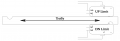
In this configuration if a limit switch becomes loose the trolly will cease movement in that direction (up or down).
1609867832790.png
Proper Planning Prevents Poor Performance. In other words, plan for failure mitigation. IF failure DOES occur, how does the trolly respond? This case, it stops going forward (whichever direction it was traveling). With the OTHER limit switch still functional, the trolly can be moved back to where it began so that it can be unloaded and safely repaired.

IF the trolly is moving UP and the UP Limit becomes loose the trolly will stop. It can still go back down. It doesn't end up hanging in the wind. And IF a load is lifted to the full up while the down limit has fallen loose, that problem can be dealt with by an override switch. Need I draw that out too???
 

MisterBill2

Joined Jan 23, 2018
27,584
In this configuration if a limit switch becomes loose the trolly will cease movement in that direction (up or down).
View attachment 226830
Proper Planning Prevents Poor Performance. In other words, plan for failure mitigation. IF failure DOES occur, how does the trolly respond? This case, it stops going forward (whichever direction it was traveling). With the OTHER limit switch still functional, the trolly can be moved back to where it began so that it can be unloaded and safely repaired.

IF the trolly is moving UP and the UP Limit becomes loose the trolly will stop. It can still go back down. It doesn't end up hanging in the wind.
to a specific brand and model of pushbutton frequently used as emergency stop buttons, as mentioned by Max. And since this hoistr is winding a lift strap the limit switch sketch shown would be a challenge to implement.
 

Tonyr1084

Joined Sep 24, 2015
9,744
And since this hoistr is winding a lift strap the limit switch sketch shown would be a challenge to implement.
At this point we're not certain exactly how this is being used. IF he's using some sort of trolly then the position can be easily detected. I had a garage door opener that had a screw that drove a set of contacts back and forth. When the contact reached its mate, which was adjustable, the door would cease movement. That was an old Sears Craftsman GDO.

As to the exact use by the TS, we don't know. It's up to him to decide how to detect position. Since he's already discussing limit switches I'll assume he's figured that part of it out on his own.
 

Tonyr1084

Joined Sep 24, 2015
9,744
The TS has made some statements that seem to indicate a lack of understanding when engineering a machine. So far he's stated a 1 HP motor. He's also stated a 90:1 Gear Reduction. In effect, that's 90 HP. 1 HP can lift 550 pounds 1 foot in one second. So this project, in theory, can lift 49,500 pounds one foot in one second. I believe, have to read back through the post, the TS has stated he intends to lift 100 pounds average. In other words, his lift can pick up 495 times more load than he plans on typically lifting. I can see 2X lifting capacity. I can see 5X lifting capacity. By that I mean a machine that can lift two to five times more load than the user intends to lift. But 495 times more ? ? ? That's like using a 5 ton steel beam to bridge the gap between the sidewalk curb and the gutter. WAY overkill. But if this is what the TS wants . . .
 
Top