Reversing DC motor controll

BobTPH

Joined Jun 5, 2013
11,527
First I wat to go all the way up and down. There is no reason to stop short in either direction. I figured momentary switches woul add a level of safety in the event the limit switch failed. As for the motor it is 12 Vdc. Max draw at lockup is 900 watt. The power supply is rated for 85 amps
I am sorry, but, for me at least, that does not answer the questtion.

The question is whether a press and release of the pushbutton causes it to go all the way up or down, or whether you must hold the pushbutton down until it is all the way up or down.

The second part of your answer,

" I figured momentary switches woul add a level of safety in the event the limit switch failed. ",

makes me think you want to hold the button until the movement is finished. Otherwise, the buttons would not provide the added level of safely you mention, since it would continue going whether the button is pressed or not.

Bob
 

Tonyr1084

Joined Sep 24, 2015
9,744
Also, an afterthought; since the relays are going to be high current devices, their control coils will likely be heavier current draw as well. You need to be sure your switches can handle that current. If not - you need heavier PB's.
 

MisterBill2

Joined Jan 23, 2018
27,584
It appears to me that in this case the TS is more cincerned about safety than convenience, and so holding the button fro the duration of the move is the desired mode. I have observed over the years that occasionally things do not go exactly as intended, And leting go of a button is much simpler than trying to stop a hoist by finding the off switch. Since there was no E-Stop included in the latching relay circuit.
 

Tonyr1084

Joined Sep 24, 2015
9,744
The question is whether a press and release of the pushbutton causes it to go all the way up or down, or whether you must hold the pushbutton down until it is all the way up or down.
Makes me think you want to hold the button until the movement is finished.
Yes, his intent is to hold the button while the trolly is in transit. When the trolly reaches its limit the limit switch disables the relay coil and thus stops the motor where it is. An added benefit is that of dynamic braking IF the motor is a PM (Permanent Magnet) motor.
 

Thread Starter

Capt. Brett

Joined Jan 2, 2021
5
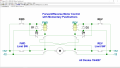
Yeah! That's great! Actually, you don't need the steering diodes in that configuration.

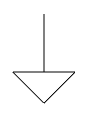
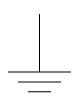
You changed the ground symbols from common ground to earth ground. Not that it's important, but at 12 volts, you really don't need to earth ground anything except the 100 - 220VAC input. But I suppose it's OK to earth ground the system. The 12V negative line from the PS probably is already grounded inside the PS. The downward pointed triangle is a common ground, not necessarily tied to earth ground. But it looks good. As long as your relays are rated for the high current the motor will demand.
Didn't know the difference in ground symbols. Mechanical engineer by trade. You sparkys blow my mind it's another world. Never the less THANK YOU SO MUCH!
 

Tonyr1084

Joined Sep 24, 2015
9,744
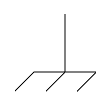
1609705001504.pngChassis Ground

1609705028777.pngCommon point (or ground)

1609705066239.pngEarth Ground
These are the most common ground symbols.

The chassis ground is typically the metal casing or frame that some electronics are mounted on. With points that are all tied to ground, the chassis ground reduces the amount of wiring needed. The chassis ground is sometimes ALSO grounded to Earth ground. The Common Point is just a reference point. It can be a chassis ground with points on the electronics above and below the middle voltage where that middle is typically considered to be zero volts. You can always have points (volts) above or below ground. Ground is most commonly considered the zero volt point.
 

MaxHeadRoom

Joined Jul 18, 2013
30,679

Tonyr1084

Joined Sep 24, 2015
9,744
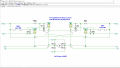
Here's another approach.
I think its self explainatory...

View attachment 226653
Interesting arrangement for self latching relays that break only when the limit switch opens. Good design. However, the TS wants to be able to stop the trolly should a limit switch fail. TS feels safer that way. This way - your way - once the trolly is moving it will continue till it reaches the end with no way to stop it should a problem arise.
 

MisterBill2

Joined Jan 23, 2018
27,584
My question now is where will you find the limit switches good for 65 amps running current? They might exist but they will not be cheap..
Interesting arrangement for self latching relays that break only when the limit switch opens. Good design. However, the TS wants to be able to stop the trolly should a limit switch fail. TS feels safer that way. This way - your way - once the trolly is moving it will continue till it reaches the end with no way to stop it should a problem arise.
NO, it is not a good design. A hoist circuit with no shutoff available is not a good design, AND, when the limit switch opens the EMF generated by the motor will tend to keep the relay energized . In addition, It is a poor choice to run both drive current and control current through the same contacts.
 

eetech00

Joined Jun 8, 2013
4,705
Interesting arrangement for self latching relays that break only when the limit switch opens. Good design. However, the TS wants to be able to stop the trolly should a limit switch fail. TS feels safer that way. This way - your way - once the trolly is moving it will continue till it reaches the end with no way to stop it should a problem arise.
if the limit switch fails, the circuit will break and the motor will stop automatically.
 

eetech00

Joined Jun 8, 2013
4,705
My question now is where will you find the limit switches good for 65 amps running current? They might exist but they will not be cheap..

NO, it is not a good design. A hoist circuit with no shutoff available is not a good design, AND, when the limit switch opens the EMF generated by the motor will tend to keep the relay energized . In addition, It is a poor choice to run both drive current and control current through the same contacts.
the limit contacts could be replaced with relay contacts from relays energized thru normally closed limit contacts.
 

eetech00

Joined Jun 8, 2013
4,705
NO, it is not a good design. A hoist circuit with no shutoff available is not a good design, AND, when the limit switch opens the EMF generated by the motor will tend to keep the relay energized . In addition, It is a poor choice to run both drive current and control current through the same contacts.
Diode transient surpressors (or other) could be used across the motor to supress the EMF.
 

eetech00

Joined Jun 8, 2013
4,705
Interesting arrangement for self latching relays that break only when the limit switch opens. Good design. However, the TS wants to be able to stop the trolly should a limit switch fail. TS feels safer that way. This way - your way - once the trolly is moving it will continue till it reaches the end with no way to stop it should a problem arise.
If failure of the limit switch is a concern, then there should be at least two limit switches at each end to reduce the chance of an unsafe failure.
 
Top