Off to a decent start, but we're going to need some clarification. Do you want to "Push the UP button" and have it go all the way to the UP LIMIT? Or do you want it to go UP only while you're pushing the UP button? There's a difference.
If your goal is to send something to full up position then stop with just a single command then a push button isn't the best way to go. Let me be a little clearer on this: Suppose you are moving a sled from ground level to the second floor. You push the button once and let go while the sled moves all the way up. OR you want to move the sled HALF way up. You push the button and hold it as the sled rises. When it's at the level you want you release the push button? Same would apply to the down command as well.
I understand the desire for the "ON" "OFF" switch, that makes sense. But there are other things to consider as well. Power source is important. If you want to move a heavy load you need a power supply with sufficient power to do the work. So tell us about the motor and the power supply. How many amps does the motor draw at a dead stall and what's the peak amperage at the rated voltage of the supply? Also important is the amperage going through the switches. A small motor shouldn't be a problem for a small push button, but a big motor will burn the switch out.
Are you opposed to doing this with relays? If the switches are small and the load is big then you can use the switches to activate relays that will control the heavy load.
First I wat to go all the way up and down. There is no reason to stop short in either direction. I figured momentary switches woul add a level of safety in the event the limit switch failed. As for the motor it is 12 Vdc. Max draw at lockup is 900 watt. The power supply is rated for 85 amps
I figured momentary switches woul add a level of safety in the event the limit switch failed. As for the motor it is 12 Vdc. Max draw at lockup is 900 watt. The power supply is rated for 85 amps
There would be no difference from that point of view, maintained or P.B.
The "Lockup"? is it likely to be stalled?
What is the nature of the load?
Max.
PS = 12V @ 85A
Motor = 900W @stall (75 amps) (I'd be a little concerned for the capabilities of the PS that close to max headroom (not @MaxHeadRoom).)
Those little buttons will not handle that kind of amperage. Use of a relay is highly recommended - OR going with a DPDT switch, spring loaded, center off, rated for that kind of amperage. If travel from full down to full up isn't long then holding a PB is probably no big deal. Same with a spring loaded switch. But if the trolly time is longer than it is comfortable holding a button in one position then an electronic package should be considered. Not necessary, just a possible recommendation. I hated holding the lift button on the overhead crane while it slowly lifted 50 tons high enough to clear other large tanks (water / oil / other). Then slowly traversing from North to South or the other way.
The circuit that Max presented in post #4 will work, except that a bit of revision is needed if you really want separate push buttons instead of the three-position center off switch.
The circuit in post #1 is almost OK, EXCEPT that the switch shown is a 4 position slide switch, which is a poor choice for the application.
IF it is OK for the motor to only run when the buttons are pressed then no relays are required. Relays are only needed to keep the motor running when the button is released. I do not recommend that if the application has the possibility of ever needing to stop the motor before it reaches the end stop position.
So there are a number of considerations. And there is a question of how much current the motor requires. That affects the choice of switches and wire sizes.
An overhead crane running without an operator holding a button is a sure way to have a disaster not limited to killing people. Some operations must always be under operator control. An overhead crane with a 300#load can do so much damage in just a few seconds that you can not imagine it.
I sited the overhead crane as an example of the need for constant human attendance during operation. The TS doesn't want to push a button once for a moment and have the trolly (or whatever) traverse from full down to full up without the need for attendance. If something requires that big a motor then I would suspect it probably should be under constant human control.
That's not what I read.
The TS said: "I figured momentary switches would add a level of safety in the event the limit switch failed."
To me that means hold the switch until the operation is complete.
A motor of that power level, if we say that running power is quite a bit less than locked-rotor power, is about one horsepower=760 watts. So that motor really needs to be kept under control. So no latching relays, more like power contactors with 100amp contacts will be required. No small wire, either, since the full load current will be around 65 amps. . This might be the motor to raise and lower a snow plow blade, although most of them use hydraulics.
Since the inertia will be quite a bit, probably it should utilize dynamic braking, which is free because of having a reversible hookup. Two contactors, single pole with NC and NO contacts, and the motor connected between the two sets of commons. Both NC contacts tied to the negative, both NO contacts tied to the positive. That gives both dynamic braking and an intrinsic interlocking, meaning no fireworks if forward and reverse contactors operate at the same time. Then each NC limit switch opens the coil circuit for that direction's contactor.
There would be no difference from that point of view, maintained or P.B.
The "Lockup"? is it likely to be stalled?
What is the nature of the load?
Max.
The chance of the motor locking up or stalling is for all practical purposes “0”. The motor has a 90:1 gear reduction. It will be Turning a shaft winding a strap to lift no more than 100 lbs Think of a winch of sorts
In a lifting/lowering application it is much safer to have the operation under under supervised control with momentary push buttons. And the dynamic braking would be useful to prevent undesired coasting. So The arrangement described in post #30 would be a good choice. A motor that powerful is a lot more than what is needed to lift a load as described. It seems like the application is a mobile winch adapted to an indoors hoisting application.
Hoisting versus pulling enters the realm of a lot of additional safety rules and regulations, mostly not related to the electrical part of the system.
If the 90:1 gearing is worm and pinion, then there will be automatic braking when power is removed due to the inability to back feed or free-wheel.
Max.
Because the up and down buttons are momentary, I vote for Max's circuit in post #4, but replacing the DPDT switch with a two-coil latching relay device as a set-reset, voltage-reversing flipflop. This can work with either SPDT or DPDT contacts.
An intermediate step between this and an all-electronic solution is one normal DPDT relay controlled by an electronic set-reset flipflop for the two switches. I'd go with two discrete transistors, or parts of a ULN2003. Do we know the motor starting current?
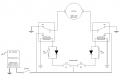
Using two relays and small PB Switches, this works up to 2 amps motor draw. You can raise or lower (something) to whatever level you like without exceeding the limits. 2 amps because that's how big I drew the PS. In the event you push both UP and DOWN at the same time the motor does nothing. And when the relays are both off (or both on) they can act like a dynamic brake for the motor. View attachment 226538
I like your design. I have made a change to it to get the limit switches out of the high current path. let me know if this will work. See attached diagram.
Yeah! That's great! Actually, you don't need the steering diodes in that configuration.
You changed the ground symbols from common ground to earth ground. Not that it's important, but at 12 volts, you really don't need to earth ground anything except the 100 - 220VAC input. But I suppose it's OK to earth ground the system. The 12V negative line from the PS probably is already grounded inside the PS. The downward pointed triangle is a common ground, not necessarily tied to earth ground. But it looks good. As long as your relays are rated for the high current the motor will demand.

 Facebook
 Google
 GitHub
 Linkedin