Produce an oscillating Dc wave

Thread Starter

MrsssSu

Joined Sep 28, 2021
267
1639197034064.png
Hi People :),
The reason why I will be needing an oscillating dc waveform is because I need it to be fed into the input of a comparator to produce high frequency square wave dc signal. I built this Wein Bridge Oscillator and it works fine to produce quite a high frequency sine wave. However, I want to produce an oscillating dc waveform that looks like a curvy shape by changing the (-12V) to a positive voltage at negative rail but it produces no signal at all.

Does anyone have a solution to produce high frequency dc waveform (does not matter the shape as long as oscillating because it will be fed into a comparator to produce dc signal) ?

Thank you
 

LowQCab

Joined Nov 6, 2012
5,101
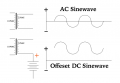
The correct term for an "Oscillating-DC-Waveform" is "AC-Voltage".

You are wanting to create a Sine-Wave so that You can create a Square-Wave ????
It's much easier to just start-out with a Square-Wave in the first place.

Why do You need a Square-Wave ?
What are You trying to build ?
.
.
.
 

Thread Starter

MrsssSu

Joined Sep 28, 2021
267
The correct term for an "Oscillating-DC-Waveform" is "AC-Voltage".

You are wanting to create a Sine-Wave so that You can create a Square-Wave ????
It's much easier to just start-out with a Square-Wave in the first place.

Why do You need a Square-Wave ?
What are You trying to build ?
.
.
.
As to previous question about producing high frequency square wave, you will need a high-speed comparator which needs an oscillating dc wave and reference it with another constant dc voltage to produce high frequency square wave. This will help to adjust the PWM from 0 to 100% with just changing the reference input voltage of comparator. That's what i want. Furthermore, It is an extremely high frequency square wave. High frequency needs comparator:)
 

LowQCab

Joined Nov 6, 2012
5,101
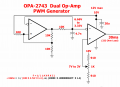
This Circuit works with either a high-quality Op-Amp, or a "Push-Pull" Comparitor ..........
What is "Very High-Frequency" to You ?
.
.
.
PWM Comparitor .PNG
 

Papabravo

Joined Feb 24, 2006
22,082
This Circuit works with either a high-quality Op-Amp, or a "Push-Pull" Comparitor ..........
What is "Very High-Frequency" to You ?
.
.
.
View attachment 254849
Much higher than a 741 can mange. That's for certain sure. The TS seems to be stuck in a 1-dimensional component world that consists of the 741. He obviously paid no attention to the comments in his other post about why using a 741 for his purposes was a futile and pointless idea.
 

Reloadron

Joined Jan 15, 2015
7,888
First, before posting questions I suggest you give this a read.
Next, when you already have a thread please keep everything in a single thread. This makes it much easier for those trying to help you and make suggestions. Generally the threads will end up merged by a moderator.
Finally, please provide detailed information about your project and try to use correct terms. Terms like "High Frequency" are useless unless the frequency is known. The 741 operational amplifier was among the first I worked with over 45 years ago. There are much, much better and newer operational amplifiers out there today. This includes single supply operational amplifiers.
As to previous question about producing high frequency square wave, you will need a high-speed comparator which needs an oscillating dc wave and reference it with another constant dc voltage to produce high frequency square wave. This will help to adjust the PWM from 0 to 100% with just changing the reference input voltage of comparator. That's what i want. Furthermore, It is an extremely high frequency square wave. High frequency needs comparator:)
If that is what you want you start with a triangular waveform into a comparator. Using a 741 operational amplifier you can start with a square wave followed by an integrator using another 741. The triangular waveform is run into the non inverting input of a comparator like an LM339 and a changing Vref voltage from a pot is run into the inverting input. While over simplified that is one way to do it. That or just invest about $7.00 USD and buy two PWM controllers on Amazon which is far simpler.

Also, rather than trying to do all of this with discrete components this can be done using a small single little 8 pin chip like the ATTNY 85 or a PICAXE 08M. Using either and some basic programming easily found online and adding a pot you have a PWM circuit.

Ron
 
Last edited:

MisterBill2

Joined Jan 23, 2018
27,508
Really, a comparatorcircuit iscomplex compared to a Schmit-trigger logic gate, whichwil give you a square-edged wave close to a square wave.
 

Audioguru again

Joined Oct 21, 2019
6,826
MrsssSu says, "We will build ...." so then it is probably a school assignment and the teacher is stuck talking about a 53 years old 741 opamp.

The Wien Bridge oscillator will produce a sort of a severely clipped triangle/squarewave because its gain is 6 instead of 3, it has nothing to limit the output level that will prevent clipping and the frequency will be about 10.6kHz that is too high for an old 741 opamp.
 

DickCappels

Joined Aug 21, 2008
10,661
MrsssSu says, "We will build ...." so then it is probably a school assignment and the teacher is stuck talking about a 53 years old 741 opamp.

The Wien Bridge oscillator will produce a sort of a severely clipped triangle/squarewave because its gain is 6 instead of 3, it has nothing to limit the output level that will prevent clipping and the frequency will be about 10.6kHz that is too high for an old 741 opamp.
The problem is that they don't update the examples in the textbooks. Maybe that's ok since that allows students to sell back their books (for a pittance) at the end of the term. I fear the LM741 examples will be haunting forums like this for several more decades.
 

MisterBill2

Joined Jan 23, 2018
27,508
Actually, just a simple logic 6 inverters IC will do a better job of generating a higher frequency square wave. One R and one C chasing a logic high around the loop. and if the duty cycle is not exactly50% then add a "T" flipflop and it can be within nanoseconds of a good 50%. Temperature stability will be a different issue, but it can be a good square wave with very good rise and fall times.
OR, the TS can use that Wein bridge circuit to drive a FF and get a nearly perfect square wave. BUT don't use a 741.
 

Reloadron

Joined Jan 15, 2015
7,888
I never used the lousy old 741 opamp for any of my projects but instead used a Motorola"improved" opamp that had a part number ending with an S.
Well that just makes it simple. Replace the old 741 with an old part made by Motorola having a part number ending with the letter S. You may want to include new and improved.

Ron
 

k1ng 1337

Joined Sep 11, 2020
1,038
Much higher than a 741 can mange. That's for certain sure. The TS seems to be stuck in a 1-dimensional component world that consists of the 741. He obviously paid no attention to the comments in his other post about why using a 741 for his purposes was a futile and pointless idea.
'1-dimensional component world'

You sir are a poet lol
 

MisterBill2

Joined Jan 23, 2018
27,508
The TS can make a square wave oscillator using a CD4001 quad nor gate that will run at a higher frequency and deliver a much squarer waveform. OR us a more modern dual opamp, the LM358, or my favorite, the LM324 quad opamp package. That one is still available from multiple sources and at least ten years newer. And they both have the much more common pinout, which is handy.
Or a current one that may go up to 100 Megahertz. But it takes a more expensive scope to look at that waveform.
 

k1ng 1337

Joined Sep 11, 2020
1,038
The TS can make a square wave oscillator using a CD4001 quad nor gate that will run at a higher frequency and deliver a much squarer waveform. OR us a more modern dual opamp, the LM358, or my favorite, the LM324 quad opamp package. That one is still available from multiple sources and at least ten years newer. And they both have the much more common pinout, which is handy.
Or a current one that may go up to 100 Megahertz. But it takes a more expensive scope to look at that waveform.
I have used both lm358 and lm324 to produce sine waves although I had some trouble. Some literature says the 358 is meant for DC input and the 324 experiences crossover distortion from 4 op amps in one package making it difficult without having vast knowledge of op amps. I suspect my component choices are out of whack.

I also have lm741, lm386 and ne5552 but have not tried them for sine waves.

My interest is making a guitar tuner where clean basic waveforms such as sine, square, triangle and saw are common on commercial tuners.
 
Top